


All month we’ve been on the same question: where an ordinary day gets its shape.
Two Sundays ago it was the people who used to supply your hours — the job, the school run, the husband who left at ten past seven — and what a week does once they stop coming. Last Sunday it was your own body, which sets the schedule and doesn’t consult you.
There’s a third version, and it catches people who were braced for the opposite problem. Nothing has been taken out of your day. Somebody has been put into it.
He retired. And the hours you used to have to yourself left with his job — the ones nobody ever arranged, that simply came with a house standing empty most of the day. He finished on a Friday, and by Monday he was there at nine, and at eleven, and at three.
The awkward part is that you can’t say what’s wrong with it. He isn’t doing anything. That’s the whole of it. He’s here, doing nothing in particular, in the kitchen where you used to do nothing in particular by yourself.
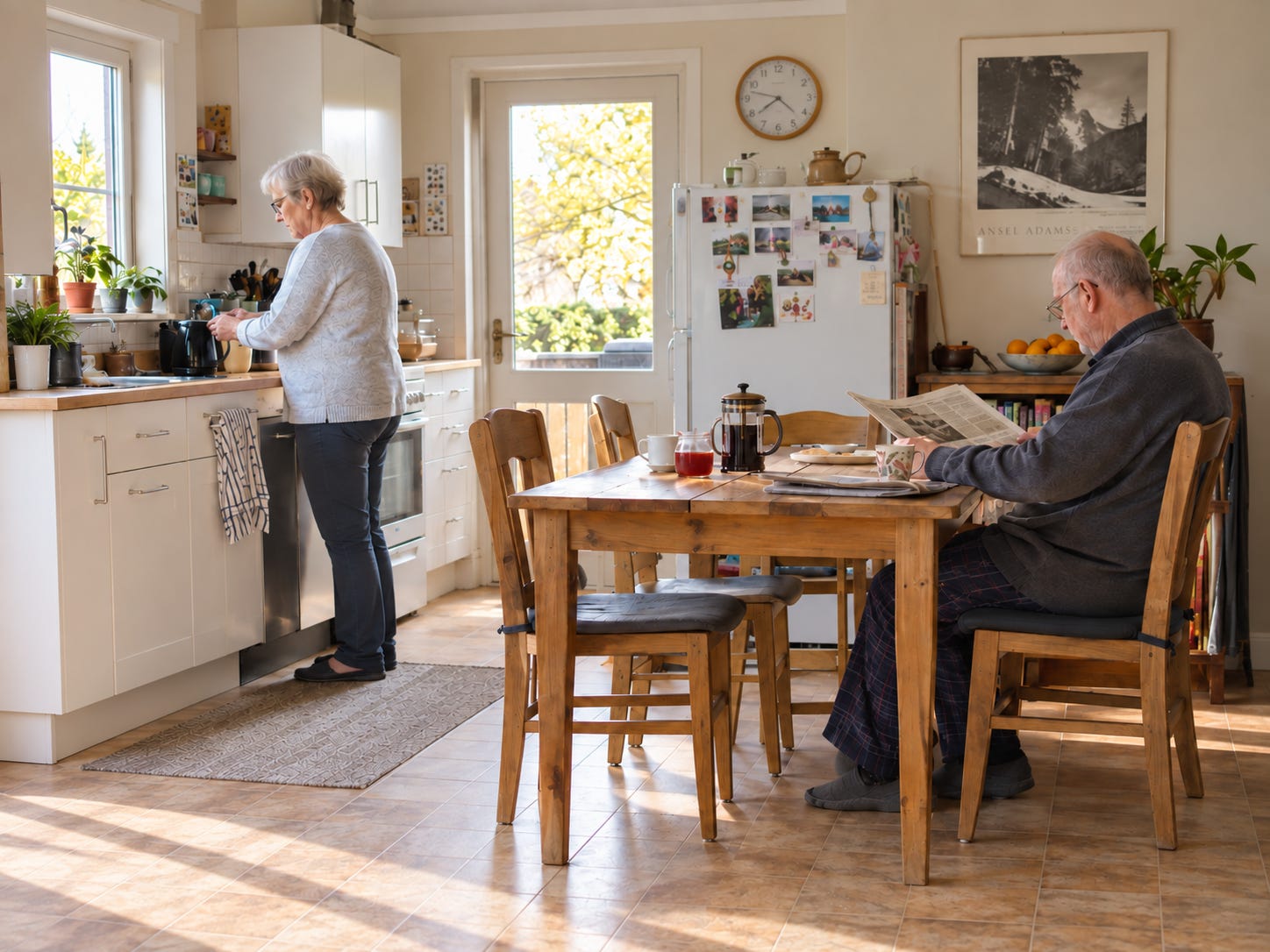
(I’ll write this as a married couple who both retired, because that’s the most common version. If the other person is a sister who moved in, or a son who came back for a while, swap the word — none of the mechanics change. And if you live alone, read it sideways: what follows is a fairly exact account of what another person’s company costs by the hour, which is a different thing from saying it isn’t worth paying.)
What you’ve probably concluded by now
It usually takes one of two shapes, and both are worse than what’s actually happening.
The frightening one: maybe we don’t really like each other. Thirty years of a good marriage, and now four months of low-grade irritation seem to be telling you something the thirty years didn’t. That one gets thought at night and never said out loud.
The other one puts it on him. He’s underfoot. He has opinions about the grocery store now. He asked, in a helpful voice, why you always do the wash on Mondays — and you heard something in that question that he swears wasn’t in it.
Neither one is right. What’s actually happening is more ordinary than either, and it has been measured.
It gets better after about two years
Researchers at Cornell followed married couples in late midlife through the retirement years, in a study that tracked them across the nineties. They measured two things: how satisfied people said they were with the marriage, and how often they had serious disagreements. Both moved, and not gently.
The transition lined up with a drop in marital quality for husbands and for wives, and the worst version was being out of step — one retired, the other still working. In the study’s own words, married men and women “who move into retirement while their spouses remain employed report the greatest marital conflict, regardless of gender.”
Then the finding worth pinning to the refrigerator door. The same study reports that “actually being retired (more than two years), however, promotes marital quality, suggesting that role strain is reduced once couples are settled into retirement.”
Read that twice if you’re in month five. Couples further along report a better marriage than the ones still in the middle of it. It’s a passage, not a verdict.
Why every way of saying it comes out wrong
For decades, being alone was something the week handed you. You didn’t request it, didn’t schedule it, certainly never thanked anyone for it. It arrived as a byproduct of two employers and a school calendar — half an hour here, a Tuesday afternoon there, the long quiet of a house with one person in it. You had it in such quantity you never had to notice you needed it.
So you never developed any words for it.
And now that it has to be asked for, the only sentences available are terrible ones. I need some space. Can I have a minute. Do you have to be in here? Every one of those is a sentence about him, when the thing you mean is a sentence about you. He hears a review of his presence. You meant a description of your morning.
That’s what keeps this stuck. Sitting in different rooms is not hard. Saying it is hard, because until now the week said it for you.
The quiet used to arrive on its own. Now somebody has to ask for it out loud.
So the question this week isn’t how to spend better time together — you have nothing but time together. It’s which hours of the day are yours, which are his, and which ones are the two of you on purpose. And whether either of you has ever said it out loud.
What You’ll Find Below
Below the line this Sunday:
✅ Why the fight is always about the dishwasher — the reason the friction lands on small objects, and the question to ask instead of who’s right
✅ Three kinds of hours — yours, his, and the two of you on purpose, and why leaving out the third one makes the other two impossible
✅ The conversation, word for word — including the version for the opposite problem, when you’re the one who wanted more company and got less
✅ What comes with a membership, beyond Sundays — every article in the archive, more than two hundred of them, open to you whenever you want them, plus a new Fun Pack each month*.
* This month’s pack is put together differently. Four of the seven kinds are new — Memory Lane, Finish the Line, Guess the Year, This or That — and there are eight coloring pages and a thirty-day calendar that weren’t there before.