


The good day usually arrives without warning. You wake up and something has lifted — the hip is quiet, the head is clear, you slept in one piece for the first time in a week. And you know exactly what to do with it, because you’ve been keeping a list without meaning to.
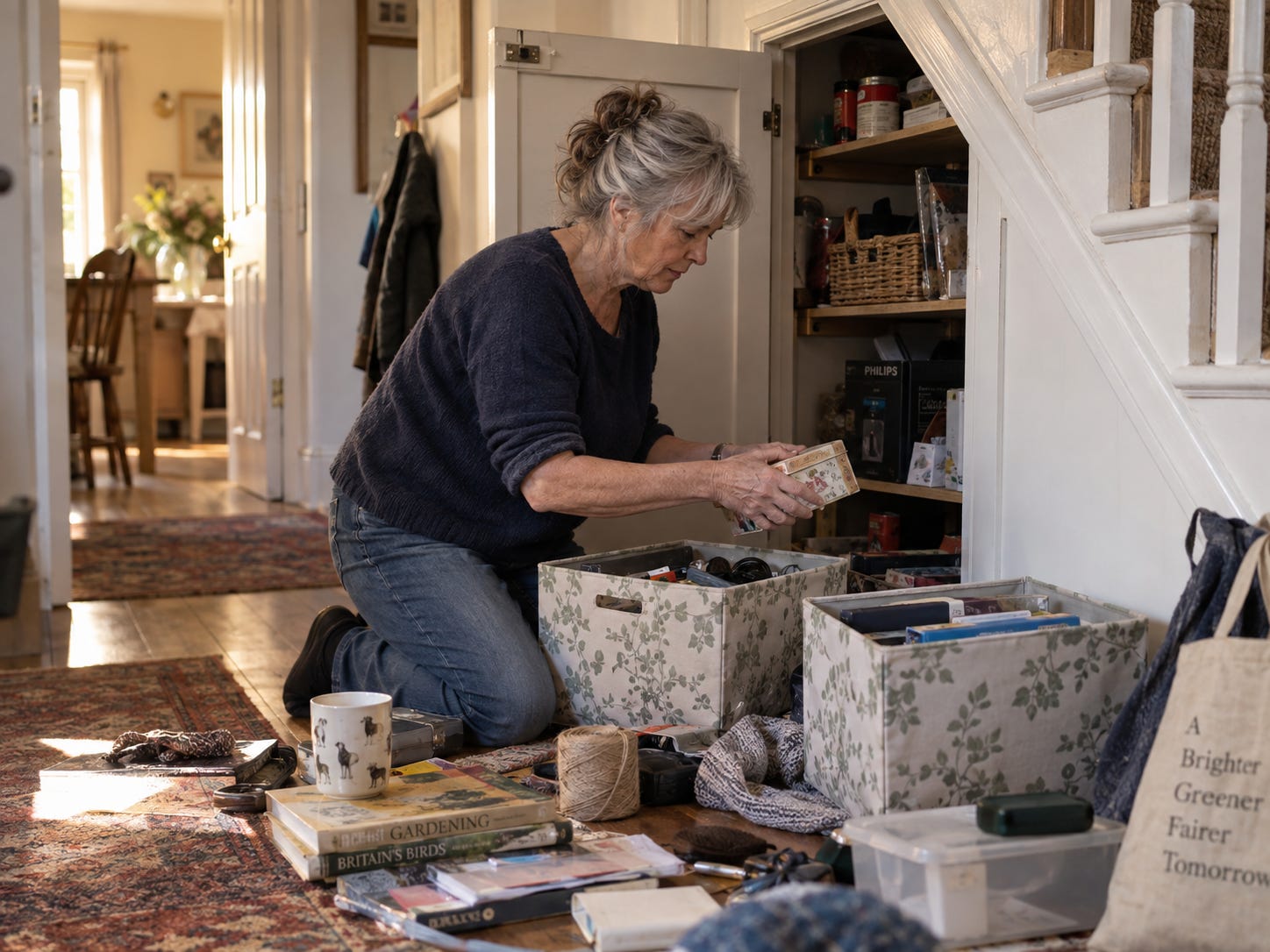
So you strip the beds. You do a real grocery run instead of grabbing the four things you can carry. You call the bank about the thing you’ve been avoiding, and you clean the oven, and you think, while you’re at it, that you may as well clear out the closet under the stairs.
Then you pay for it for three days.
And on the fourth day, when you’re upright again and the week has gone, the conclusion that arrives is always the same one: I can’t rely on myself anymore.
Last Sunday, and this one
All month we’re on the same question: where an ordinary day gets its edges. Last Sunday it was other people who had been supplying them without anybody noticing — the job, the school run, the husband who left at ten past seven — and what a week does once those people stop.
Today it’s closer to home. What sets your hours now is your own body, which lives in the same house as you and still won’t negotiate. And unlike the bus, it doesn’t post a schedule.
The good day is the problem
This is the part that sounds wrong until you sit with it.
When people describe a week that fell apart, they describe the bad days — the flare, the night with no sleep, the morning where getting to the kitchen was the whole achievement. But look at where the damage actually starts and it’s usually the good day. The good day is when you empty the tank. The bad days that follow are the bill.
Pain clinicians have a name for this: the boom-and-bust cycle. You feel well, so you do far too much. Doing too much sets you back. Being set back means everything piles up. Then the next good day arrives with an even longer list waiting for it, so you overdo it even harder — and round it goes.
A 2023 review of activity pacing in the journal Annals of Medicine puts it plainly: overactivity is a problem in its own right, because people “push beyond their limitations, which can contribute to a boom-and-bust cycle of activity leading to prolonged periods of rest.”
That is the reverse of what most of us were raised to believe. The problem isn’t only that you can’t do enough on the bad days. It’s that you do too much on the good ones — and the good ones are the only currency you have.
The good day isn’t a bonus. It’s the whole week’s budget, spent on a Tuesday.
Why this breaks a routine specifically
A routine built on top of that pattern comes apart in a predictable way.
You decide on a sensible morning. Up at eight, a proper breakfast, a walk to the store and back. It works beautifully on Monday. On Tuesday you’re wrecked from Monday, so you skip it. On Wednesday you feel guilty about Tuesday, so you do the walk and the groceries to make up for it. Thursday you can’t get out of bed.
By the end of two weeks you have concluded, reasonably, that routines don’t work for you. That people who keep routines must have bodies that behave.
But the routine didn’t fail because you lack discipline, and it didn’t fail because your body is unreliable. It failed because it only had one version — a version written on a good day, for a good day, by someone who was feeling well enough to be optimistic.
A routine with one version is a routine that will be abandoned. Not might be. Will be, and usually within three weeks.
So the question worth asking isn’t how do I stick to my routine when I feel awful. You won’t, and you shouldn’t have to. It’s this: what would a version of my day look like that I could do on my worst ordinary day — and how do I decide that now, while I’m well enough to think straight?
That’s what the rest of this is about.
What You’ll Find Below
In the premium section this week:
✅ The two-version day — Writing the full day and the small day in advance, so the decision doesn’t get made at seven in the morning by somebody in pain
✅ What the small day has to contain — The two or three things that hold everything else up, and how to tell them apart from the things you merely like
✅ The schedule you already have — Why the pill box is the most reliable time-giver in the house, and how to build the rest of the day onto it
✅ Everything else that comes with membership — the full library of more than 200 articles, yours to browse and revisit, and a brand-new Fun Pack* every month.
* This month’s pack is put together differently. Four of the seven kinds are new — Memory Lane, Finish the Line, Guess the Year, This or That — and there are eight coloring pages and a thirty-day calendar that weren’t there before. I hope you will enjoy it!