


I have two children in school, so the last week of August is not a restful one in my house. School lists are strangely specific about things that shouldn’t matter — one of mine needs squared notebooks with a particular size of square, and apparently the wrong squares are unusable — so you end up in a store at eight in the evening comparing two nearly identical objects.
Then the alarms get set again. Bedtimes move back. The whole house snaps into a shape it hasn’t held since June.
I called my parents that same week. They’re both eighty. I asked what was new and my mother said nothing was, the way she always does — and she was right, and that’s the part I’ve been thinking about since.
Because for most of the people I write for, September doesn’t start anything. The world speeds up in a way you can feel: the traffic changes, the stores change, the grandchildren go back and the phone goes quiet on weekday mornings. Your own week looks precisely the way it looked in July. Everyone else gets a fresh page. You get the same page, with more noise around it.
The day is yours now. No shift, no school run, nobody waiting on you at six — after forty years of the opposite, that was supposed to be the reward.
Except the shift and the school run and the six o’clock were also what held the day in place. Take them away and the hours don’t come back to you as yours. They come back open, which is not the same thing as empty. An open day is easy enough to fill. It’s just much harder to live in than a full one.
That’s the whole of September: an ordinary day, and how it gets its edges back once the ones that came free have stopped coming. Today, why the structure came apart, and why the usual advice about discipline is aimed at the wrong thing. In the Sundays after — the days your body won’t let you plan, two retired people sharing one house from morning to night, and the hardest version of it: holding a day together for someone who can’t hold their own.
But we start with the thing that gets diagnosed wrong.
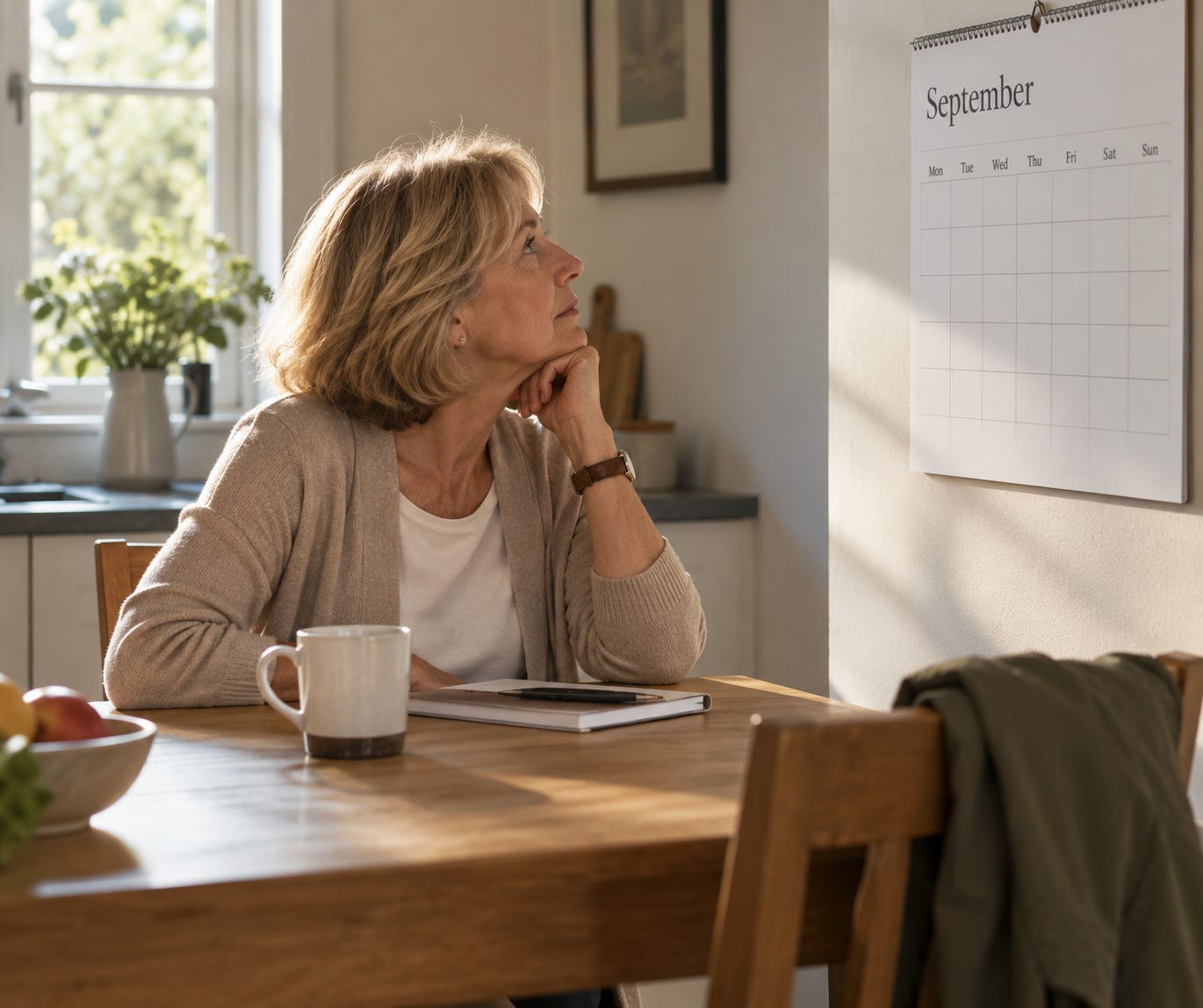
Your routine was never entirely yours
Here is the story people tell themselves when the days go shapeless: I’ve let myself go. I used to be so organized. Somewhere along the way I lost my discipline.
I’ve heard versions of that sentence from my mother and from readers who write to me — one of whom ran a department of forty people and now cannot reliably get out of the house before eleven. It’s always said with a particular embarrassment, as though the problem were moral.
It isn’t. The two problems have completely different fixes, so it’s worth knowing which one you’ve got.
A moment ago I said the shift and the school run were holding your day up. It’s worth being specific about what that looked like, because it’s easy to forget how much of it there was. A bus that left at twenty past, whether you were on it or not. A boss who noticed what time you came in. A child who had to be picked up at three, no negotiating. Sunday lunch at your sister’s, every Sunday, for eleven years.
Almost none of that was self-discipline. It was other people’s clocks, and yours ran alongside them.
When those clocks stopped — the job ended, the grandchildren grew up, the friend moved nearer her son, the spouse retired too or stopped being there at all — the scaffolding came down. What stayed behind was you, a whole day, and no external reason for anything to happen at any hour. Then you looked at the mess of it and concluded you’d gone soft.
You didn’t go soft. The frame was removed.
What the research calls this
There’s a name for the thing that came down, and it turned up in an odd place: researchers trying to work out why people’s moods come apart after a big life change.
In the 1980s they suggested that we don’t keep our body clocks set on our own. We borrow the setting from other people. They called those borrowed settings social zeitgebers, which is German for time-givers — the alarm for work, the meal somebody is waiting on, the friend you see on Thursdays, the place you’re expected to be at ten. The review that took stock of the idea decades later lays the sequence out plainly. Something big changes. Your routine goes with it. Your body clock goes with your routine. And after that, sleep and appetite and energy and mood all get harder.
Read that order again, because it runs the opposite way to how we usually talk about this. Willpower isn’t at the top of it. Other people’s schedules are. Your routine sat underneath them, and your body sat underneath your routine.
Which is why somebody can be perfectly disciplined for forty years and then, a year after everything changed, find themselves eating lunch at four in the afternoon. Nothing about them weakened.
The time-givers went quiet.
At the end of August I wrote about a day that used to have edges, and about the plan that holds for nine days and then quietly stops. This is the part underneath that: if you built a shape and it fell over anyway, the problem probably wasn’t the shape. It was that you were the only one holding it up. Nothing in it came from outside you, so there was nothing to catch it on the days you didn’t feel like it.
So the useful question isn’t how do I get more disciplined. It’s this: what exactly did my day lose, and can I put that particular thing back?
Which means knowing what a day borrows from other people in the first place. It turns out to be three separate things, and most people have only lost one or two of them — which is why the generic advice keeps failing, and why the fix is smaller than you’d think.
What You’ll Find Below
In the premium section this week:
✅ One question, no homework — The single thing to ask yourself about the emptiest part of your day, and what the answer tells you
✅ Rhythm, role or witness — Which of the three you actually lost, why the repair for one does nothing for the others, and what to do when it turns out you’ve lost all three at once
✅ The asks, word for word — What to say when you ask someone for the piece you’re missing, and what to do when they agree and it fades two weeks later
✅ Everything else that comes with membership — the full library of more than 200 articles, yours to browse and revisit, and a brand-new Fun Pack* every month.
This month’s pack is put together differently. Four of the seven kinds are new — Memory Lane, Finish the Line, Guess the Year, This or That — and there are eight coloring pages and a thirty-day calendar that weren’t there before. I hope you will enjoy it!