


My husband’s parents spent years quietly building a small collection of paintings. Nothing a dealer would chase — no famous names, no auction stories. Just beautiful pieces gathered one by one, over decades, each bought because they loved it. Their walls held that collection the way other families’ hutches hold the good china.
After my mother-in-law died a few years ago, my father-in-law started offering them to us. Take some, he said. They should stay in the family.
We stood in front of those walls and chose two. Two we genuinely loved, two that fit our house. And we said no to all the rest.
I have the same conversation with my own parents. A few things in their home mean something real to me — objects I remember from childhood, pieces that have been in the family for generations. Those, someday, I’ll want. The rest, and I say this with all the love in the world: the rest are their memories, not mine.
I’m telling you this because, if you’re reading this letter, odds are you’ve stood on the other side of that conversation. Maybe you’ve already asked the light question — “You’ll want the china eventually, won’t you?” — and felt the pause before the kind answer. Maybe you keep not asking, because you suspect what the pause would say.
Today’s letter is about that pause. I’ve been inside it, and it isn’t what it feels like from your side of the hutch.
It’s Allowed to Hurt Exactly This Much
Let’s stay with the china, since it’s the classic. In your house it might be a workshop and a son, or a cedar chest and a granddaughter. The shape is the same.
Say you finally ask the light question, the one from the top of this letter, in a voice arranged to make the answer sound unimportant. And there it is. The pause. Then the kind, careful answer: “It’s beautiful, Mom. We just don’t really have the room.”
Whatever you say next will probably be gracious. Where her answer lands is somewhere else entirely.
The honest word is rejection, so let’s use it. It won’t feel like she turned down a cabinet. It will feel like she turned down the Sunday dinners, the holidays, the whole version of the family those dishes stood for. Some part of it will feel like she turned down you.
You can know she loves you and still feel all of that. Both fit in the same afternoon.
And underneath it sits something that deserves saying plainly, so I’ll say it. You weren’t storing those dishes. You were keeping them for her. Every time you packed the set for a move, every shelf you dusted of things you never once used, part of you was preparing a gift, decades in advance.
A gift forty years in the making, declined in one sentence. Of course it stings. It would sting anyone alive.
There’s grief in it too, and I don’t think that’s too strong a word. The china held a picture of the future: her table, your dishes, the thread running forward. When she says no, the picture goes dark with it. You’re allowed to mourn a future, even one made of porcelain.
So before any reframe, stay here a moment longer. Four decades of careful keeping. Four decades of choosing the story over the shelf space, of paying movers to carry someday from house to house. That is not a small thing to have carried.
You did the loving thing with the information you had. The information just changed. That’s all that happened here, and it’s plenty.
It’s Not Your Family. It’s the Era.
Now for what the sting can’t see from inside your kitchen: this exact scene is playing out in millions of kitchens, in front of millions of hutches.
The New York Times wrote about it back in 2017: aging parents with houses full of things, and grown children who don’t want them. What the piece described was already a wave then, and it was poised to keep growing as an entire generation began downsizing at once.
Downsizing experts told PBS the same year to prepare for disappointment. Younger generations lean minimal, they explained, and much of the family furniture that anchored dining rooms for half a century now has almost no market at all.
One downsizing expert put a number on it in The Washington Post: eight times out of ten, the kids don’t want the furniture. Eight out of ten. Hold that next to how personal that pause feels when it’s your hutch.
The market has been saying the same thing in dollars. A mahogany secretary desk that brought over $71,000 at auction in 2004 sold recently for around $12,000. Dealers call the whole category “brown furniture,” and they have watched a generation’s treasures reprice in one direction only.
And this isn’t a 2017 story that came and went. A piece from December 2025 walks through the identical scene: parents downsizing around the holidays, younger family members still saying no thank you, professionals still gently coaching parents to adjust their expectations.
Line those up and your private wound changes shape.
If eight families in ten are hearing that same pause, it was never a verdict on your family. Your daughter is not colder than other daughters. You did not raise someone ungrateful, and you did not fail to make the past matter to her.
Whatever this is, it isn’t her, and it isn’t you. It’s a tide. And no one standing in a tide asks the water what they personally did wrong.
What the No Means (and What They Do Want)
Start with the practical reason, because the practical reason is real. Her home is smaller than the one you raised her in, and it’s already full. There is no empty wall waiting for a hutch, no cabinet with twelve open slots. When she says “we don’t have the room,” she isn’t being polite. She’s describing a floor plan.
The deeper reason is kinder than it first looks.
An heirloom’s meaning never lived inside the object. It lived in the context around it: your dining room, your holidays, the particular light of those Sunday afternoons, you at the head of the table. The china means all of that because it was there while it happened, in your rooms, inside your life. Her life happens in different rooms. Meaning, it turns out, doesn’t ship with the box.
That explains the gentler surprise sitting in the research. When AARP asked what younger family members actually want to inherit, it was the small, personal things: the photographs, the recipes in a parent’s handwriting, a ring that was worn rather than stored. Things with a person still in them, small enough to fit an apartment and a different life.
That’s what I was trying to say, standing in front of my in-laws’ paintings. The two we took, we love — they hang where we see them every day. Saying no to the rest wasn’t saying no to the people who collected them. It was just the truth, arriving early: those were their memories. Ours are still being made.
Her no was never a no to you. It was a no to twelve place settings. The you part, it turns out, they’d like to keep.
Which is why AARP’s advice is to ask them, specifically, and to ask now. One real question about one real object, and then let their actual answer replace the imagined one you’ve been keeping house for.
One more finding, because it explains your exhaustion. Gerontologists have a name for the lifetime of possessions that travels with you: the “material convoy”. It moves with you through every season of life, and the research is blunt about the later ones: past 50, managing the convoy becomes real work, and nobody teaches it. You’ve been managing yours while curating someone else’s future on the side.
No wonder you’re tired.
The Decision Comes Back to You
So follow the no where it actually leads, because it leads somewhere better than the sting.
If the china was never going to her, then all this careful keeping had an audience that was never coming. That sentence has a devastating reading, and I won’t pretend it doesn’t. It also has a freeing one, and you’re allowed to take both in the same breath.
There is no future inspection. Which means there is no museum to maintain, and the curator can retire.
You are released. Released from saving the good things, from the glass-front archive, from the imagined someday when heirs would finally walk through the exhibits you kept for them. They never asked for the exhibits. You can step down from a job you never applied for.
And with that, the decision about every object in your house returns to the only person it ever truly belonged to. You.
The question gets simpler than it has been in decades. You no longer have to guess what she might treasure thirty years from now. You only have to answer for yourself, one object at a time: Do I love it? Do I use it? Does it keep me safe or well? Yes to any one of those and it stays, proudly, no justification required. Where that little test comes from, I’ll get to in a minute.
But begin with the sweetest move available, tonight if you like.
Stop saving the china.
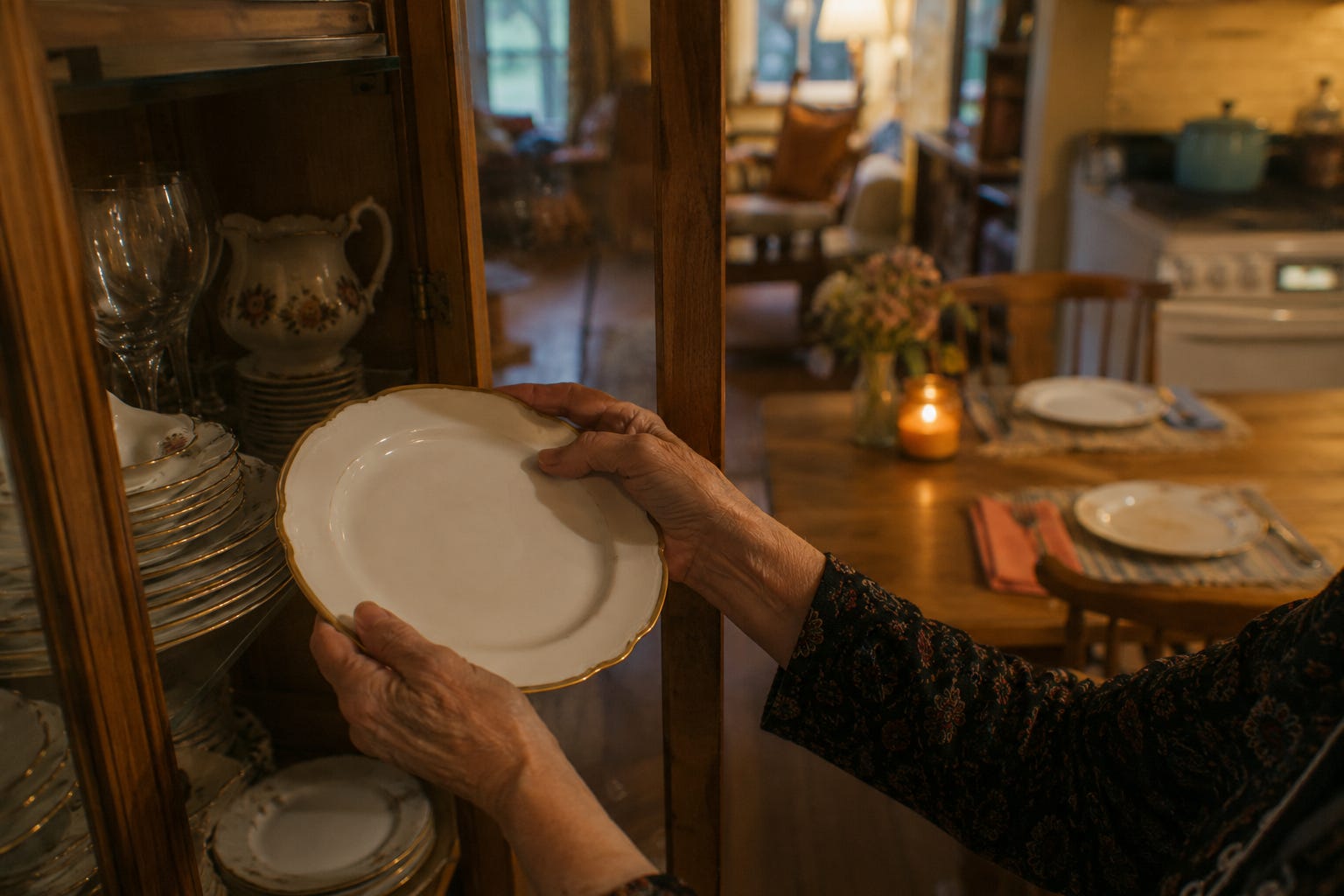
The someday you were saving it for was never on any calendar, so put it on one. Take the good plates down and eat an ordinary Tuesday dinner off them. Pour something cold into the good glasses. Better yet, invite someone you like and set the table for two, gold rims and all.
The china was made to hold food in front of people you love. Forty years behind glass was storage, and storage was never its dignity.
Nothing honors an object like use.
Why I Made a Guide for This
I’ll be straightforward about what usually comes next, because you may feel it already. Deciding you’re free is one thing. Standing alone in front of forty years of keepsakes is another thing entirely.
Sentimental objects are the hardest category in any home. I’ve been writing about lighter homes since [my first decluttering letter, early last year](LINK: decluttering-tips-for-seniors), and the replies keep teaching me the same lesson: the garage is easy, the keepsakes are brutal. Willpower was never the missing piece. A gentle system is.
So I built one. It’s called The Smart Senior’s Guide to Decluttering & Downsizing, and it works the way this letter thinks. The Love, Use, or Support Rule, the one question you just met, deciding what stays. Gentle Bursts: fifteen minutes, one drawer, then rest, because energy is a budget now and the guide respects it. A full chapter on Sentimental Spaces, about preserving meaning rather than everything. And the section I’d hand to every reader of today’s letter: how to have the downsizing conversation with your family, so decisions get made with you, never for you. There’s a room-by-room checklist, and printable worksheets too, including the Love/Use/Support card and the Gentle Bursts tracker.
One honest note, since some of you will remember it. I first shared this guide with readers late last year, and since then it has been completely redesigned. Back then, buying it meant receiving a PDF by email. Now the guide opens the moment you buy it: a full online reading experience you can read on your phone, tablet, or computer, picking up wherever you left off. The printable PDF, over 100 pages, is still included, yours to keep.
It’s $19.99 right now instead of $24.99, with instant access. And it carries a gentle 7-day money-back guarantee: if it isn’t right for you, email me at diana@wegetbetterwithage.com and I’ll refund you, kindly, no questions asked.
PS — If your subscription includes Plus + All Guides, this guide is already yours: you can download it from this page. If it doesn’t yet, you can upgrade there too.
And if a guide isn’t what you need right now, take today’s letter at full strength anyway. The tide, the one-question test, the Tuesday table: all of it is yours, free. You’re welcome here exactly as you are.
The Real Inheritance
The china was never the inheritance.
The recipes in your handwriting are. The photographs with the stories still attached. The way you tell what happened at that table in 1987, which no one else alive can tell. That’s what they want, the research says so, and it weighs nothing.
So, two small assignments, both kind.
Tonight, take the good plates down and use them. An ordinary dinner on the good china, because it turns out you’re the someone you were saving it for.
This week, ask each of your kids one specific question about one specific thing. “Would you want Grandma’s ring someday?” Then believe the answer, whichever way it goes. The real answer is almost always lighter than the imagined one.
The hutch kept its promise, you know. It kept everything safe until you found out who it was for.
It was for you. Set the table.
Remember what Joan Didion replied when asked why she used the silver every day: “Every day is all there is.”
I’ve become increasingly less sentimental about objects as the decades have rolled on and as I have moved and moved and moved. With each move, less was brought along to the next place. I am now down to, maybe, three boxes of things that belonged to my parents. As far as my husband’s parents go, there is one box. I still have a whole bunch of things we ourselves have collected on our travels (we were never much for fancy Sunday dinners and I have never owned a set of china) but, even then, every few months another bag of “stuff” goes to the charity shops. Every so often I invite my younger granddaughter over to see if she is interested in any of the jewelry that I am downsizing. Nothing is super expensive, just stuff I won’t wear anymore but, yes, I have held onto a couple of my mother’s things still. What my granddaughter has done with the jewelry I don’t know. My daughter has some jewelry I gave her years ago that I know is tangled in one of her drawers. Oh well.
One thing I suggest, though, if someone really wants to leave “things” behind is, for goodness’ sake label them with why you kept them. Or write them into your family history that you’re leaving behind. Seriously. My mother in law did that and it brought much more meaning to a conch shell that had a tiny label “picked up from the beaches of Hawaii on my first trip in 1970 with my new husband….” Or the heavy silver vanity mirror that I know that my grandfather gave my mother for her 18th birthday. Coupled with the family history photos that are online and the history I’ve written that goes with, at least those objects can mean something.