


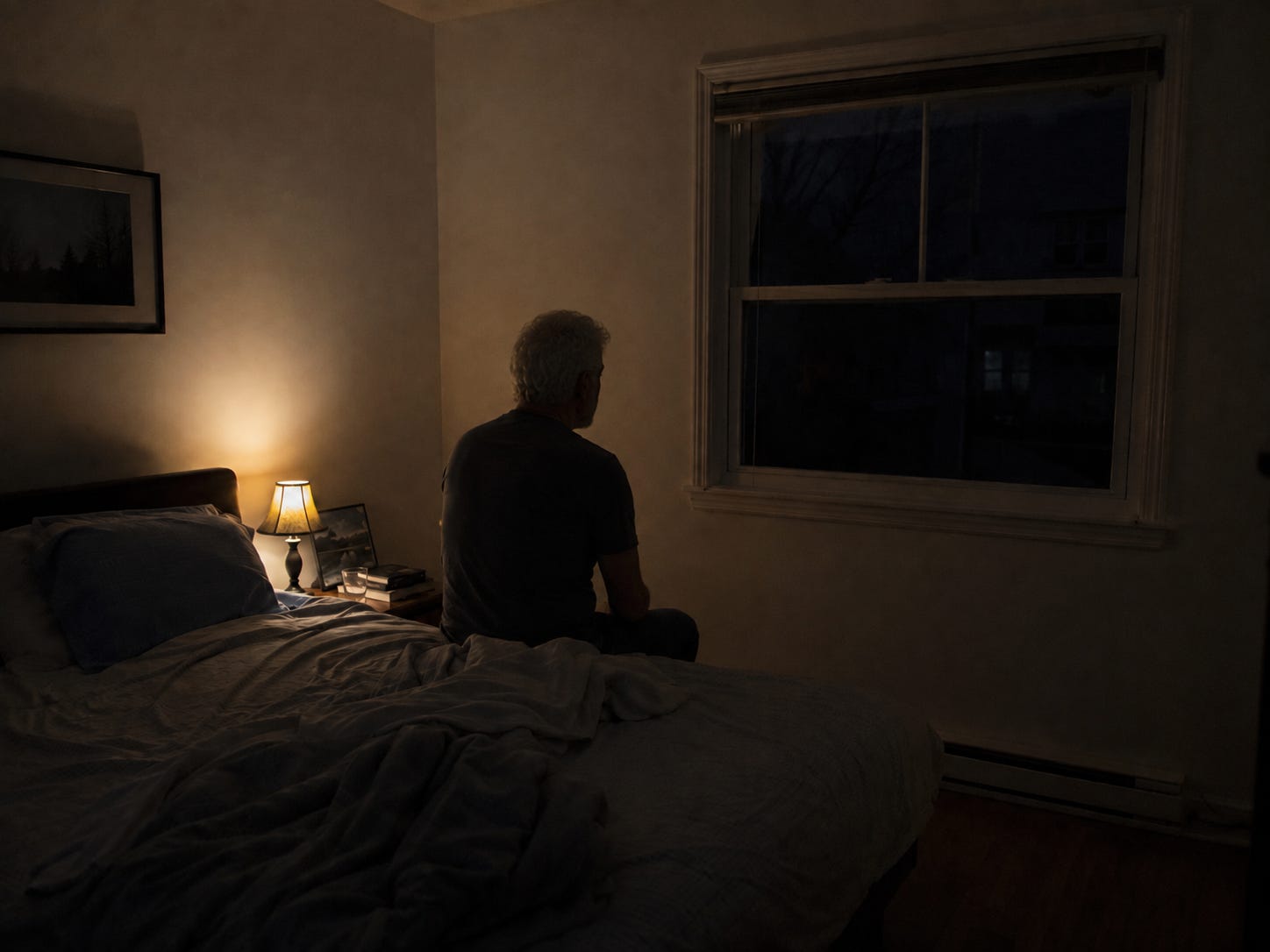
You wake at four in the morning, and you are not drifting at the edge of a dream. You are properly awake, the way you are awake at eleven in the morning, except the house is dark and silent and there is nowhere to be.
You do the arithmetic without meaning to. Asleep by ten thirty, so that is five and a half hours. You turn the pillow over to the cool side. You tell yourself not to look at the clock, and then you look at the clock.
And somewhere underneath all of it sits a quieter thought, the one that actually costs you something: there is something wrong with me.
There probably is not. What there is, is a change that happened quietly and was never explained to you.
What changed
Sleep does not stay the same across a life. The changes begin earlier than most people expect — in middle age, in bodies that are otherwise perfectly healthy — and they run in two directions at once.
The first is depth. The deep, slow-wave sleep that dominates your twenties starts to shrink from midlife onward, and the lighter stages expand to take up the space. A lighter sleeper surfaces more easily: at a car door down the street, at a full bladder, at nothing identifiable at all. Waking three or four times a night is the average for an older adult, not a symptom.
The second is timing. The internal clock drifts forward with age — researchers call it a phase advance. You get sleepy earlier in the evening and you wake earlier in the morning. Nothing has broken. The whole schedule has slid.
Put the two together and four in the morning stops being mysterious. You are sleeping more lightly, so you come to the surface more often. Your clock has moved earlier, so by four your body has already had most of what it came for, and it sees no reason to pretend otherwise.
Lighter, not broken. Those two words are worth keeping.
The number that gets quoted wrong
There is a belief, common enough that people repeat it to their doctors, that older adults simply need less sleep.
They do not. The recommendation for an adult over sixty is the same as for an adult of forty: seven to nine hours. The requirement holds. What changes is how easily the night delivers it, and when the night wants to start.
That distinction matters for a practical reason. If you believe you need less, you will treat five hours as sufficient and stop investigating. If you know you still need seven, you will notice that you are running a deficit, and a deficit has causes worth finding.
There is a second belief worth putting down: that being tired all day is simply part of getting older. It is not. Around one in five older adults experiences serious daytime sleepiness, and it often points at something underneath — which is a different matter from waking early and feeling fine. Waking at four and getting on with your day is a shifted clock. Waking at four and dragging yourself through until evening is a question for a doctor.
The one habit everything rests on
If you change nothing else, change this: get up at the same time every day. All seven of them.
The same bedtime does not do it. It is the wake time that matters.
Bedtime is a poor lever, because you cannot decide to be sleepy. Wake time is a lever you control completely, and it is the signal your body clock actually reads. Hold it steady and the sleepy hour starts arriving on its own schedule, roughly the same time each evening, without you negotiating for it.
The temptation runs exactly opposite, of course. After a bad night, the humane thing seems to be sleeping in — recovering the loss. What sleeping in does is move the anchor. You wake at nine, so you are not tired at ten thirty, so you fall asleep at midnight, so the next morning is worse. One bad night becomes a bad week, and the week gets blamed on insomnia rather than on the recovery attempt.
Get up at the usual time on the bad mornings too. It is a rough day. It buys the night back.
The second half of the anchor is light. Your internal clock resets every morning against the first strong light it gets, and morning light — ideally before ten — is the signal that holds the whole rhythm in place. This gets harder with age for a reason that has nothing to do with habits: aging eyes let in less light, particularly the short-wavelength light the clock cares most about. The same amount of daylight simply lands with less force than it did at forty.
So the instruction is stronger than “get some daylight”: get more than feels necessary, and get it early. Coffee outside instead of at the counter. The walk before the errands rather than after them. Curtains open first, before anything else.
What to do at four in the morning
Lying in bed determined to fall back asleep is the least effective thing available to you, and it is the thing almost everyone does.
The bed works by association. When it is reliably the place where sleep happens, your body starts responding to it — the lights go out and something in you begins to let down. When it becomes the place where you lie awake calculating and waiting, that association turns, and the bed starts working as a cue for alertness instead.
The standard clinical advice is to stop lying there: if you have been awake for something like twenty minutes and you are frustrated, get up. Leave the bedroom. Sit somewhere dim with something undemanding — a book you do not mind putting down, not the news, not a screen. Go back when you feel sleepy, not when you feel it is time.
Twenty minutes is not a rule to time. Nobody should be measuring it, because measuring is the problem. It is roughly “long enough to know this is not working.”
Do not look at the clock. Every look starts the arithmetic again, and the arithmetic is what wakes you the rest of the way. Turn it around, or cover it.
And if what wakes you is not your body but your mind — the bills, the appointment, the adult child you are worried about — that is a different problem with a specific fix: give the worry an appointment earlier in the day. Fifteen minutes in the late afternoon, on paper, going through what is on your mind and what you will do about it. It sounds too simple to work. It works because the three a.m. mind is not solving anything; it is holding things, and it will keep holding them until it believes they have been written down somewhere. I have written more about what to do when worry shows up at night before.
One practical note, since you will now be getting out of bed in the dark more often than you used to: the path from your bed to the door is worth making safe on purpose. A low light near the floor, nothing loose underfoot.
When it is not the habits
Everything above assumes the ordinary case. Some of it is not, and the line between the two is worth drawing clearly.
Trouble falling or staying asleep at least three nights a week, going on longer than three months, is chronic insomnia. That is a recognized condition with a first-line treatment, and the first-line treatment is not a pill — it is a structured course of cognitive behavioral therapy for insomnia, which outperforms medication over any horizon longer than a few weeks. It is worth asking for by name, because it is not always offered.
Loud snoring, gasping, or a partner who has watched you stop breathing points at sleep apnea, which is common, underdiagnosed, and treatable. Sleeping pills deserve particular care after sixty: they are for short stretches, they carry real risks in older bodies, and they are not a long-term answer to a clock that has moved.
And the daytime test sorts most of the rest: a changed rhythm leaves you functional, an underlying problem does not.
Why I made a guide for this
I will be straightforward about what usually comes next, because you may feel it already. Understanding why you wake at four is one thing. Rebuilding a night around it, on the evenings when you are tired and discouraged and the last three attempts did not hold, is another thing entirely.
I have been circling this subject for a while. Every time I have written about sleep here, the replies asked a version of the same question: fine — but what do I actually do, in what order, starting tonight?
So I put the answer in one place. It is called Sleeping Well After Sixty, and it is built to think the way this article does — sleep as something you set conditions for, not something you try harder at.
It is drug-free first, and it is organized around three moves: Anchor, Wind Down, and Let Go. Anchor is the fixed wake time you just met, with the morning light that holds it. Wind Down is the hour before bed and the room itself. Let Go is the chapter for four in the morning — the twenty-minute rule, the worry window, and what to do with a mind that will not stop. There is a chapter on the myths that keep people awake, one on what helps and what quietly hurts across caffeine, alcohol, naps and evening meals, and a full chapter on when it is medical rather than habitual, including the questions worth taking to a doctor. The tools come as printable cards, including one for three in the morning that lives on the nightstand, and there is a sleep diary if you want to see the pattern instead of guessing at it.
One honest note, since some of you will remember it. Buying a guide from me used to mean a PDF arriving by email. This one opens the moment you buy it: a full online version you can read on your phone, tablet, or computer, picking up wherever you left off. The printable version, over a hundred pages, is included and yours to keep.
It is $19.99 right now instead of $24.99, with instant access. And it carries a gentle 7-day money-back guarantee: if it is not right for you, email me at diana@wegetbetterwithage.com and I will refund you, kindly, no questions asked.
PS — If your subscription includes Plus + All Guides, this guide is already yours: you can download it from this page. If it doesn’t yet, you can upgrade there too.
And if a guide is not what you need right now, take this article at full strength anyway. The anchor, the twenty minutes, the worry appointment — all of it is yours, free. You are welcome here exactly as you are.
Four in the morning, revisited
The next time it happens, the room will be dark and the house will be quiet and you will be entirely awake, and none of that will have changed.
What can change is the sentence that arrives with it.
Not something is wrong with me. Something more like: my sleep is lighter than it used to be, and my clock runs earlier than it used to, and I have been awake for about twenty minutes now, so I am going to get up and sit with the lamp on for a while.
That is not resignation. It is the difference between a body that is failing and a body that has changed and is waiting for you to notice.
You are allowed to stop fighting it at four in the morning and still care about sleeping well.
This is really helpful. At last I'm getting the whole message about why my sleep at 75 is different from when I was younger! You'd think it would be simple, and thank you for making it so. Once I started doing all these suggestions - and many I started long ago - I stopped berating myself about changed sleep. Really lifesaving stuff here.
The writing, the ideas, and the way it’s all laid out is crystal clear. I will look for the guide. I might have subscribed already, in any case continue the great work. This 75 year old lady greatly appreciates it ALL!🙏🏽♥️