
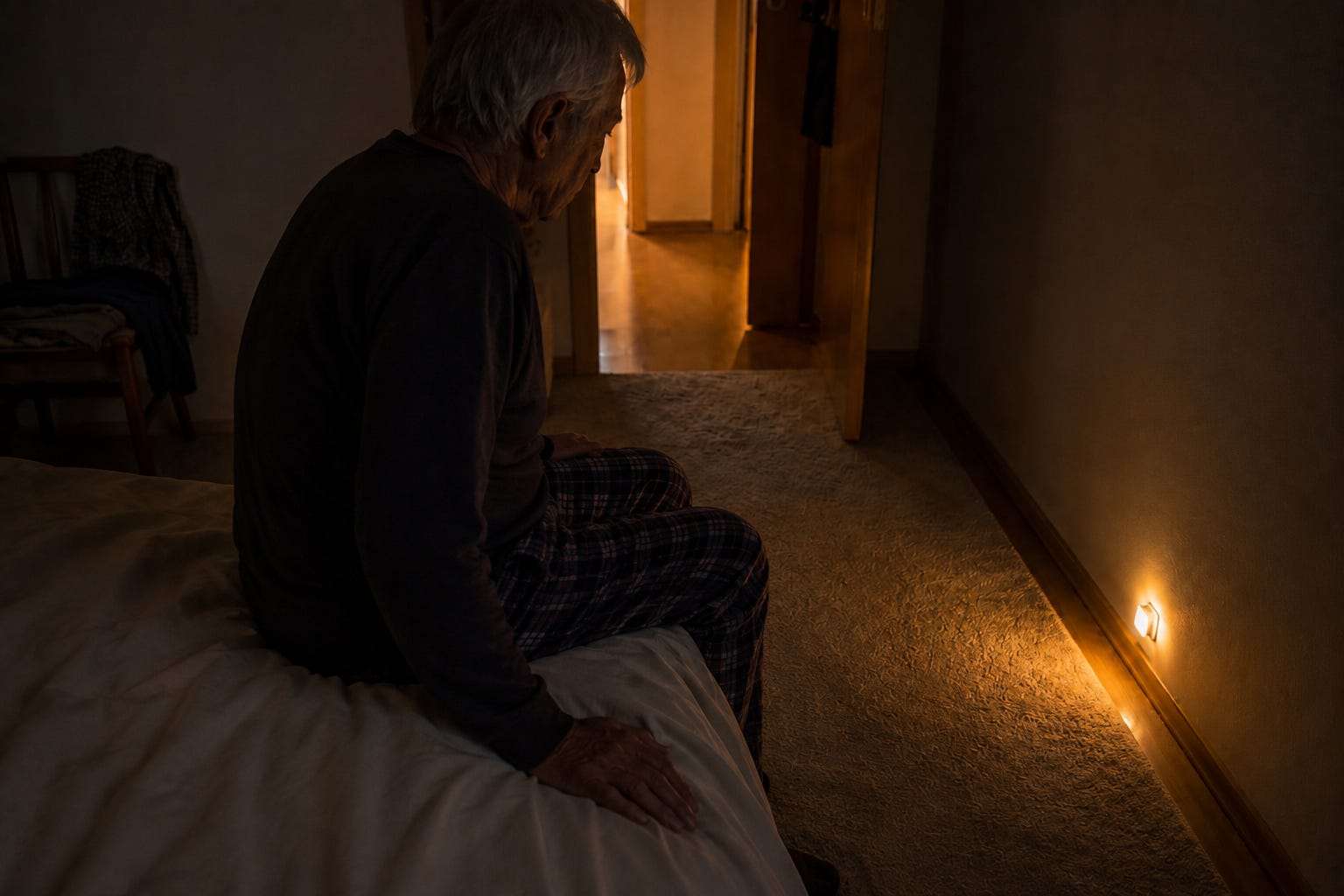
The Twenty Seconds Between Your Bed and the Door
It is ten past three in the morning and you are awake, and you need the bathroom.
You know this room. You have slept in it for years. So you swing your legs over the side, stand up, and start walking before your eyes have opened all the way, because turning on the light means being awake for another hour and you cannot afford that tonight.
Twenty seconds. Bed to door. In the dark, half asleep, moving fast.
That walk is the most dangerous thing you will do all day.
The room that never gets safety-proofed
Think about where the safety work goes.
Grab bars go in the bathroom. Rails go on the stairs. The kitchen gets the reachers and the lighter pans and the mat that doesn’t slide. All sensible. All the rooms where you are awake, upright, and paying attention.
The bedroom gets nothing, because the bedroom is where you are safe. It’s where you rest. Nothing happens in there.
Except that more than one in four people aged 65 or older fall each year, according to the National Institute on Aging. And a good share of those falls happen on a route so short and so familiar that you don’t think of it as a route at all.
The bed to the door. The door to the bathroom. Back again.
You have made that trip ten thousand times. That’s exactly the problem. Familiarity is why you do it without the light on.
Three things make that walk dangerous, and none of them is weakness
Here is the part worth understanding, because once you see the three, the fixes become obvious.
The dark. Your eyes at sixty-five do not do what they did at forty. The pupil lets in less light and the adjustment from bright to dark takes noticeably longer. So you are not walking through a dim room; for the first several seconds you are walking through a black one, and the shoe you left out is not there until your foot finds it.
There’s a study worth mentioning here with its limits attached, because the limits matter. Researchers measured lighting levels against fall rates and found that more than half the bedrooms fell below the recommended level, and that every additional hundred lux was associated with roughly eight to ten percent fewer falls. That was done in twelve residential care facilities in New Zealand, with residents averaging eighty-five years old — so it is not a measurement of your bedroom. What it does establish is that light is not a comfort feature. It’s a structural one.
The drop. When you stand up quickly, blood pressure falls before your body corrects it. The NIA puts it plainly: “Stand up slowly. Getting up too quickly can cause your blood pressure to drop.” You know the feeling — the grey swim at the edges, the two seconds where the room isn’t quite steady. At three in the morning, after lying flat for four hours, that dip is deeper. And you are already walking through it.
The rush. Urgency is the accelerant. The NIA specifically names conditions that cause rushed movement to the bathroom as a risk factor for falling, and anyone who has waited a little too long knows why. Hurry removes the small corrections your body makes automatically. It’s not the stumble that breaks a hip. It’s the stumble at speed.
Dark, drop, rush. Every one of them is a condition of the room and the hour — not a verdict on your body.
What to change before tonight
None of this requires a contractor. Most of it can be done this evening, and none of it makes the room look like a hospital.
Put light on the floor, not on the ceiling. Motion-activated night lights, plugged in low, along the actual path you walk. Floor-level light shows you the obstacle without waking you fully — an overhead light does the opposite, which is precisely why you don’t turn it on. Two or three of them, under twenty dollars, and the dark stops being a factor.
Clear the runway. Stand at your bedside and look at the strip of floor between you and the door. Shoes. Charging cables. The chair that has clothes on it. A basket. Whatever lives there has to move, because you will meet it in the dark eventually. Keep that strip empty the way you keep a doorway empty.
Deal with the small rug. The throw rug beside the bed is the single most predictable hazard in the room. Either remove it, or fix it down with double-sided carpet tape. A rug that shifts under a half-asleep foot is a trapdoor.
Check the height of the bed. Sit on the edge. Your feet should rest flat on the floor with your knees at roughly a right angle. Too high and you drop onto your feet; too low and you have to push yourself up out of it. Both make the first second of that walk less stable. Risers or a different mattress depth fix it.
Give yourself something solid to hold. Not a wobbly lamp table. A firm nightstand you can push against, or a bed rail if standing has been getting harder. Something that takes your weight when you plant a hand on it.
Sit for a slow count of ten. This is the free one, and it’s the one that undoes the drop. Wake up, sit on the edge of the bed, count to ten without hurrying, then stand. Ten seconds gives your blood pressure time to catch up. It is the cheapest fall prevention in existence, and it costs you nothing but the habit.
Look at what’s on your feet. The NIA names backless shoes as unsafe footwear, and backless slippers are what most people keep by the bed. Slippers with a back and a grip sole, or bare feet on a clear floor. The scuff-along kind are the ones that catch.
Seven things. Six of them you could do tonight, before you go to sleep. The count of ten starts the first time you get up.
If it happens anyway
One more thing belongs in this room, and it’s the piece people skip because thinking about it feels like inviting it.
Most of the harm from a fall at home doesn’t come from the floor. It comes from the hours afterward — lying there, cold, unable to get up, waiting for someone to notice. That’s what turns a bruised hip into a hospital admission. And it is almost entirely preventable with three decisions made in advance.
Can you reach a phone from the floor? Not from the bed — from the floor. A phone charging on a tall dresser is a phone you cannot get to when you most need it. Keep it on a low nightstand, or on the floor beside the bed while you sleep. If you live alone, a watch or pendant that calls for help is worth more than every night light in this article combined.
Does anyone else have a key? A neighbor, a daughter, the friend two streets over. Help that has to break a door takes longer than help that walks in.
And the third one, which takes ten minutes and feels a bit silly: practice getting up. Getting off the floor is a skill, and it has a sequence. Roll onto your side. Push up onto hands and knees. Crawl to a sturdy chair. Put both hands on the seat, bring your stronger leg up so the foot is flat, and push up from there, turning to sit.
Try it once, in daylight, with someone in the house. Ten minutes. You’ll learn whether you can do it, which is information worth having before the night you need it — and if you can’t, that’s worth knowing too, because it changes which of the things above matters most.
The falls-prevention step that doesn’t look like safety at all
Now the part that connects to why you were awake at three in the first place.
Read the NIA’s own list of what prevents falls and you find the expected items: exercise, get your vision checked, review your medications, make your home safer. And sitting among them, in the same plain register: “Get enough sleep. If you are tired, you are more likely to fall.”
It sits there like an afterthought, and it isn’t one. Fatigue slows reaction time and blurs judgment about a step’s height. A body that hasn’t slept properly for three weeks is a less stable body on the way to the bathroom, and no night light corrects for that.
The medication piece runs the same direction, and it’s the one I’d want a friend to know. Sleeping pills are the obvious answer to a broken night, and the NIA is direct about the cost: drugs that make you drowsy or dizzy raise fall risk, and “the more medications you take, the more likely you are to fall.” Which sets up a genuinely unfair loop — you sleep badly, you take something to sleep, and the something makes the three a.m. walk less steady than it was before.
There’s a wrinkle worth knowing about the ones you can buy without asking anyone.
Over-the-counter reads as gentler. Yet the active ingredient in Tylenol PM, Advil PM, and most every “PM” formulation is diphenhydramine — a first-generation antihistamine, the same compound as in old-fashioned allergy pills. The American Geriatrics Society lists that whole class among the medications older adults should generally avoid. It clears the body more slowly with age, and the heavy-headedness it leaves behind in the morning is the same heavy-headedness that makes a three a.m. walk unsteady. The option that looks mildest is often the one sitting closest to the risk.
What carries the stronger evidence isn’t a different tablet. The American College of Physicians recommends cognitive behavioral therapy for insomnia — CBT-I — as the first treatment to try for long-running insomnia, ahead of medication rather than after it has failed. In practice it’s a set of methods: a fixed wake-up time held every day, a rule for what to do when you’re lying there at three, and a slow retraining of the link between your bed and being awake. Its advantage over a tablet is that the benefit stays after you stop doing it. Sleep medications are approved for four to five weeks of use — they were designed as a bridge, not a destination.
One caution, and I mean this one plainly. If you are taking a prescribed sleeping pill, don’t stop it because of something you read here. Sleep often gets worse for a stretch before it gets better, and several of these need tapering rather than stopping. That’s a conversation with your doctor — a good one to have, and not a solo decision.
So the bedroom has two safety systems, and only one of them is hardware. The lights and the clear floor handle the trip you take. Sleeping better reduces how many trips you take, and how unsteady you are on each one.
If sleep is the part that’s been broken for a while — the four a.m. wake-up, the nights that got shallower, the eight hours that quietly stopped happening — that’s what I spent a hundred pages on. Sleeping Well After Sixty is drug-free first, built around three moves called Anchor, Wind Down, and Let Go, and it starts from something I’d want you to hear before any technique: you are not a bad sleeper. Your sleep changed, and changed sleep can be worked with. Read it on screen or print it out, $19.99. Learn more here.
Tuesdays and Fridays, something like this lands in your inbox — free, and it stays yours. On the website it goes behind the paywall after a couple of weeks. In your inbox it doesn't.
If you change one thing in that room tonight, reply and tell me which. I read them.
A third of your life happens here
You spend roughly a third of your life in this room, which makes it strange that it’s the room that gets checked least.
That isn’t carelessness. The bedroom doesn’t announce itself as a place where things go wrong — it announces itself as the place you go when the day is over and nothing more is required of you.
But you cross it in the dark, at the hour when your blood pressure is lowest and your judgment is softest, and you do it half a dozen times a week without once looking at the floor in daylight.
So look at it tomorrow, in the morning, with the curtains open. Stand where you get out of bed and walk to the door slowly, watching what your feet pass. You’ll see it in about fifteen seconds — the cable, the rug, the shoes, the corner of the chair.
Then move three things.
That’s the whole job — no renovation, no conversation with your children about whether this house still works for you. Three things, moved, in a room you already know better than anyone.
The changes that keep you at home are almost never the big ones.
Two older pieces if you want to go further in this room: lighting for aging eyes goes properly into what changes in your vision and what to do about it, and five simple bathroom changes covers the other end of that night-time walk.
Sources
Falls, and what prevents them, including “Get enough sleep. If you are tired, you are more likely to fall”: National Institute on Aging, Falls and Fractures in Older Adults: Causes and Prevention.
Lighting levels and fall rates: Shedding Light on Falls, Journal of Applied Gerontology, 2024. Measured in twelve residential care facilities, not in private homes.
CBT-I before medication for long-running insomnia: American College of Physicians, clinical practice guideline for chronic insomnia.
First-generation antihistamines (the “PM” sleep aids) in older adults: American Geriatrics Society Beers Criteria, summarized for the public here.


Several years ago I fainted — swooned — getting out of bed quickly to let my elderly dog out the front door. I fell into furniture and cracked a couple ribs! I was recovering from flu at the time.
I’ve been waking up dizzy lately due to a new medication. So, I pause before I stand up, and I grab the footboard for support when I do stand.
This is an excellent, important article on a subject I care deeply about.
Am 87, live alone and a couple of months ago I had a fall in the kitchen. Was unable to get up again to fetch my cellphone from the bedroom. What saved me from a disaster was the “panic button” I wear around my neck at all times. It enabled me to summon help and it all ended happily without a hospital stay.
Ever since that fall, I have been on a ‘mission’ to raise awareness amongst my elderly friends of the dangers of falls - especially during nighttime trips to the bathroom. And especially of those living alone. Have been interviewing my 80-something friends and, alarmingly, none of them had any plan in place for anything. Not for minimising the risk of a fall, not for being rescued in the event of a fall.
I am now planning to share this article with these friends, just hoping it will stay unlocked long enough to reach them.