

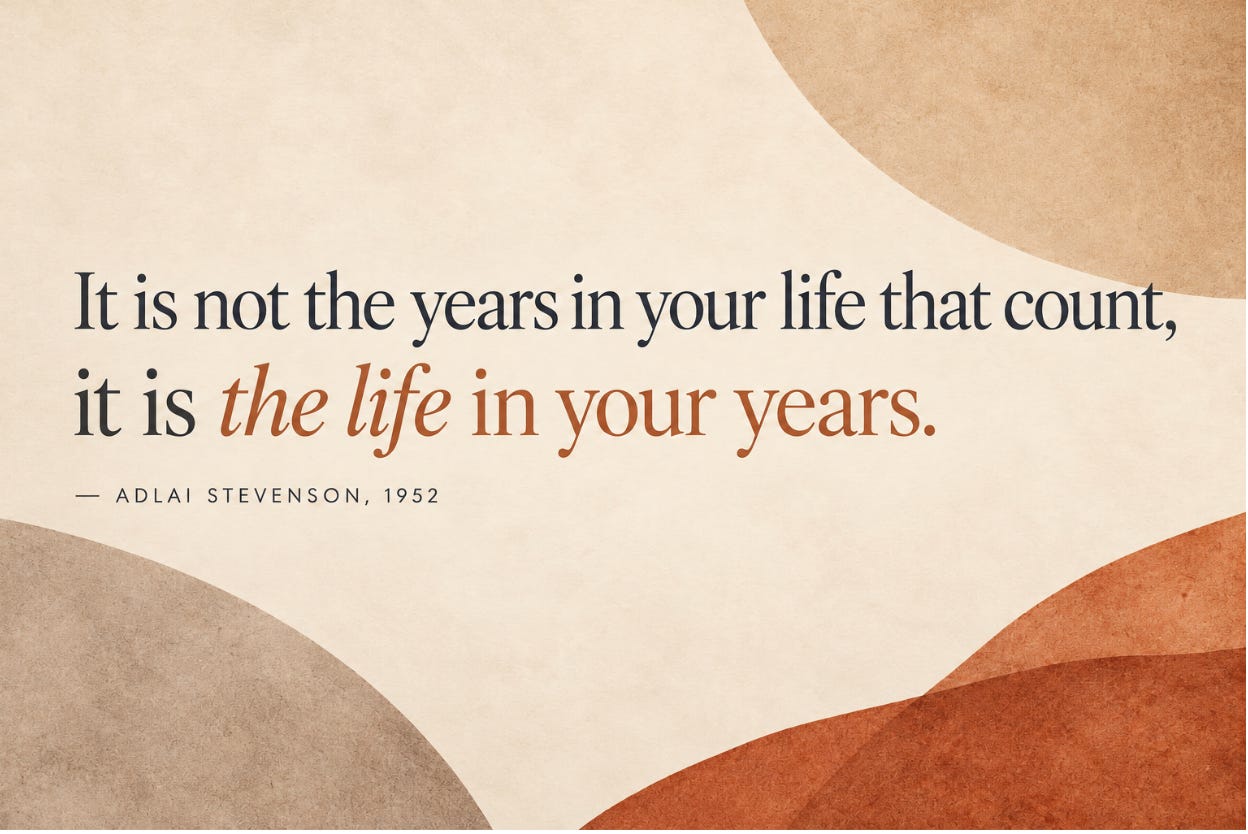
Adlai Stevenson used those words in a speech in 1952. The expression had appeared before, but its appeal is easy to understand.
We hear a great deal about living longer: longevity research, the habits of centenarians, promising treatments, and the possibility of extending our healthy years. Longer lives are a remarkable achievement of modern medicine and public health.
But imagine being offered another ten years. What would you want those years to contain?
Perhaps you would like to keep traveling, playing tennis, enjoying your grandchildren as they grow up, or living in a home you love. Maybe you want time to pursue interests you once had to put aside. Or simply the freedom to choose how to spend a day.
Those wishes depend on more than being alive. They depend on having the abilities, opportunities, and choices that make participation in life possible.
The World Health Organization defines healthy aging in terms of maintaining the abilities that enable well-being in later life. Importantly, those abilities reflect more than our medical condition. They are shaped by our physical and mental capacities, the environments we live in, and how the two interact.
That is a broader, and more humane, way to understand aging well.
A person can live with arthritis, use a walking aid, or need help with some daily tasks and still have a rich, satisfying life. Likewise, someone in excellent physical health may struggle because of isolation or circumstances that limit their options.
There is no universal picture of successful aging. What matters is how well our capabilities and circumstances support the life we want.
Three parts of that picture deserve particular attention.
1. Your Health and Capabilities: What Your Body and Mind Allow You to Do
The body and mind influence how we move, feel, learn, and manage everyday life. But the foundation of healthy aging is wider than regular exercise or the absence of disease.
Moving with confidence
Much of an ordinary day relies on movements we barely notice: getting out of a chair, carrying shopping bags, climbing stairs, or turning to greet someone.
When those movements become difficult, the effect can extend beyond the task itself. A person who feels unsteady might begin avoiding unfamiliar streets; someone who struggles with stairs may turn down an invitation.
Strength, endurance, mobility, and balance each play a role. The CDC recommends that adults 65 and older combine aerobic activity, muscle-strengthening exercise, and balance work.
The most useful activity often depends on what you want to keep doing. Gardening may call for strength and mobility; exploring a new city may require stamina and steadiness. Suitable training can help, and so can adapting an activity when pain, illness, or disability changes what is comfortable.
Feeding and resting the body
Nutrition and sleep have their own important roles. Adequate, varied food supports health, including the muscles and bones that help us stay capable. The National Institute on Aging offers guidance on nutritious eating in later life.
Yet eating well is not simply a matter of knowing what to put on a plate. Appetite, dental health, medication, food prices, and the practicalities of cooking for one can all affect what is possible.
Sleep is similarly personal. Poor sleep can interfere with concentration, energy, mood, and the activities we look forward to. While sleep patterns commonly change with age, persistent exhaustion should not be dismissed as inevitable. Pain, stress, medications, and sleep disorders can all contribute, sometimes making professional advice more useful than another bedtime tip.
Keeping the mind and emotions in the picture
Cognitive health is about more than remembering names. Attention, judgment, language, and the ability to learn help us manage finances, make decisions, and navigate unfamiliar situations.
Thinking abilities can change with age, but curiosity and learning remain worthwhile throughout life. Reading, discussion, classes, and new skills can all keep us intellectually engaged. What they cannot promise is immunity from dementia; claims about a particular puzzle preventing it go beyond the evidence.
Emotional health matters just as much. Anxiety, depression, grief, and prolonged stress deserve attention rather than dismissal as ordinary features of getting older. Aging well does not mean feeling positive every day.
And there is the practical side of prevention: managing chronic conditions, reviewing medications, and keeping up with appropriate vaccinations, screenings, and vision or hearing checks. None of it sounds especially glamorous, but it can protect everyday function.
Together, physical, cognitive, and emotional health form an essential foundation. They do not, however, tell us what makes life fulfilling.
2. Relationships and Purpose: What Makes the Days Meaningful
Someone might exercise regularly, eat well, and have no major health problems, yet feel that their days lack companionship or anything particularly engaging.
That is a reminder that good physical health, valuable as it is, does not answer every question about a good life.
Relationships that fit your life
Friendships and other relationships offer affection, understanding, conversation, humor, and support. Some connections are woven into routines so familiar that we only notice them when those routines disappear.
Retirement can mean losing daily conversations with colleagues. A move can separate us from old friends. Changes in health or the death of someone close can reshape an entire social world.
Research summarized by the National Institute on Aging links loneliness and social isolation with poorer health outcomes. But being alone and feeling lonely are not the same thing.
Some people enjoy large social circles; others prefer a few close relationships and plenty of time to themselves. We explored why a smaller circle can be enough in You Don’t Need a Bigger Social Life — Just the Right Few.
The point is not to reach a target number of friends. It is to have the kinds of connections you want, and opportunities to maintain them as life changes.
Curiosity, purpose, and contribution
Purpose can sound like another assignment: reinvent yourself, start a project, find a calling.
But meaning does not have to be grand. It might come from tending a garden, studying history, helping a neighbor, painting, mentoring someone, or following a subject that never stops being interesting.
Interests also change. What felt rewarding at forty may not hold the same appeal at seventy, and there can be pleasure in discovering something new.
The WHO’s framework includes the ability to contribute to society, which is easy to overlook when discussions of later life focus mainly on what people need from others.
Older adults are not only recipients of care and assistance. They also bring knowledge, creativity, companionship, and experience to their families and communities. Having opportunities to contribute, without being expected to give more than one wishes or can manage, is part of being able to participate in life.
Of course, these opportunities depend on more than motivation or good intentions. They also depend on the world around us.
3. Environment and Autonomy: The Part We Often Forget
Consider two people with similar physical abilities. One has safe sidewalks, shops nearby, accessible transport, and a community center within easy reach. The other needs a car for almost everything and finds local walking routes difficult.
Their health may be much the same. Their possibilities for everyday life are not.
That distinction sits at the heart of the WHO’s work on age-friendly environments. Our surroundings can support the abilities we have or make them harder to use.
A home that helps rather than hinders
We get used to the way our homes work, including the inconveniences. But a house that suited us twenty years ago may benefit from small changes: better lighting, safer steps, accessible storage, or easier-to-use handles.
In Ten Small Changes That Make a House Easier to Live In, we explored practical improvements that can make everyday tasks more manageable.
For some people, occasional help, different equipment, or a change in living arrangements may be more useful than trying harder to do things the old way. Adaptations are not necessarily concessions. They can be ways of preserving options.
Resources and access
Financial security is another part of healthy aging that wellness advice often overlooks.
Nutritious food, suitable housing, healthcare, transport, and social activities are not equally accessible to everyone. Financial pressure can restrict choices even when someone is doing everything possible to look after their health.
A rewarding life does not require wealth, but adequate resources and access to essential services matter. So do communities and public policies that accommodate different incomes, abilities, and circumstances.
It is unfair to place the full responsibility for aging well on individuals when some obstacles are structural.
Independence is not doing everything alone
We often equate independence with managing every task without help. Yet someone who arranges assistance with cleaning may have more energy for the activities she loves. Someone who stops driving after dark may continue enjoying evenings out through other transportation.
In each case, receiving help can preserve a person’s ability to decide how to live.
That ability to make choices, express preferences, and have those preferences respected is central to autonomy. It matters whether someone is fully mobile, living with disability, managing a chronic condition, or relying on daily support.
Being involved in decisions about your own life can matter more than performing every task yourself.
How the Three Parts Come Together
Imagine a person who loves singing in a community choir.
Her health may help her attend rehearsals. Learning new music engages her mind. Friendships make the gatherings enjoyable. But she also needs transportation, a welcoming group, and a place she can access.
If walking becomes difficult, a change in venue or a suitable ride could allow her to continue. The answer may involve her environment rather than her fitness.
That is why healthy aging cannot be reduced to a checklist of personal habits. Our abilities, relationships, and surroundings continually shape one another.
So Where Should You Start?
After considering all this, it would be easy to feel there are even more things you ought to be doing. That would miss the point.
Try starting somewhere more personal:
What would you like to keep doing, enjoying, or experiencing five or ten years from now?
Perhaps it is traveling, working in the garden, spending time with family, pursuing a hobby, or making your own decisions about everyday life.
Then ask what would help make that possible.
If you are feeling less physically capable, suitable strength or balance work might help. If fatigue is limiting your days, sleep or a health concern may need attention. If connection is missing, you may want to make space for different relationships. If the real obstacle is transport, housing, money, or access to help, naming that matters too.
The right next step might be a habit, medical advice, a practical adjustment, or support from someone else. You do not have to improve everything at once, especially in areas where life is already going well.
More Life in the Years Ahead
Bodies change. Circumstances change. Even carefully made plans may need to change with them.
Aging well is not one ideal lifestyle or a permanent state of perfect health. It is the ongoing possibility of doing, choosing, learning, connecting, and participating in ways we value.
For one person, that might mean adventure and travel. For another, a familiar neighborhood, creative work, close friendships, and a home that feels right.
The details will be different for each of us, and they may change over time.
What does aging well mean to you, and what would you most like to preserve in the years ahead?
Turning 75 this month and still building. I share my experience and thoughts at https://substack.com/@martintrussellcpt
From an 85 year old, still thriving, good general advice. Thanks.