


The list came home in the pharmacy bag, folded behind the receipt. Or someone forwarded it with a kind note. It had a bathtub on the front, a line about falls, and twenty items underneath. The first two were a walk-in shower and a stairlift.
It is probably in a drawer now.
The home modifications for aging in place that you will feel every day are rarely the ones at the top of those lists. They are small and cheap: lever handles, wide light switches, night lights that come on when you move, grab bars fixed into the studs, a second rail on the stairs.
Most cost under fifty dollars. Here is how to find the ones your house needs, and in what order.
What’s the problem with the usual home safety list
These lists fail in two ways.
The first is the order. The walk-in shower and the stairlift come first. They look good in photos, and they are also the most expensive things on the page.
Someone comes with a tape measure and quotes twice what you expected. You say you will think about it. The bathroom does not get done this year.
And once the big job looks like the only real fix, everything below it seems pointless. Why change a light switch if the answer is a new bathroom?
The second is the length. Twenty items, all urgent, and no way to tell which ones matter in your house. So none of them get done.
The list was written for an average house. Yours is a specific one: a five-by-eight bathroom, a landlord who does not like drilling, or stairs that are the only way to the bedroom.
Where should you start with home modifications?
Start with one evening of noticing, before you buy anything. Walk through your day in the order you live it. Take a pencil and paper, and write down every place where the house makes you work harder than it should.
You have already adjusted to the house in small ways. You take the stairs one at a time. You stopped using the top shelf. You set the grocery bag down on the step, because the key needs one hand and the knob needs the other. The house has not adjusted to you once.
Do the walk in the evening, when you are tired and the effort shows. Go where you actually go: bed, bathroom, kitchen, your chair, your door. Look for four things:
Where you hesitate: before the tub, the bottom step in the dark, the heavy pot.
Where you lean: a hand on the hall wall, on the counter, on the door frame.
Where you detour: the other door because this latch sticks, the big pot washed in the tub.
What you put off: the hall bulb that needs the step stool, the window you stopped opening.
Write down what happened (“held the counter to reach the roasting pan”), not what it means (“kitchen unsafe”). And do not fix anything on the way. Stop for one bulb and you will never finish the walk.
Sort by how often, not by how bad
Sort your list by how often each thing happens, not by how alarming it sounds. A cabinet door that needs two hands, opened eleven times a day, costs you more than a basement step you use twice a month. It is also cheaper to fix, and you will feel the difference within a week.
Then split the page into three columns:
This week. Happens often, costs little, needs no one but you.
This month. Needs ordering, measuring, or an afternoon of somebody’s time.
Someday, and not yet. Real money, a trade, or a decision you have not made.
The walk-in shower can go under “someday.” It stays on the page, and it stops blocking the fourteen things you could do on Saturday.
Then pick the top item from “this week.” Just that one.
What are the most common home modifications for aging in place?
Here are ten, starting with the things you touch most often. Nearly all cost under fifty dollars, or fifty to three hundred with installation. Several need only you and a screwdriver. One is free. Each comes with one example, so you can see what to look for. For most changes, the guide gives two or three picks, with the reasons behind each one.
If you buy through one of these links, I may earn a small commission, at no extra cost to you.
1. Lever handles instead of round doorknobs. A round knob needs you to grip and twist at the same time. A lever opens with a push of your forearm, even with a laundry basket in your arms. About half an hour per door, with a screwdriver. Example: Kwikset Casey passage lever.
2. Rocker light switches. A wide, flat panel you can press with your palm or elbow, instead of a small switch you have to find in the dark. An electrician can change every switch in the house in a morning. Example: ENERLITES paddle switches, 10-pack.
3. A single-lever faucet. One lever controls heat and flow, so you can work it with the side of your hand while holding a pot. A plumber, an hour or two. Check under the sink first: it has one hole or three, and the faucet has to match. Example: Moen Adler pull-down kitchen faucet. (I wrote more about handles, switches and faucets here)
4. D-shaped cabinet pulls. A kitchen can have forty small round knobs, and each one needs a pinch. A bar pull works even with wet hands. Measure the gap between the screws on your old knobs and buy to match. One evening’s work. Example: Ravinte bar pulls, 10-pack.
5. Night lights between the bed and the bathroom. About a quarter of falls at home that end in the emergency room happen in the bedroom, more than in any other room. Use plug-in lights that come on when you move, low to the floor, in a warm color. Ten minutes, no tools. Example: AUVON plug-in motion night lights. (I wrote about those twenty seconds at night here)
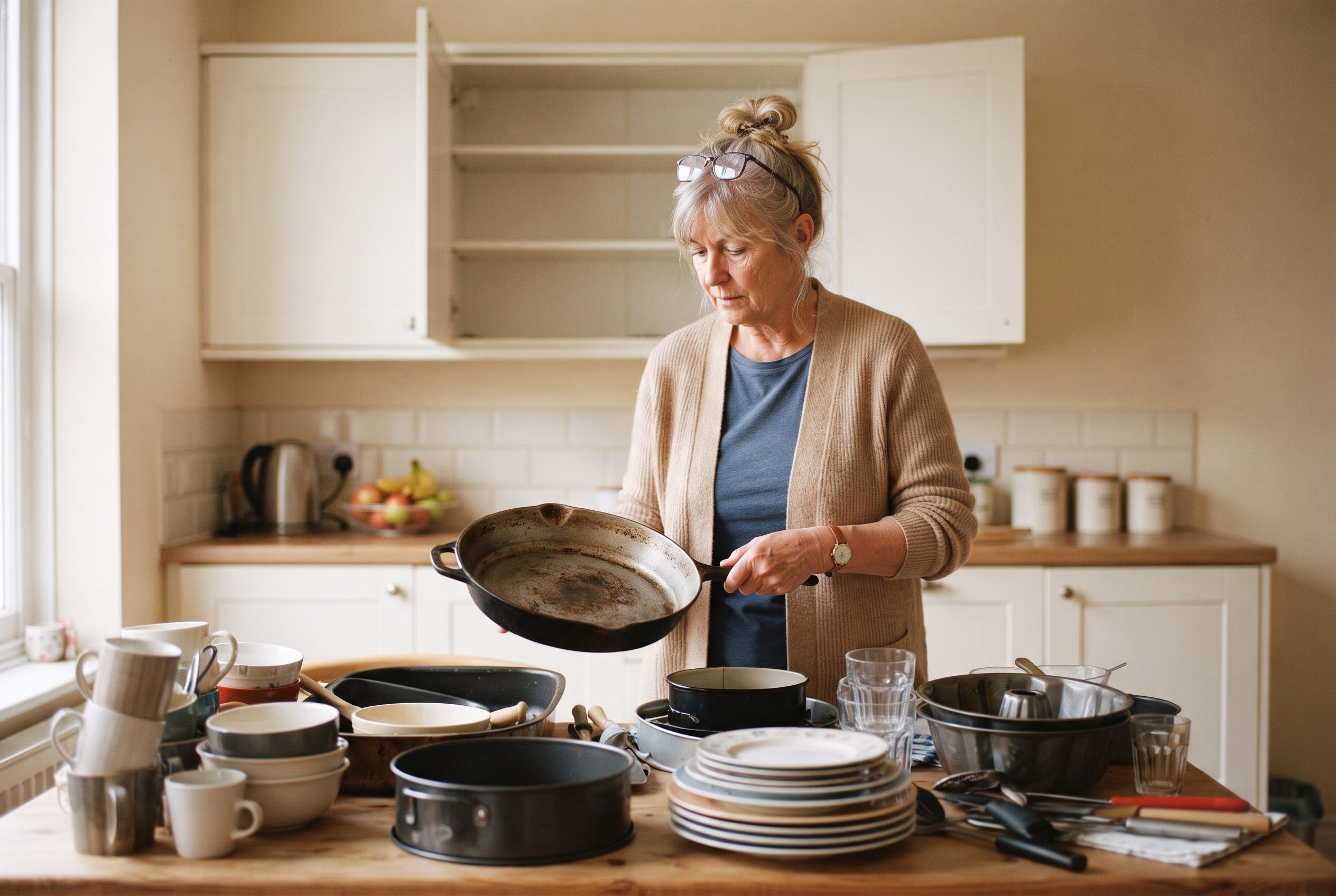
6. Everyday things between your hip and your shoulder. This one is free. Empty the upper cabinets onto the table and sort everything into three piles: every week, a few times a year, never. The first pile goes within easy reach. It is usually about a dozen things.
7. Pull-out shelves in the low cabinets. Your heaviest pot probably lives at the back of a low cabinet. A tray on drawer slides brings it to the front. Measure the opening, not the cabinet. A handy person fits one in about twenty minutes. Example: STORKING pull-out cabinet organizer.
8. Grab bars where your hand already goes. A proper grab bar holds 250 pounds, wall included, so it goes into a stud, never into drywall alone. In the shower, mount it 33 to 36 inches off the floor. Suction-cup handles look similar in the store, but they are not made to hold your weight. Example: Moen Home Care 24-inch grab bar.
9. A shower seat and a handheld shower head. The seat should be 17 to 19 inches high, like a dining chair, so you can stand up again easily. A handheld head on a six-foot hose screws onto your existing shower arm in ten minutes. A raised toilet seat brings the toilet to the same height. Example: Medline shower chair with back and arms.
10. A handrail on both sides of the stairs. With only one rail, you may be on the wrong side of it coming down. Add a second one, round enough to wrap your fingers around, 34 to 38 inches high. A carpenter can do a flight in two or three hours. Example: Promenaid handrail kit.
What about the bathroom?
Most people worry about the bathroom first, and it deserves the attention. About one in five falls at home that end in the emergency room happen there, close behind the bedroom and the stairs. What helps most is simple: something solid to hold, a place to sit, and water you can bring to you.
Stand where you step out of the shower, one foot on the mat. Let your hand reach out the way it usually does.
Look at what it lands on: a towel bar held up by two small anchors, the edge of a glass door, the soap shelf. None of them were built to hold a person.
Put a piece of tape on that spot. That is where the first grab bar goes.
Grab bars no longer have to look medical. They come in the same finishes as faucets, like brushed nickel, matte black or bronze. Some are designed as towel bars that are rated to hold a person.
Stepping over the side of the tub is the hardest move in the room: one leg up, the other balancing, both wet. Before you price a new shower, look at a transfer bench. It sits across the tub wall, so you sit down outside the tub and slide across.
Do small changes actually prevent falls?
Yes. The evidence here is stronger than for most home advice. A review of twelve trials with more than five thousand people found that changing the home cut the rate of falls by about a quarter. For people already at high risk, it was closer to two-fifths. The changes were ordinary ones: clutter, loose rugs, poor light, nothing to hold on to.
They worked even better when an occupational therapist did the assessment. That is the evening walk from earlier, done with someone trained to spot what you no longer notice.
The stairs have their own quick test. Stand at the bottom and reach out to both sides. If one hand finds nothing, put a second rail on your “this month” list.
When the big renovation is the right one
Some items will land in “someday”: the walk-in shower, the stairlift, the ramp. Sometimes one of them is the right answer. A stairlift can give you back a whole floor of your house.
But order matters. Finish “this week” and “this month” first, then look at “someday” again. It is common to find that the expensive job was not the one you needed.
When it is, do it properly. A cheap version of a big job usually goes unused. A ramp that is too steep is the classic case: the standard slope is one inch of rise per foot of length, so three porch steps need about twenty-four feet of ramp.
A House That Fits
This is what our new guide is for.
A House That Fits is the practical aging-in-place guide for small changes you can actually make. It works with the house you already have, and it does not ask you to renovate.
It is built on three moves: notice where your day costs more than it should, alter the one thing that gives it back, and keep it working.
Inside, room by room:
What your hands touch all day: switches, handles, faucets, the key and the lock.
The twenty seconds at night, from bed to bathroom in the dark.
The bathroom that does not have to look like a hospital, with the measurements that matter and what to check before you trust a grab bar.
The kitchen: the top shelf, the back of the low cabinet, heavy pans, carrying.
The way in and the way out: doors, steps, stairs, the path, the ice, and getting in and out of the car.
Where things live, so the house remembers for you.
The bad day: setting up the house for your worst day, not your average one.
Living alone, on purpose, and who knows you are all right today.
What it costs and who helps pay, in the United States, Britain, Ireland, Canada and Australia.
Keeping it working, with a twenty-minute season check four times a year.
The ten above are a sample. The guide covers more than thirty changes, room by room, with over a hundred products. For each one, it tells you exactly what to buy and why: usually two or three options, what each one is for, what it costs, who installs it, and what to check if you buy it somewhere else. There are sheets to print and write on, including the walk from this article, laid out room by room.
At the end of most chapters there is a small box called If someone says you should move, with a sentence you can actually say. The bathroom one goes: “I’ve got the bathroom taken care of — bar in the shower, proper seat, handheld. Come and look at it next time you’re here.”
It is $19.99, down from $24.99. You can read it on any device or print it, and it is yours to keep.
PS — If your subscription includes Plus + All Guides, this guide is already yours: you can download it from this page. If it doesn’t yet, you can upgrade there too.
Love this list - I’m an RN. The small rugs have gotta go, too.
And please get rid of all clutter in your pathways.
The house has not adjusted to you once- that line gets to the heart of it. We get so good at working around an awkward cupboard or stubborn doorknob that we stop noticing the effort it takes.
Your evening walk makes those compromises visible, and the “this week” column gives readers somewhere to start without waiting for a renovation budget.
That’s what makes this more useful than another safety checklist: it treats independence as something we can support through ordinary, manageable changes, not just expensive equipment.