

Imagine two women, both seventy-two. Both retired, both healthy, both quietly determined to keep the mind active — the way you’re told to.
One does the crossword every morning with her coffee. The same paper, the same style of puzzle, the way she has for eleven years. She’s genuinely good at it now; she finishes most days before the coffee’s cool.
The other signed up six months ago, against her own better judgment, for a beginner’s cello class at the community center. She is not good at it. She squeaks. She loses her place. She is the oldest in the room by a decade and she feels every year of it.
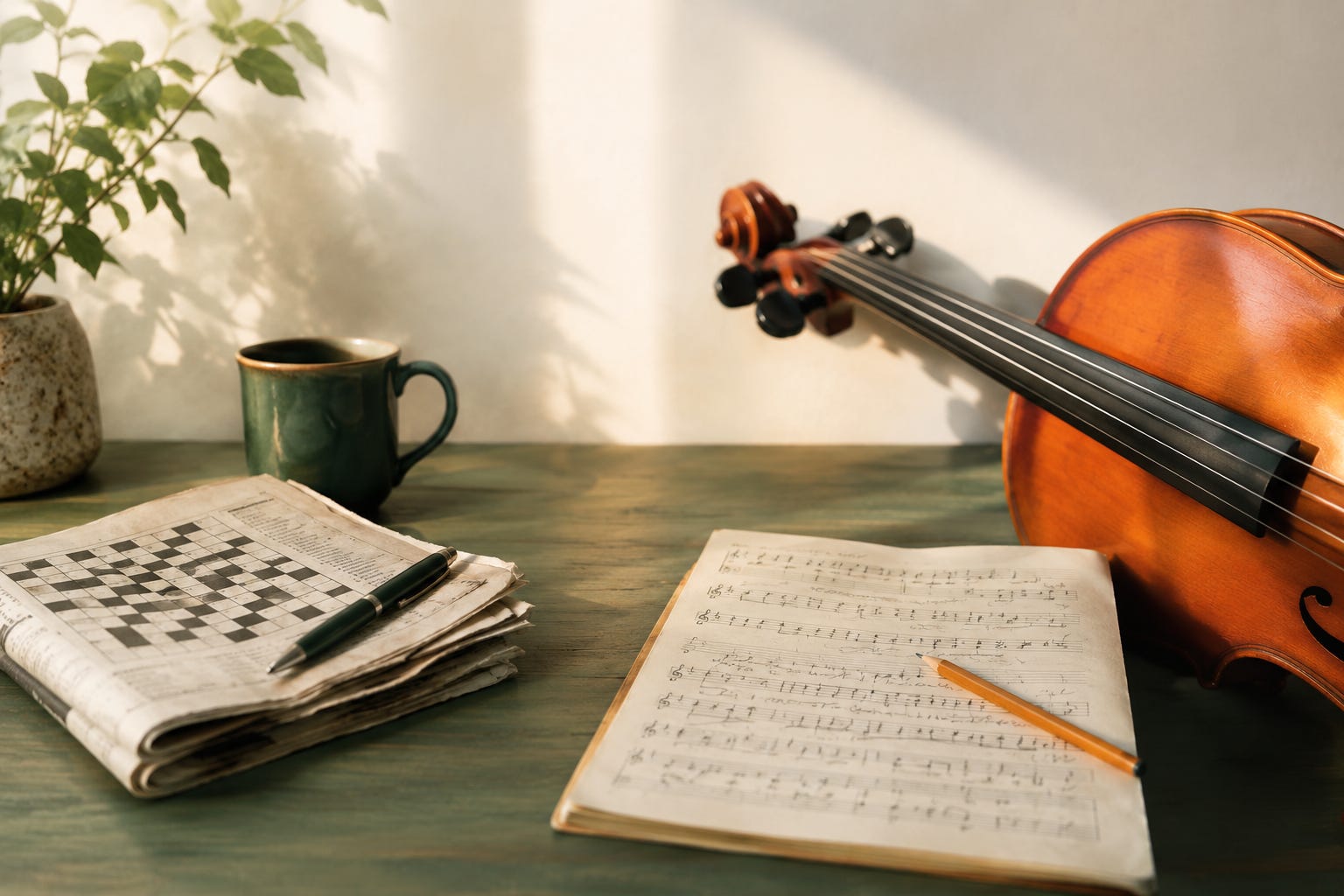
Look at the two of them and you’d bet on the crossword. You’d be wrong: it’s the cellist whose brain is changing.
We’ve spent two Sundays here already. First on why a settled week quietly dims a mind — sameness dims a brain faster than age ever does. Then on how to actually begin again when the idea has come to feel too heavy to lift. Both landed on the same doorstep: start, badly, at something new.
Today we walk through the door and find that it opens onto many rooms, not one. The crossword and the cello are both filed under “learning.” They are not doing remotely the same thing to a brain. Which room you walk into changes what happens in your head.
Why the squeaking cello wins
Think back to the study from last Sunday — the Synapse Project, where older adults who took up something genuinely hard and new, like photography or quilting, gained real memory improvements, while the ones who stuck to pleasant, familiar activities mostly held steady.
The crossword is a pleasant, familiar activity. That’s not an insult; it’s a category. After eleven years, our first woman’s brain has automated the whole thing — the patterns, the setter’s tricks, the shape of the answers. She’s exercising a skill she already owns. It’s the mental equivalent of a daily walk on the same flat path: good for you, comforting, and asking almost nothing new of the body.
The cello asks for everything at once. Her fingers have to learn where to go while her eyes read notation while her ears judge the pitch while her mind holds the next bar in advance — and all of it is done badly, which means the brain is constantly correcting, adjusting, laying down new wiring to close the gap between what she meant and what came out. That gap, and the effort of closing it, is the whole engine.
Both women are busy, so busyness plainly isn’t what separates them. The real divide is quieter, and harder to admit out loud: one of them is still struggling at her thing, and the other has mastered hers and mistaken the comfort of that for benefit.
That single distinction sorts almost everything. And once you see it, you can rank the ways people spend their “keeping sharp” hours from most to least useful — which is exactly what most brain-health advice refuses to do, because it’s easier to say “stay active” and let you assume it’s all equal.
It isn't equal. Some of it works, and some of it only feels like it does.
Below, I’ve sorted it into a ladder — five rungs, from the kind of learning that changes a brain most to the kind that changes it least, so you can find where your own hours sit. Then why brain-training apps mostly don’t do what they promise, two questions that tell you whether an activity is still working on you, and what to do on the days when the bottom rung is the only one you can reach.
What’s below is for Plus members. August is one theme carried all the way through, so membership is more than a single post:
The rest of this article — the ladder and its five rungs, what to make of brain-training apps, and how to place your own hours.
August’s Fun Pack — a brand-new set of around 25 puzzles in five styles (crossword, sudoku, word search, word scramble, word match), themed to this month. Play them online with your progress saved, or print the PDF — large-text and high-contrast built in, answers included. A themed puzzle book runs $8–12 in a shop; yours is new every month.
The full archive — every Sunday deep-dive, yours to revisit.