


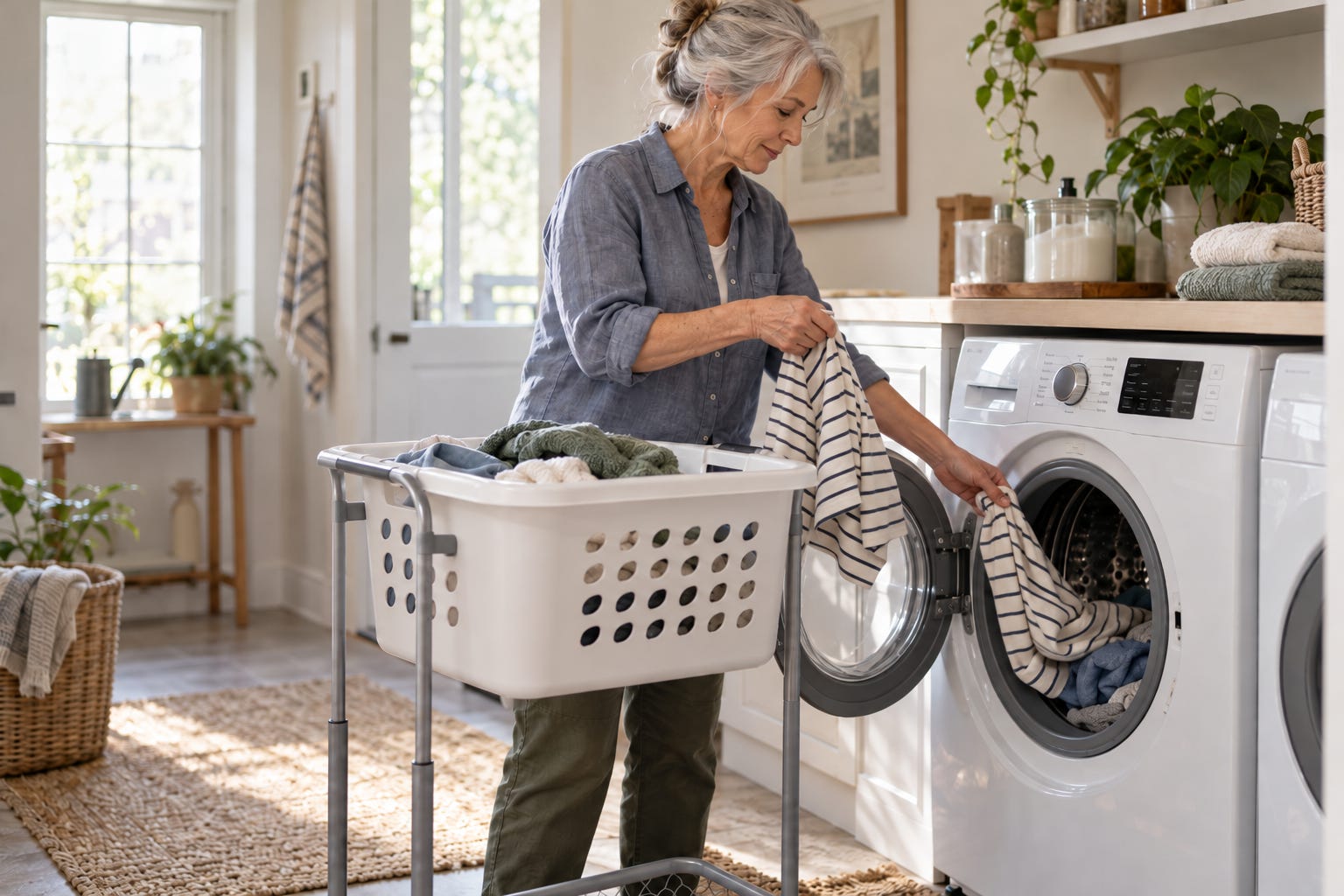
The heaviest part of laundry day might be the basket you pick up before you’ve even switched on the washing machine.
Then come the small demands we hardly notice until they start to bother us: reaching into the drum for a forgotten sock, wrestling a wet towel into the dryer, gripping a large detergent bottle, and bending over a bed to fold clothes. A routine you’ve followed for years can gradually become more tiring than it needs to be.
The good news is that you probably don’t need an entirely new laundry room. A few adjustments to where things sit and how you move them can make a surprisingly useful difference.
Start with less laundry at once
There’s a catch to owning a generous laundry basket: sooner or later, you’re tempted to fill it.
If one big weekly wash leaves you exhausted, try smaller loads spread over the week. A half-full basket is easier to manage, and fewer clothes are easier to lift out of the washer, especially when they’re wet. In an Arthritis Foundation collection of readers’ laundry tips, several people mention doing smaller loads rather than letting everything pile up.
You might also save a step by sorting clothes where you take them off. Two modest hampers can mean no more emptying one enormous basket onto the floor to separate lights and darks. If you live with others, sharing the sorting and putting-away work makes sense too.
None of this requires buying anything. It just replaces one demanding laundry day with a few manageable steps.
Let the basket roll, when it can
Carrying a loaded basket often means holding it away from your body while navigating doors, corners, and furniture. A wheeled hamper can take much of that carrying out of the journey.
One example is the Sterilite Ultra Wheeled Hamper, which has wheels and a retractable handle for use on smooth floors. It’s a sensible type of product to consider if your laundry room is on the same level as your bedroom. Before buying, check the width of your doorways and whether rugs or thresholds will interrupt the route.
Wheels don’t solve stairs. If you have to carry laundry between floors, keeping a second basket near the washer and moving small amounts at a time may be a better approach. Always leave yourself a clear view of the steps and a free hand for the rail.
And remember that a bigger wheeled basket can still become a very heavy basket if you fill it to the top. The goal is to move less weight, not simply to move more of it on wheels.
Change the height, not your back
Think about how many times you reach down to a basket on the floor: while loading the washer, moving things to the dryer, sorting the clean load, and folding.
Try putting the basket on a stable table or stand at a comfortable working height. That may remove a surprising number of repeated bends. Keep the surface close enough to work without stretching or twisting, and make sure the setup cannot tip.
If the washer itself is the problem, the right adjustment depends on your machine. A top-loader may require a long reach into the drum; a front-loader may require repeated bending. A lightweight reacher grabber can help retrieve an occasional sock or other small item from a stationary, switched-off machine. Choose one whose trigger is comfortable for your hand, and never use it to drag out a heavy bundle of wet clothes or stretch beyond your balance. Example: FitPlus PowerGrip reacher, 32-inch.
For some homes, a sturdy elevated laundry cart can be useful because it keeps the basket up off the floor while allowing it to move around the room. Look for a comfortable basket height, a stable frame, wheels that lock securely, and enough space around the washer. Example: rolling laundry basket on a raised frame, with locking wheels. A stable table you already own may do the same job for free.
If reaching into a front-loader remains difficult, ask the appliance manufacturer about a compatible pedestal rather than improvising a platform. Appliance stability and installation matter more than gaining a few inches.
Give your hands fewer awkward jobs
It’s easy to overlook how much handwork laundry involves. Detergent caps, heavy bottles, wet jeans, small clothespins, and repeated gripping can be particularly bothersome when your fingers are stiff.
Start with the detergent. A smaller bottle or easy-pour dispenser may be easier to manage than a large economy container, even if buying the biggest size seems like the sensible choice. Example: refillable detergent dispensers with labels, 2-pack. If you refill a small dispenser, label it clearly and keep detergent securely stored. Pods must stay in their original child-resistant packaging and out of reach of children.
If you hang laundry outdoors, consider pegs with broader grips or designs that don’t require such a strong pinch. Try a few before replacing an entire set: a peg should be comfortable to use and secure enough to hold the clothes.
When transferring wet laundry, gather heavier pieces with both hands and keep them close to your body. If a garment is too heavy or awkward, move smaller amounts instead of tugging at the whole load.
The aim isn’t to avoid using your hands. It’s to stop asking the same small joints to do the hardest version of every job. If pain, numbness, or weakness is persistent or worsening, a healthcare professional or occupational therapist can help assess what is going on and suggest appropriate adaptations.
Make the last half of laundry day easier
Laundry isn’t finished when the dryer stops. There’s still folding, hanging, ironing, and putting everything away.
Try folding at a table rather than bending over a low bed. Sit in a supportive chair if that’s more comfortable. And ask whether every item really needs the same careful treatment. Towels can be folded simply; casual shirts may go directly onto hangers; some clothes won’t need ironing at all if you remove and hang them promptly, according to their care labels.
A particularly practical suggestion from the Arthritis Foundation’s readers was to hang suitable clothes instead of folding them. It removes a whole series of repetitive movements.
Finally, pay attention to where the clean clothes go. The things you use often deserve easy-to-reach drawers and shelves, rather than the highest cabinet or the bottom of a deep cupboard. Your laundry system includes storage, not just the machines.
Three changes to try before buying anything
For your next load, try just three experiments: wash a smaller amount, raise the basket onto a stable surface while transferring clothes, and fold or hang everything at a comfortable height.
Then notice which part felt easier. If carrying is still the problem, a wheeled hamper might earn its place. If it’s retrieving the final sock, a reacher may be enough. If the basket keeps ending up on the floor, a proper raised stand could help.
Good equipment should solve an inconvenience you’ve actually noticed. There is no prize for collecting laundry gadgets, and no reason to replace a perfectly good routine beyond the parts that no longer serve you.
A cleaner, easier laundry day may be less about doing everything differently and more about removing a handful of unnecessary struggles.
What should we make easier next?
I’d love to turn this into a regular series of practical articles about everyday tasks, with useful ideas and tools that genuinely make a difference.
Vote above, and if there’s another household task you’d like us to tackle, you’re welcome to suggest it in the comments.
Great suggestions….but you overlooked detergent sheets.
I have been using them for 2 years.
Very effective! And they keep the
big plastic jugs out of the land fill!
Win, win?
Smaller loads spread over the week is such a practical idea, since wet laundry is the heaviest part. Small changes like sorting clothes where you take them off are the kind that actually stick.