


One of the questions people type into Google every autumn is short and a little suspicious: are flu shots for seniors stronger?
Yes. And the reason they exist is one most people never hear at the pharmacy counter.
After 65, the flu shot you got at 45 tends to work less well. The CDC says it without softening it: older adults can have lower protective immune responses after flu vaccination than healthy younger people. The body still answers the vaccine. It answers more quietly.
So vaccine makers built versions for that quieter answer. In the United States, the CDC and its vaccine advisers recommend that people 65 and over preferentially get one of three: a high-dose vaccine, an adjuvanted vaccine, or a recombinant one. Health agencies in Canada, the UK and Australia have landed in the same place.
Most people walk in, roll up a sleeve, and get whatever is in the fridge. Often that is the right one. Sometimes it isn’t, and the only way to know is to ask.
The week after the flu
Before getting to which one, it helps to know why the shot matters more now than it did at 45.
Most people think of flu as a bad week in bed. After 65, the bed is only part of it.
The numbers the CDC publishes are stark. Between 70 and 85 percent of seasonal flu deaths, and between 50 and 70 percent of flu hospitalizations, have been in people 65 and older.
Two studies, both from Canada, show what sits underneath those numbers.
The first was published in the New England Journal of Medicine in 2018. Researchers in Ontario took people who had a lab-confirmed flu infection and were admitted to hospital for a heart attack sometime in the year before or the year after it. Then they looked at when the heart attacks happened. In the first seven days after the flu was diagnosed, the rate was about six times higher than in the rest of those two years. After day seven, the extra risk disappeared.
That is a short, sharp window, and it explains why doctors who look after hearts care so much about flu shots. The infection puts the whole system under strain at exactly the age when the system has less spare room.
The second study followed 925 people aged 65 and over who were admitted to hospital with flu or a similar respiratory infection. Their average age was 79. A month after going home, nearly one in five had lost a meaningful amount of their ability to look after themselves. For about half of those, the loss was severe: they could no longer manage at least two basic everyday tasks, such as washing or dressing, on their own. People who were already frailer going in were the most likely to come out worse.
That is the part of flu that doesn’t show up in the word “flu”. Ten days in bed takes strength out of the legs. At 75, strength doesn’t always come back on its own.
Why October
The CDC’s advice is that September and October are generally good times to be vaccinated, and that everyone should be vaccinated by the end of October.
The reason is timing. According to the CDC, antibodies develop about two weeks after the shot. The UK’s national flu program expects flu to peak in December or January. Getting the shot now means being covered well before then.
Going in September or October rather than July or August matters too. The CDC says protection from the vaccine declines over time, and advises adults 65 and over not to get vaccinated that early for exactly that reason.
If October slips by, go in November. Or December. Late is still better than not at all.
Three vaccines with one job
The names sound like a chemistry exam. What each one does is simple.
High-dose is the most literal. According to the CDC, it contains four times the antigen of a standard dose, the part of the virus your immune system learns from, so an older immune system has more to work with. In the US it is sold as Fluzone High-Dose.
Adjuvanted takes a different route. It adds an ingredient, the adjuvant, that makes the immune system pay closer attention to the dose it is given. The one you will usually hear about is Fluad.
Recombinant is made a different way: from a protein of the flu virus, rather than from a virus grown in eggs. In the US, that is Flublok.
You don’t have to choose between them. The CDC doesn’t rank them; any one of the three counts. Canada’s advisory committee says the high-dose has the most evidence behind it, followed by the adjuvanted and then the recombinant, but recommends all three over a standard shot.
And if the place you go has none of them that day? The CDC’s guidance is clear: get whatever age-appropriate flu vaccine is available rather than waiting. A standard shot in October is better than a stronger one you never get around to.
What “stronger” feels like the next day
This is usually the real question behind “are they stronger”: will it knock me out?
For most people, no. According to the CDC, the common side effects in clinical studies of the adjuvanted vaccine were mild to moderate and temporary: pain and redness where the needle went in, headache, muscle aches, and a general feeling of being off. Most cleared within a few days. Injection-site pain bad enough to limit what people did was no higher with the adjuvanted vaccine than with the high-dose one.
Practically, that means a sore arm, maybe a slow day. If you have something important the next morning, a long drive or a day with grandchildren, book the shot so you have a quiet day after it.
What it won’t do is give you the flu. The CDC explains that flu shots are made either from virus that has been killed, or from proteins of the virus. Neither can cause flu.
What it costs, and where to go
This depends on where you live, so here it is country by country.
In the United States, Medicare Part B covers the flu shot once each flu season. Medicare’s own wording: you pay nothing for a flu vaccine if your doctor or other health care provider accepts assignment for giving the vaccine. Most pharmacies and doctors’ offices do, but it is worth one sentence when you book: “Do you accept Medicare assignment for the flu shot?” That covers the “are flu shots free for seniors” question in one go. If you’re going to a pharmacy, call ahead and ask which of the three senior vaccines they have in stock. It saves a wasted trip.
In the UK, the NHS flu vaccine is free if you are 65 or over, or will turn 65 by 31 March 2027. The program for this age group opened on 1 October. You can book through the NHS App, at a pharmacy that offers the free flu vaccine, or through your GP surgery. The vaccines the NHS uses for people 65 and over include the adjuvanted, high-dose and recombinant ones, along with a cell-based vaccine, so the choice is largely made for you.
In Canada, the national advisory committee recommends the same three for anyone 65 and over. Which ones are publicly funded, and for whom, is decided by each province and territory, and the rules differ. Last season, for example, British Columbia didn’t fund the high-dose vaccine, and Quebec offered the adjuvanted one only to some groups. Ask your pharmacist or your local public health office which of the three your province covers for people 65 and over.
In Australia, the calendar is the other way round. Your flu season is winter, so the shot is recommended from April, before it starts. For people 65 and over, the adjuvanted vaccine, Fluad, is free under the National Immunisation Program, and the high-dose vaccine is available privately. If you’re reading this in October, you’ve likely had yours already. Keep it in mind for next April.
Wherever you are, the words to use at the counter are the same: “I’m over 65. Do you have the high-dose or the adjuvanted flu vaccine?”
At the counter
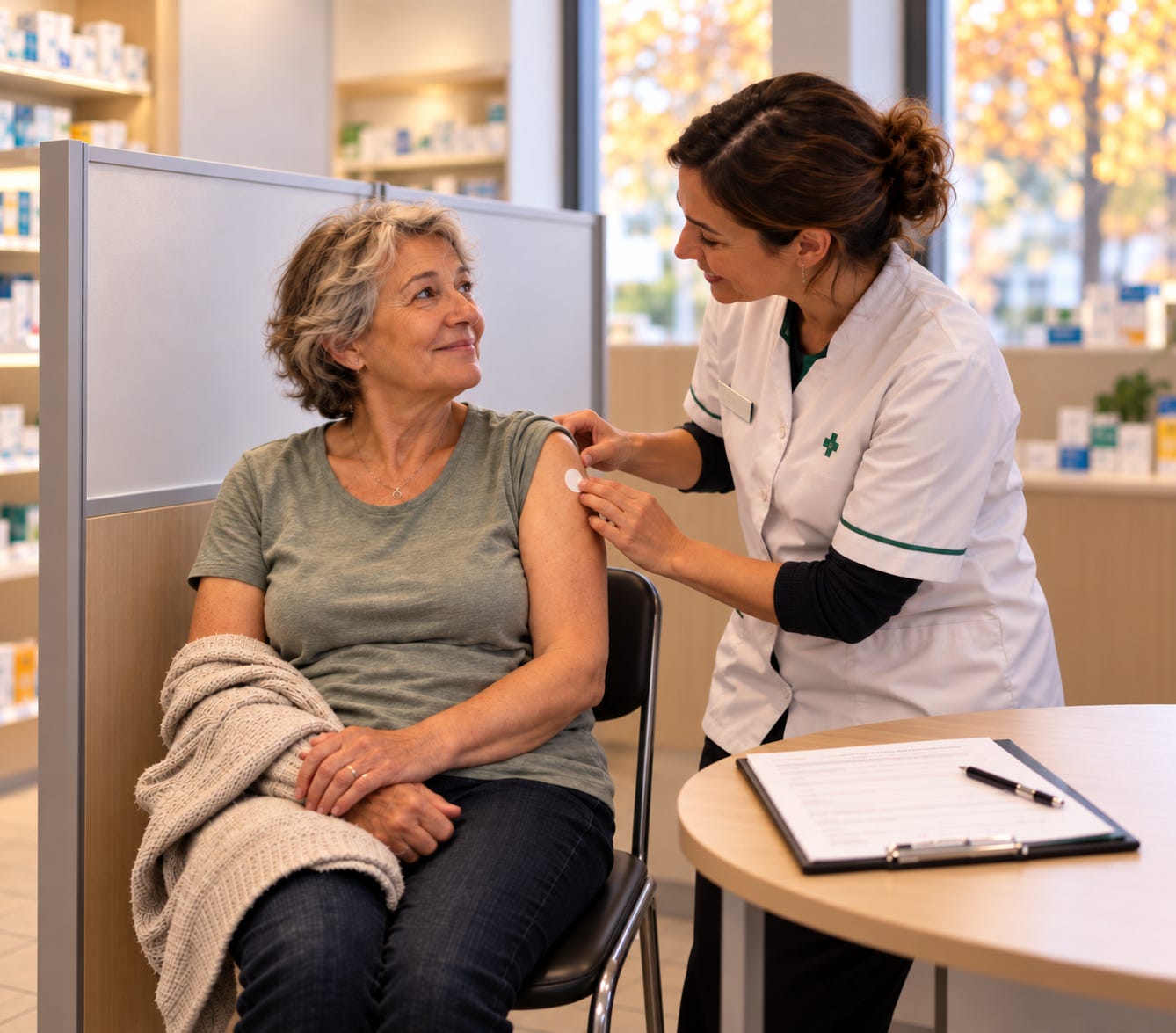
A few small things make the visit easier, and none of them need a doctor’s opinion.
Wear something with a loose sleeve. A cardigan over a short-sleeved top is ideal; a tight turtleneck means half-undressing in a pharmacy corner.
Ask for the arm you use less. If you’re right-handed, the left arm. A sore shoulder is a nuisance for a day, and it’s less of one when it isn’t the arm that lifts the kettle.
Bring your card, whichever one applies where you live, and a list of your medications if you have one written down. You may be asked about allergies or about how you felt after last year’s shot. Answer plainly. That is what the questions are for.
Then, before you leave, ask one more thing: “Which vaccine did I just get?” The person giving it will know. Write the name and the date somewhere you’ll find it again: the back of the medication list, a note on the fridge, the notes app on your phone. It sounds fussy. It is surprisingly hard to remember in a year’s time whether it was “the strong one” or not, and the box will be long gone.
Some places will hand you a little card or a printed record. Others won’t, and you’ll be glad you asked.
If getting out is the hard part
One of the searches that comes up most around this subject is “flu shots at home for seniors”. It makes sense. The people who most need a flu shot are often the ones for whom a pharmacy trip is a production: a ride, a walk across a car park, a queue.
The options vary a lot by area, so this is a list of places to ask rather than promises.
Start with your own doctor’s office. Ask directly whether anyone does home visits for flu shots, and if not, who in the area does. Then try your local pharmacy, since some will come to the house or know who does. Your local public health department or council is the third call; they usually know what exists nearby.
If you get home care, home nursing, or regular visits from a health service of any kind, ask them as well. And if a family member is the one who drives you to appointments, a flu shot can usually be fitted into a trip that is happening anyway.
The other vaccines worth a question
The flu shot isn’t the only one with a version for later life. RSV and pneumonia vaccines also come up for older adults, and they follow their own rules, which are different from the yearly flu shot. That is a conversation for your doctor or pharmacist rather than for this article, but the flu shot appointment is a good moment to ask.
“While I’m here, am I up to date on the others?”
Before the end of the month
Here is the whole thing, short enough to remember at the counter.
After 65 there are flu vaccines made for an older immune system: high-dose, adjuvanted, or recombinant. Any of the three is a good choice. Ask for one by name. Expect a sore arm and maybe a slow day. Go before the end of October if you’re in the northern hemisphere. And if they only have the standard one, get the standard one.
If you’re getting value from my articles and want to support the work, the paid membership is where to do it - learn more about the perks you get as a Plus member.
Sources
CDC, Interim Clinical Considerations for the Use of Seasonal Influenza Vaccines, 2026–2027
Kwong JC et al., Acute Myocardial Infarction after Laboratory-Confirmed Influenza Infection, New England Journal of Medicine, 2018
Andrew MK et al., Persistent Functional Decline Following Hospitalization with Influenza or Acute Respiratory Illness, Journal of the American Geriatrics Society, 2021
Medicare.gov, Flu shots
NHS, Flu vaccine
UK Health Security Agency, National flu immunisation programme 2026 to 2027 letter
Public Health Agency of Canada, NACI guidance on influenza vaccination in adults 65 years of age and older
Immunize Canada, Publicly funded influenza vaccines, 2025–2026
newsGP (RACGP), 2026 flu vaccines ready to roll out
I am 73 years old and I have never gotten a flu shot and I never will! Instead I go to my naturopathic doctor and get an immune booster shot. I haven't had the flu since the 1990s when my children were bringing germs home from school. My husband is 78 and he does not get the flu shot either. We focus on healthy living…exercise, eating well and supplementation.
The studies show that the elderly death rate from flu has not abated with the introduction of the flu shot. It's time to revisit this annual shot.