
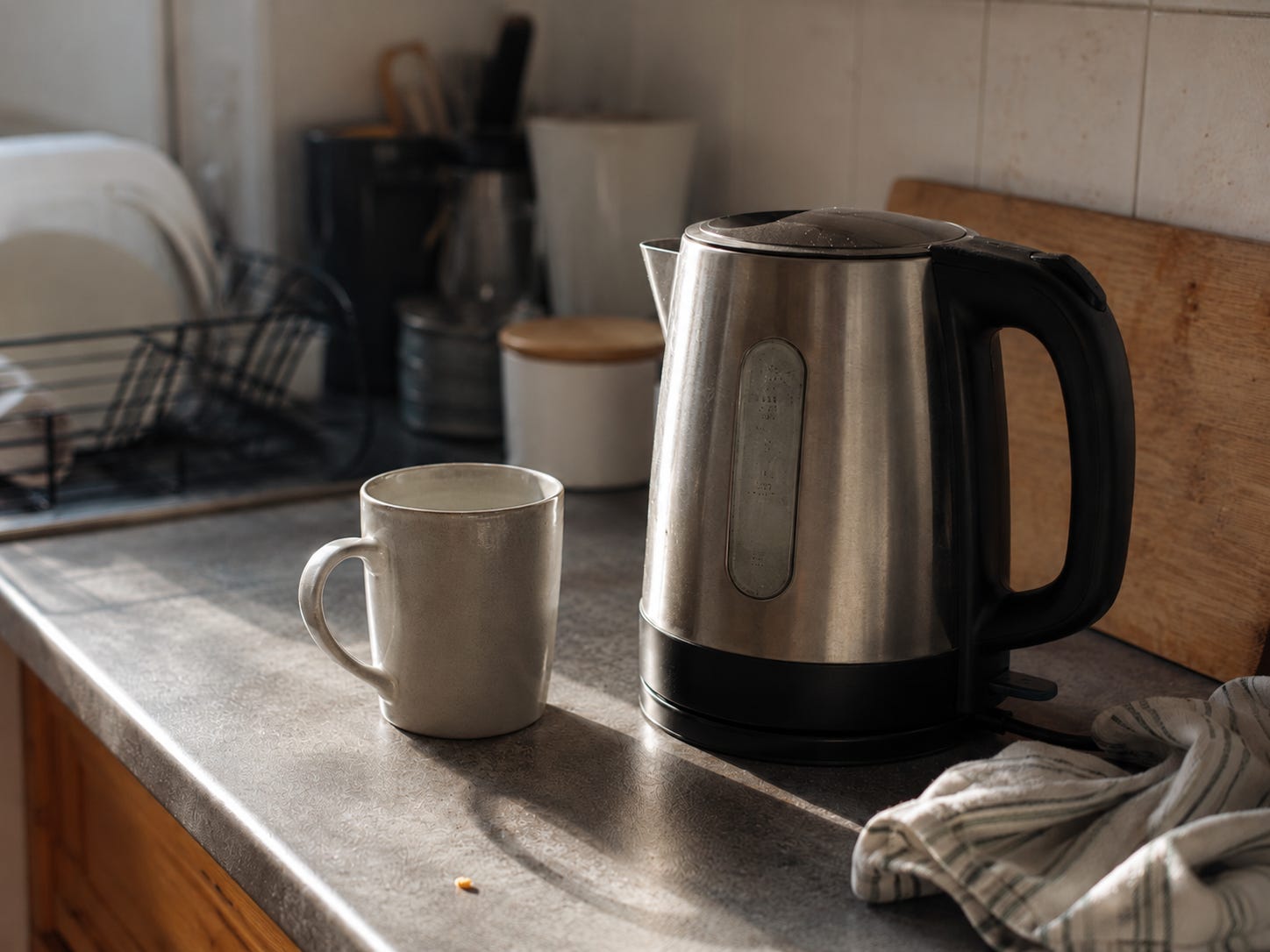
The kettle boiled while you were doing something else.
By the time you came back to it the water had gone quiet, so you pressed it down again — and while it heated the second time you stood there for a moment, trying to remember what it was you had gotten up to do in the first place.
Small thing. It is also the third time this morning that something has been started and then started again, and it is not yet eleven o’clock.
That is not a memory problem. It is what a day looks like when the shape of it is being decided somewhere other than in your own head.
Your day used to have edges
Think about what put the boundaries in an ordinary weekday, twenty years ago.
You got up at a particular time because something started at a particular time. You ate when the break was. You came home when the day ended, and the evening had a shape because it began when you walked through the door. Somebody was expecting you somewhere, most days, and that expectation did more scheduling than any decision you ever made.
None of that was discipline. It was scaffolding, and other people were holding it.
Then it comes down — not all at once. A job ends, children stop needing picking up, someone who used to leave the house at ten past seven stops leaving the house at all. Each removal is small enough to absorb — together they take away every fixed point that wasn’t yours to begin with.
What’s left is a day with no edges. And a day with no edges does not feel like freedom for very long. It feels like the hours are happening to you.
Why the usual advice bounces off
The standard answer to this is a routine. Get up at the same time, plan your week, block out your mornings.
I have given that advice myself. Back in June I wrote about why the week needs its shape back and how to give it one, and I still think every word of it is right.
But there is something that piece didn’t cover, and it has stayed with me all summer. You make the plan. It holds for nine days, or two weeks, and then it stops — and stopping feels worse than never having tried.
Here is what I think was going on. Every routine system rests on the same assumption: that seven o’clock is yours to assign. You set the alarm for seven, and seven belongs to you, and what happens next is a matter of will.
For a great many people at this stage of life, that assumption is simply false. The alarm goes at seven and by twenty past you are doing something that somebody else needed, or that your body decided, and the plan is already behind. Do that four days running and you conclude you have no discipline left.
You have plenty. You are trying to run a system designed for a life where the hours are yours — in a life where they are shared.
What you concluded instead
When the plan comes apart for the fourth time, almost nobody blames the plan.
What people conclude is something about themselves. That they have let things slide. That they were only ever organized because they were made to be, and left to their own devices this is what they are.
It is a reasonable conclusion — and it is the wrong one. If you had been given the same day with the same interruptions at forty-five, the plan would have come apart then too. Nothing about you changed. The conditions did, and nobody handed you a new method to go with them.
The distinction is not academic, because the two explanations lead to completely different next steps. If the problem is you, the answer is to try harder, which has already failed. If the problem is that the method assumes hours you do not have, the answer is a different method.
Who is actually setting your hours
This is the part I want to be careful with, because it is the whole of next month and I would rather point at it than rush it.
The hours in your day are being set by something. Usually one of four things, and most people have more than one.
Other people’s calendars, still running you even after they stopped being yours — grandchildren’s school terms, someone else’s appointments, the phone call that always came on a Tuesday until it didn’t.
Your own body, which sets the schedule without consulting you and does not announce itself in advance. Pain, a bad night, the hour a medication is due, the energy that arrives at three in the afternoon and leaves again.
The person you live with, whose day is now happening in the same rooms as yours, at their tempo, all day, which is a new problem for two people who spent forty years in separate buildings between nine and five.
The person you are looking after, whose needs set the clock completely, and whose day has quietly become your day.
Notice that not one of those is a character flaw. They are circumstances, they are extremely common, and the routine advice on offer is written as though none of them existed.
The shift that makes it workable
The theme of next month is embracing routine, and the word is carrying the weight there. Not building one. Embracing the one you have.
Which means giving up on the version where you assign the hours, and doing something smaller and much more durable instead: finding the two or three fixed points that survive whatever the day turns out to be.
Anchors, not a schedule.
Three of them hold in almost any circumstance, including the four above.
The same first thing, whatever time it happens. Not at seven. First. Whether you wake at half past five or half past nine, the day begins with the same small sequence — the window opened, the kettle, the same chair. Your body takes the cue from the order, not the clock, which is why this one survives a night that went badly.
Keep it to three or four minutes and make none of it useful. The moment it includes a task, it becomes something to postpone on a bad morning, and then it is gone.
One thing in the day that is only yours. Twenty minutes that belong to no one else and produce nothing. A shared day with no private hour in it stops feeling like your life quite quickly, and this is the anchor that goes first.
It does not need a fixed hour, which is the point — it needs a fixed size. Twenty minutes that can happen at eleven or at four, and that get taken rather than requested.
A defined end. Not a bedtime. An end — the point where the day is declared over, whether or not it went well. Without one, a difficult day has no boundary and simply leaks into the evening and then into tomorrow.
It works best as an action rather than a time: the kitchen light off, the last cup washed, the curtains drawn. Something with a sound to it, that you can do at nine or at midnight, and that means the same thing either way.
All three fit a day you do not control, and none of them care what time it is.
What that looks like on an ordinary Tuesday
None of that is a schedule, so it is easier to show than to describe.
You wake at five forty, which you did not choose. You open the window, put the kettle on, sit in the same chair for four minutes. That is the first anchor, done, and it is not yet six o’clock.
The morning then goes the way mornings go. Somebody calls about something that cannot wait. An appointment moves. The thing you meant to do at ten happens at half past one, and the thing you meant to do at half past one does not happen at all.
At some point in the afternoon — three, or nearly five, it does not matter — you take your twenty minutes. There is never a good moment for it, and waiting for one is how it gets lost. You take them the way you would take a phone call you were expecting.
In the evening you wash the last cup and turn the kitchen light off, and the day is over. It is over at ten past eight, or at eleven. Either way it ends on purpose.
Look at what happened there. Almost none of the hours went as intended, and the day still had a beginning, a middle that belonged to you, and an end. That is the whole of it. Three points held while everything between them moved.
What September is for
There is a version of me that tries to fit all of that into one piece, and it would be a bad piece. Each of those four situations deserves its own treatment, with its own detail, and they are not interchangeable — the day of a woman whose husband has just retired and is now home at eleven in the morning has nothing structurally in common with the day of someone timing everything around medication.
So September gets all of it. Four Sundays, one each.
The first is about the routines that were running on other people’s calendars, and what happens in a September when everyone else’s year starts over and yours doesn’t. The second is about the days your body writes the schedule — how to build a routine with two versions, one for good days and one for bad, so that a bad day stops being a failed day. The third is about two people, one house, all day: the negotiated rhythm of a home where both of you are now always in it. And the fourth is about holding somebody else’s day together while keeping a piece of your own.
Those Sundays are for Plus members. If you would like them from the first one, this is the moment to come in — the month reads as a single piece, and the September Fun Pack comes with it. $10 a month, or $97 for the year.
Tuesdays and Fridays stay free, as they always have.
Before then, one small thing you can do this weekend, and it takes about a minute.
Write down what time you did three things today. Not what time you meant to. What time you actually got up, actually ate, actually stopped.
You are not looking for a problem. You are looking at the shape your day already has, which is the thing next month is built on.


