
Going down stairs, there is a half-second where your foot is already committed and your eye has not yet confirmed where the step is. Most of the time this passes unnoticed, thousands of times a year.
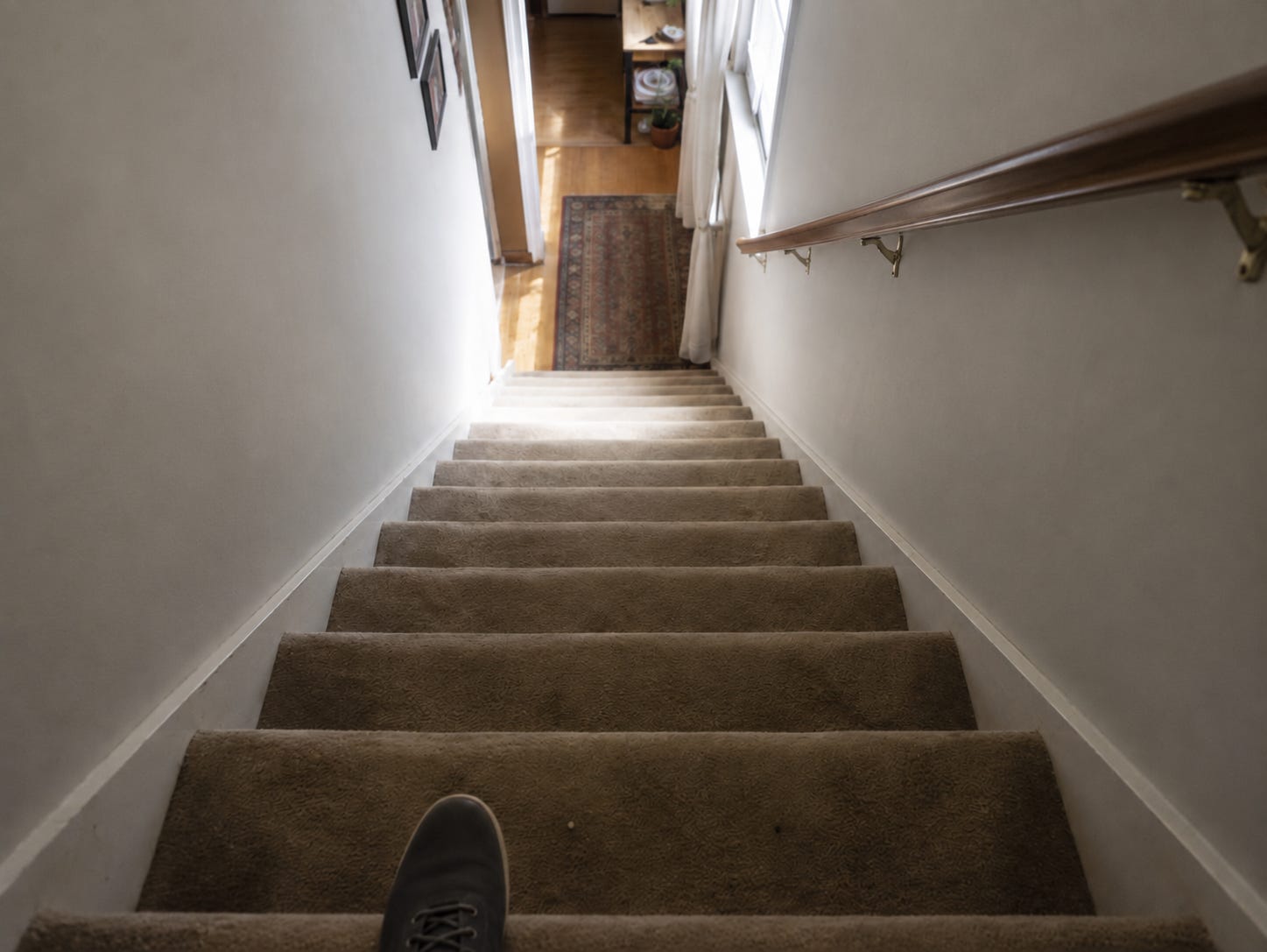
Then one afternoon the foot arrives and the step is an inch lower than it was supposed to be, and your whole body knows about it before you do.
If that has happened to you, the first explanation offered will probably be about balance. Or about being tired, or rushing, or the light.
There is another explanation, and it is sitting on your nose.
The lens you look at the floor through
Progressive lenses — varifocals, bifocals, whatever your optometrist calls them — put the reading prescription at the bottom of the lens. That is the sensible place for it. It is where your eyes go when you look down at a book.
It is also where your eyes go when you look down at the floor.
So the part of your vision aimed at the next step is being magnified for a book that is not there. Edges lose their crispness. Depth flattens slightly. A step down reads as slightly nearer, or slightly further, than it is.
Researchers measured this directly in 2002 and found that multifocal wearers had measurably worse edge-contrast sensitivity and depth perception when looking down, and a higher rate of falls to go with it.
None of this is a manufacturing fault. The lens is doing exactly what it was designed to do. Nobody designed it for stairs.
And it explains something that otherwise makes no sense: why the fall happens in your own house, on stairs you have climbed for thirty years, in daylight, wearing the glasses that let you read the small print on the pill bottle.
What happened when they tested the obvious fix
The obvious fix is a second pair — plain distance glasses, no reading section, worn for walking about and going outside.
In 2010, a team in Australia ran that as a properly randomized trial and published it in the BMJ. Six hundred and six regular multifocal wearers, average age eighty, all of them already at raised risk of falling. Half were given single-lens distance glasses and advice on when to wear them. Half carried on as usual. Everyone was followed for thirteen months.
Across the whole group, the second pair made almost no difference — an eight percent reduction in falls, well within the range you would expect from chance.
But the researchers had planned in advance to look separately at people who regularly went out and about. In that group the effect was large and clear: forty percent fewer falls. Fewer falls outdoors. Fewer falls that caused injury.
And in the group who rarely went outside, the second pair appeared to make things worse. Falls outdoors went up.
That is an awkward result. It does not reduce to advice. What it reduces to is a question about your own life: do you walk about outside, most weeks, on your own feet?
If yes, the evidence says a second pair belongs in your hall, by the door, next to the keys.
If your walking is mostly indoors, around familiar rooms, the same intervention may hand you a new problem — a pair of glasses you cannot read the kettle dial with, swapped in and out at exactly the moments your hands are full.
One more number from the same trial: only about half the people given the second pair were still using it comfortably seven months later. A second pair is a habit, not a purchase. The people it works for are the ones who put it somewhere that removes the decision — the hook by the front door, the coat pocket, beside the dog lead. The ones it defeats leave it in a drawer upstairs and swap when they remember, which turns out to be too late.
“Your eyes are fine”
The eye chart tests one thing well: whether you can resolve small high-contrast black letters, in good light, at a fixed distance, sitting still.
Stairs are none of those things. A step edge in the evening is a low-contrast boundary between two surfaces of nearly the same color, seen at an angle, while you are moving, through the bottom of your lens.
You can pass the chart and still be poorly equipped for the step. Both statements are true at once, and the first one is the one you get told.
The same goes for the two complaints people mention last, because they sound like grumbling: headlights that smear and take a while to fade, and dim rooms that have stopped being cozy and started being difficult. Glare recovery and low-contrast vision both decline with age, and neither is what the chart is for.
Say those out loud at the appointment. They are not small talk. They are the parts of your sight your day runs on.
The one that gives you no warning at all
Everything above is about vision you can still use. There is a separate category, and glaucoma is the clearest example of it.
Early on it produces no symptoms. The National Eye Institute puts the consequence in one line: about half of the people who have it do not know. The loss starts at the edges, usually nearest your nose, and it moves slowly enough that the brain covers the gap with what it expects to be there. Two eyes overlapping will hide a surprising amount between them.
Which is why reading letters off a chart will not find it, with either eye, and why the only reliable way to know is an exam with your pupils dilated, including a check of your side vision.
The reason to book this one is what treatment can and cannot do. Treatment is good at stopping further damage. It cannot bring back what has already gone.
So the entire value of the exam is in its timing. Nothing about that changes if you feel fine, because feeling fine is what the early stage consists of.
For most people the guidance after sixty is a dilated exam every one to two years — sooner if glaucoma runs in your family. The exact interval varies between countries and health systems, so ask what applies where you live.
What the longer appointment involves
Two different things get called an eye test.
The short one is the refraction: the machine, the lenses, better one or two, a prescription at the end. Fifteen minutes and you can drive yourself home.
The longer one adds the parts that look for disease. A check of your side vision. A pressure reading, done either with a quick puff of air or a light touch on the eye. And drops that widen the pupil so the back of the eye can be examined properly, which take about twenty minutes to work.
What catches people out is afterwards. For a few hours your vision stays blurry and bright light is uncomfortable, so the National Eye Institute’s own advice is to arrange for someone to drive you home, and to bring sunglasses. That is a logistics note, and a reason to book it on a day when nothing else depends on you.
That inconvenience is most of why the appointment keeps sliding down the list. It is also the whole reason this version can see what the fifteen-minute one cannot.
What to say when you get there
I went into this expecting to end up writing about eye drops and pressure readings. Instead the useful part turned out to be a short conversation, if you go in knowing what to raise.
Ask for a dilated exam, not only a sight test. In many places the quick refraction — better one, or two — is a separate and shorter appointment. You want the one where they look at the back of the eye.
Say the word stairs. Say whether you have stumbled, tripped, or grabbed a banister harder than usual — even if nothing came of it. An optometrist who knows you are asking about walking will assess differently from one who thinks you came in about reading.
Ask directly whether a second pair of distance glasses would suit you, and answer the outdoor question honestly rather than aspirationally. This is where the trial’s nuance matters, and it is a judgment call about you — which is why it belongs with a professional who can see both your prescription and your life, and not with me. I am not an optometrist, and this is a case where the right answer for one person is the wrong one for the next.
Mention the headlights and the dim rooms.
And if you are already thinking about the stairs at home, the lights on them do as much work as the lenses do. A step edge you cannot see is a step edge you cannot see, whichever end of the problem you fix. The same applies to the walk from your bed to the door at two in the morning, which is the other place it matters.
The part that is not your fault
There is a version of this subject that treats the fall as carelessness. You weren’t paying attention. You should slow down.
That is not what the evidence describes.
It describes a lens designed for reading, worn for walking, because nobody in the shop mentioned the difference. It describes a test that measures one useful thing and gets reported to you as though it measured everything. It describes a condition that removes vision from the edges inward while you feel entirely well.
Not one of those is a failure of attention.
The appointment you have been moving from one month to the next takes about half an hour, and the version that matters is the longer one with the drops.
That, and one sentence about the stairs.
The Sunday posts this month have been about the brain, and the same pattern runs through both.
Vision that goes unexamined gets compensated for — you stop driving at night, you take the stairs slower, and the adjustment happens without a decision being made. Minds do the same thing, and the August theme has been what keeps one engaged, which kinds of learning do the most for it, and why the mental fog people put down to age is usually three specific things. Those posts are for Plus members, the last one lands on Sunday, and the month reads as one piece from the start. This month’s Fun Pack comes with it — twenty-five puzzles on the theme, printable or on screen. $10 a month, or $97 for the year.
Tuesdays and Fridays stay free, always.
And if this made you think of someone who wears bifocals or progressives and has stairs — send it to them. The comments are open too, if you have already been through this and know something I don’t.


Excellent article! I blamed my bifocals for the difficulty I was having in navigating stairs; turned out I needed bilateral cataract surgery. No further perception issues, although my eyes always seem dry and sensitive to light.