
Walk across a pool at chest depth and your knee carries less than half the load it carries walking across your kitchen.
Fifty-six percent less, to be exact.
The number comes from twelve people who agreed to something unusual. They had already had a hip or a knee replaced, and their implants had sensors built into them — strain gauges that measured the force going through the joint and transmitted it out, several times a second, while they moved. Researchers in Berlin had them walk, climb, stand and cycle on land. Then they had them do the same things in chest-high water, and watched what the joint reported.
The hip carried about a third less. The knee carried a little more than half less. Those figures came out of a working joint inside a living body rather than out of a computer model, and they were published in PLOS ONE in 2017.
That gap matters if walking is the part that has started to hurt.
The advice and the body it was written for
The standard recommendation is not wrong. Walking is still the most available movement most people have, and I have said so here before — the best exercise is usually the one you already know how to do.
But that advice assumes a joint that can take the load.
For a knee with worn cartilage, an ankle that swells by evening, a hip that has been managing quietly for a decade, “just walk more” arrives as a bind. Move more, you are told, and the thing you are supposed to move with is the thing that objects. So you do less. Then doing less makes it stiffer, which makes moving harder, which makes you do less again.
That loop is not a discipline problem. It is a load problem.
Water changes the load and nothing else. Buoyancy takes the weight off without asking anything of your willpower. Nothing about the knee itself improves when you step in; it is simply not carrying you for that hour.
You are not being asked to swim
Water exercise classes are not swimming lessons, and the confusion keeps more people out of the pool than any joint ever has.
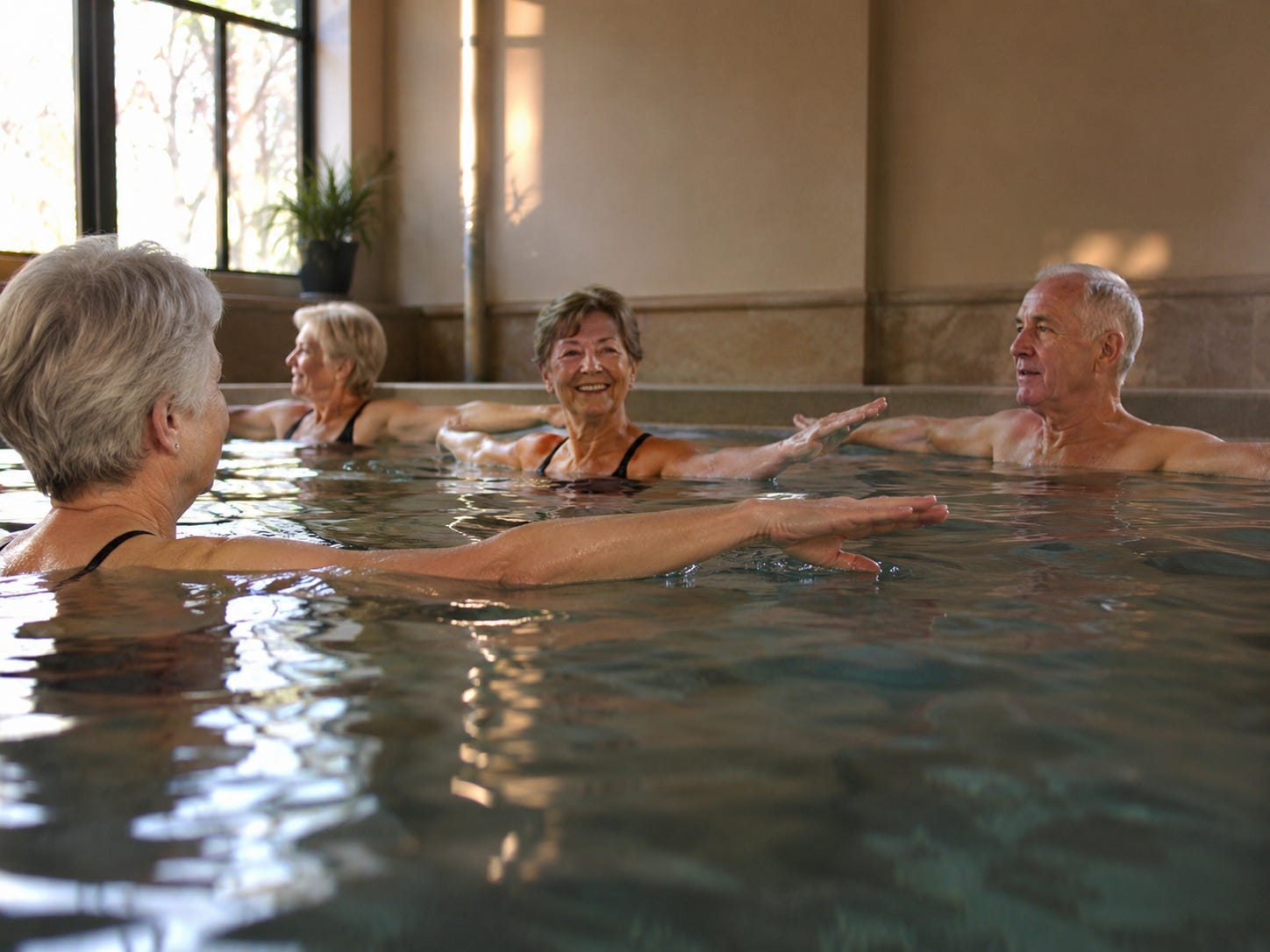
In a shallow-water class, one foot stays on the bottom at all times. You are standing, walking, lifting, reaching, in water somewhere between your waist and your chest, where you can put both feet down and stand up whenever you want. There is no lap, no deep end, and no moment where anyone expects you to put your face in.
If you cannot swim a stroke, you can still do the class.
Being frightened of water is a different thing from not being able to swim — and it deserves a different answer. That fear usually lives in two specific places: being out of your depth, and having water near your face. A shallow class removes both of them by design. You are in the same three or four feet for the whole hour, standing up, with the surface at chest height and the edge of the pool a few steps away in any direction.
The first five minutes are the whole negotiation. You walk down the steps, the water reaches your knees, then your waist, and then your chest, and the weight goes out of your legs. That is usually the part people are surprised by, rather than anything that happens in the next fifty-five minutes.
What an hour actually looks like
A typical class runs about an hour, and it is more ordinary than you are probably imagining.
Ten or fifteen minutes of warm-up — walking through the water, easy arm movements, letting your shoulders drop. Then forty minutes or so of the work itself: water walking forward and backward, leg lifts to the side, arm curls against the resistance of the water, sometimes a foam noodle or a kickboard used as something to push against. Then a short cooldown.
There is usually music. There is usually chatting. Nobody is timing you.
The resistance comes from the water, which pushes back harder the faster you move through it. The class adjusts to you automatically, without anyone setting a machine or writing a number on a card. You go at the speed your body agrees to, and the water gives you back exactly that much work.
Programs built for painful joints go further and use a warm pool, noticeably warmer than one meant for lap swimming. The arthritis-specific ones usually run two or three times a week for six to ten weeks, with an instructor trained for stiff joints rather than for fitness. Warm water loosens a joint before you have asked anything of it, for the same reason a hot shower helps a bad shoulder.
What weeks of this do, and what they do not
The largest review of the evidence pooled thirteen randomized trials covering 1,190 people with knee or hip osteoarthritis. On a hundred-point scale, the people who did aquatic exercise reported pain about five points lower than the people who did not, and quality of life about seven points higher, measured right at the end of a course of up to twelve weeks.
Five points. Twelve weeks of classes, in a joint carrying half the load.
If that sounds underwhelming next to fifty-six percent, it should.
The trials run for twelve weeks and then stop measuring. Whether the improvement lasts, nobody has established — the review says plainly that no long-term effects have been documented, and points at adherence as one likely reason why. People finish the course. The course was the thing getting them into the water. They stop.
So the honest reading is not that water exercise barely works. It is that twelve weeks of almost anything, measured the week it ends, moves a pain score a little. What a trial cannot capture is the difference between a person who found something they will still be doing in four years and a person who did not.
Your cartilage does not grow back, and the joint that hurt in June will still be the joint you have in October. What is on offer is a way of moving that your joint will accept during the years when the alternatives have started to hurt — and nearly all of its value sits in whether you keep going.
Which turns the question from whether it works into what makes a person keep showing up — and that one has a clearer answer.
The half of it that has nothing to do with water
A video does not notice when you skip it, and a physical therapist notices for six weeks and then the referral ends. A program you put together for yourself notices nothing at all — which is usually the one that has quietly stopped happening by November.
A class of the same dozen people, twice a week, in a pool where everyone got in slowly and for the same reasons — that notices. You end up with a standing appointment, a couple of names, and a reason to put the suit in the bag on a morning when your hip has opinions.
Which is why I would steer you toward a class rather than toward going to the pool on your own to move around a bit. The self-directed version is cheaper, more flexible, and available whenever you like. Whenever you like turns into eventually.
If joint pain has already been shrinking your week — and I have written before about how quietly pain reorganizes a life — a standing hour with people who expect you pushes back on that.
What kept my father in the water
My father swam as a young man. Then he did not, for decades.
A few years ago he started again, with a friend. They went together.
The friend lasted a few months. My father is still going, twice a week.
I keep coming back to that gap. Something got him into the water, and something different kept him there. When my father talks about swimming now, he does not mention his joints, or his heart, or how many lengths he does. He says it relaxes him.
Company is very good at getting a person through the door the first six times. After that, what holds them is usually smaller and more private — an hour that belongs to them, in a building where nobody needs anything from them.
So the class is the on-ramp, and you do not have to have found your reason before you go.
The part that keeps people out, and it is not the exercise
The hardest part of water exercise happens before you reach the water.
It is the swimsuit, the changing room with the wet floor and the small locker and the bench you have to sit on to get your foot into the leg hole, the walk from there to the water across open tile in front of people, and the ladder, if the pool has a ladder, and whether your shoulders and knees will manage it with an audience.
None of that is silly. It is a real set of obstacles sitting in front of a real benefit, and advice that treats them as small is advice nobody can use.
Two things are worth knowing, from the people who run these classes and the people who go to them.
The exposed part is short. The water covers you within about four steps, it happens at the very beginning, and it is over the moment you are in. The dread belongs to the walk across the tile, and it does not follow you into the water.
You will not be the only one. An arthritis water class is not a room of swimmers. It is a room of people whose knees hurt, and half of them arrived with the worry you have.
And if the changing room is the real barrier, wear the suit under your clothes and bring a robe. Every regular I read about had arrived at that independently.
September is the month the pools fill up again
Programs run in blocks, and the blocks restart now. Summer schedules wind down, fall sessions open, and the six-to-ten-week courses begin, which means that for the next few weeks there are places in classes that will be full by November. A class you join now also has the fall to settle into a habit, before the weather starts making a case for staying home.
Three kinds of places tend to run them: public and municipal pools, gyms and sports centers with a pool, and hospital or clinic rehabilitation pools, which often have the gentlest classes and sometimes the cheapest.
Before you decide it is out of reach on price, find out rather than assume. Depending on where you live, some or all of this may already be covered — by the public health system, by an insurance policy, or by a fitness benefit attached to a plan you are already paying for. Rehabilitation pools frequently charge by the session rather than by the month, which is a cheaper way to discover whether you like it at all.
Four questions worth asking when you call. What is the water temperature. Is there a class specifically for arthritis or joint pain. Do you get in by ladder, by steps, or by ramp. And can you come and watch one before you commit — most places will say yes, and watching from the side with your clothes on is a much smaller ask than showing up in a swimsuit on faith.
If you have a heart condition, an open wound, an infection, or you have been told to stay out of pools for any reason, ask your doctor first. I am not your doctor. I am someone who went looking at the evidence and found it more solid than I expected.
If there is no pool where you live
For a fair number of you there is no pool within a reasonable drive, and I would rather say so than write as though everyone has a pool down the road.
The principle still transfers, because the principle is load, not water. A recumbent bike puts almost nothing through the knee. Seated leg work does the same. So does anything done lying down. None of it gives you the warmth, and none of it gives you the dozen people who notice when you are gone, which are two of the better reasons the pool works.
But if the choice is between a pool you cannot get to and a stationary bike in the spare room, take the bike, and put it somewhere you will trip over it.
The thing your knee is actually asking for
If walking has started to cost you something, the temptation is to read that as the beginning of the end of moving.
There is a room in most towns where your body weighs a fraction of what it weighs everywhere else, where the resistance shapes itself to whatever you brought that day, and where nobody can see you below the shoulders. For an hour, the argument you have been having with your knee since spring is simply not happening.
My father did not go back to the water because of anything in this article. He went because somebody asked him to come along. Whatever he gets out of it now, he found after he was already going.
You do not have to be good at it — and you do not have to enjoy the first ten minutes.
You are allowed to go and just stand in the water and see what your body says.
A class you can get to is worth more than a perfect plan you can’t — and that idea is most of what the Sunday posts are about this month. September’s theme is stability: how the shape of an ordinary day holds together when the things that used to structure it are gone. Those Sundays are for Plus members, $10 a month or $97 for the year, and you can cancel in two clicks. Tuesdays and Fridays stay free either way.
Sources
Joint load measured in water: Kutzner I, et al. Does aquatic exercise reduce hip and knee joint loading? In vivo load measurements with instrumented implants. PLOS ONE, 2017.
Evidence review: Bartels EM, et al. Aquatic exercise for the treatment of knee and hip osteoarthritis. Cochrane Database of Systematic Reviews, 2016.


I live that success. I'm 68 and have done water exercise for 7 years. I have osteoarthritis in a knee and hip and degenerative disc disease in my spine at L5S1. It keeps me lubricated, active, strong, my weight is stable and I've met some wonderful people.