



A name won’t come to you in the middle of a conversation. You know the person, remember where you met, perhaps even what you talked about last time. But the name refuses to appear.
Three hours later, while doing something completely unrelated, there it is.
This happens sometimes to my mom, who’s 80. She’ll be trying to remember a name or a particular word, and it simply won’t come to her. Then, later, she’ll remember it.
It made me curious about what actually happens to memory as we get older. Which changes are simply part of aging? Which ones deserve attention? And is there anything useful we can do about everyday forgetfulness?
So I started looking into the research.
One of the most useful things I learned was that we use the word memory for several different jobs our brains do. And understanding which job is giving us trouble can change how we respond.
Sometimes the problem isn’t forgetting
Think about the last time you put your keys down while talking on the phone.
You finish the call, reach for your keys, and realize you have no idea where they are.
It feels as though you’ve forgotten where you put them. But there’s another possibility: you never paid enough attention to their location to form a clear memory in the first place.
Remembering depends partly on what happens at the beginning, when information comes in. If your attention is divided, the information may not be stored well enough to retrieve later.
That’s different from knowing something and having trouble bringing it to mind.
Consider the name that refuses to arrive during a conversation. You recognize the person. You know things about them. You simply can’t retrieve the name at that moment.
Or think about remembering to do something later: picking up a prescription, making a phone call, bringing a document to an appointment. Here, the challenge is remembering an intention at the right time.
These experiences may feel similar because the result is the same — something you wanted to remember isn’t available when you need it. But they don’t all call for the same solution.
And some changes in attention and recall are common as we get older, as the National Institute on Aging explains.
Three everyday problems, three different approaches
Let’s start with the keys.
If the difficulty is remembering where you put something, the simplest answer is often to stop making your brain remember a new location every time.
Choose one place for the keys, glasses or wallet. Somewhere convenient enough that you’ll actually use it. Then put the object there consistently.
At first, you’ll still have to remind yourself. Eventually, the goal is for putting it away to become part of the routine.
You can also give the action your attention for a second. When you set down the keys, notice where your hand is. There’s no need for a complicated technique. Just stop doing it entirely on autopilot.
Now consider the name that won’t come.
Trying harder doesn’t always help. Sometimes the word arrives later, after you’ve stopped searching for it. When meeting someone new, paying attention to their name, repeating it naturally and connecting it to something meaningful may help you remember it.
But if you’re talking about a name you already know and can’t retrieve in the moment, you don’t need to turn the conversation into a test. You can carry on and let it come back.
The third problem is remembering something you need to do later.
This is where a dependable outside reminder can be more useful than any attempt to improve your recall.
Suppose you need to take a document to the doctor next Thursday. Writing doctor’s appointment on the calendar isn’t enough if the document remains on your desk.
Instead, connect the reminder to the moment when you’ll need to act. Put a note where you’ll see it before leaving, or set a phone reminder for the evening before the appointment. If appropriate, place the document with the things you normally take out of the house.
The important detail is that the reminder should appear when it’s useful, not simply exist somewhere on a list.
None of these strategies promises to prevent cognitive decline. They’re ways to reduce everyday friction. And they’re valuable even when your memory is working perfectly well.
How do you know when it’s more than an ordinary lapse?
Understanding attention and reminders is helpful, but it doesn’t answer every question.
There are changes that deserve a doctor’s attention, and the distinction isn’t simply how often you forget someone’s name.
The National Institute on Aging distinguishes occasional age-related forgetfulness from difficulties that begin to interfere with daily life.
For example, forgetting an appointment occasionally is different from repeatedly struggling to manage a schedule you’ve always handled. Taking longer to remember a word is different from having increasing difficulty following or participating in familiar conversations.
And misplacing your keys is different from becoming lost in a place you know well.
Three questions are particularly useful:
Has something changed from what’s usual for me? Someone who has always struggled with names is in a different situation from someone who suddenly finds familiar names increasingly difficult.
Is it beginning to affect things I normally manage? Think about paying bills, following familiar instructions, keeping appointments, using everyday objects or finding your way around.
Is it happening repeatedly, or becoming more noticeable? One lapse rarely tells the whole story. A continuing change deserves attention.
These questions aren’t a home screening test, and you don’t need to answer yes to all three to seek advice. If your memory is worrying you, make an appointment with your doctor.
If confusion or memory loss starts suddenly, seek emergency medical care immediately. Don’t wait to see whether it happens again.
There may be more than one explanation
Another reason not to draw conclusions from a few memory lapses is that memory is affected by much more than age.
Sleep is one example. When you haven’t slept well, concentration can suffer, making it harder to take in information and remember it later.
Stress, anxiety and depression can affect attention and thinking. Certain medications can contribute to memory difficulties or confusion. A doctor may also consider medical causes such as low vitamin B12 or thyroid problems.
Some causes are treatable. Others require further assessment. The important thing is not to decide for yourself which explanation fits.
If you’ve noticed a change, it helps to tell your doctor about the wider circumstances. Have you started a new medication? Has your sleep changed? Have you been feeling unusually low or anxious? Has someone close to you noticed a difference?
Don’t stop or change a prescribed medicine without medical advice.
One useful thing to try this week
Choose one everyday memory frustration. Just one.
Perhaps you’re always looking for your glasses. Perhaps appointments are getting harder to keep straight, or you often remember something you meant to do only after it’s too late.
For the next week, pay attention to when the difficulty happens.
If it’s an object you lose, notice where you tend to put it and choose a permanent home.
If it’s something you must do later, ask whether your reminder appears at the moment you need it. A note buried in a notebook is less useful than one you’ll see at the right time.
If you’re worried about a change in your memory, write down a few specific examples, including when they happened and how they affected your day, and arrange to discuss them with your doctor.
The aim isn’t to monitor every lapse or measure how well your brain is performing. It’s to make one situation easier, or to have clearer information for a conversation with a healthcare professional.
Sometimes a small practical adjustment is all you need for an everyday frustration. Other times, what you need is an answer that a reminder or a better routine can’t provide.
Knowing the difference matters.
Why we put together a new guide
The trouble with memory advice is that it often stops just where the real questions begin.
You read that forgetting a name occasionally is normal. But what if it’s someone you know well? You hear that keeping your mind active is good for you. But do puzzles or memory apps actually help? And if you decide to speak with your doctor, what should you say, and what happens next?
These are the questions behind our new guide, Is This Normal? A Guide to Memory After 60.
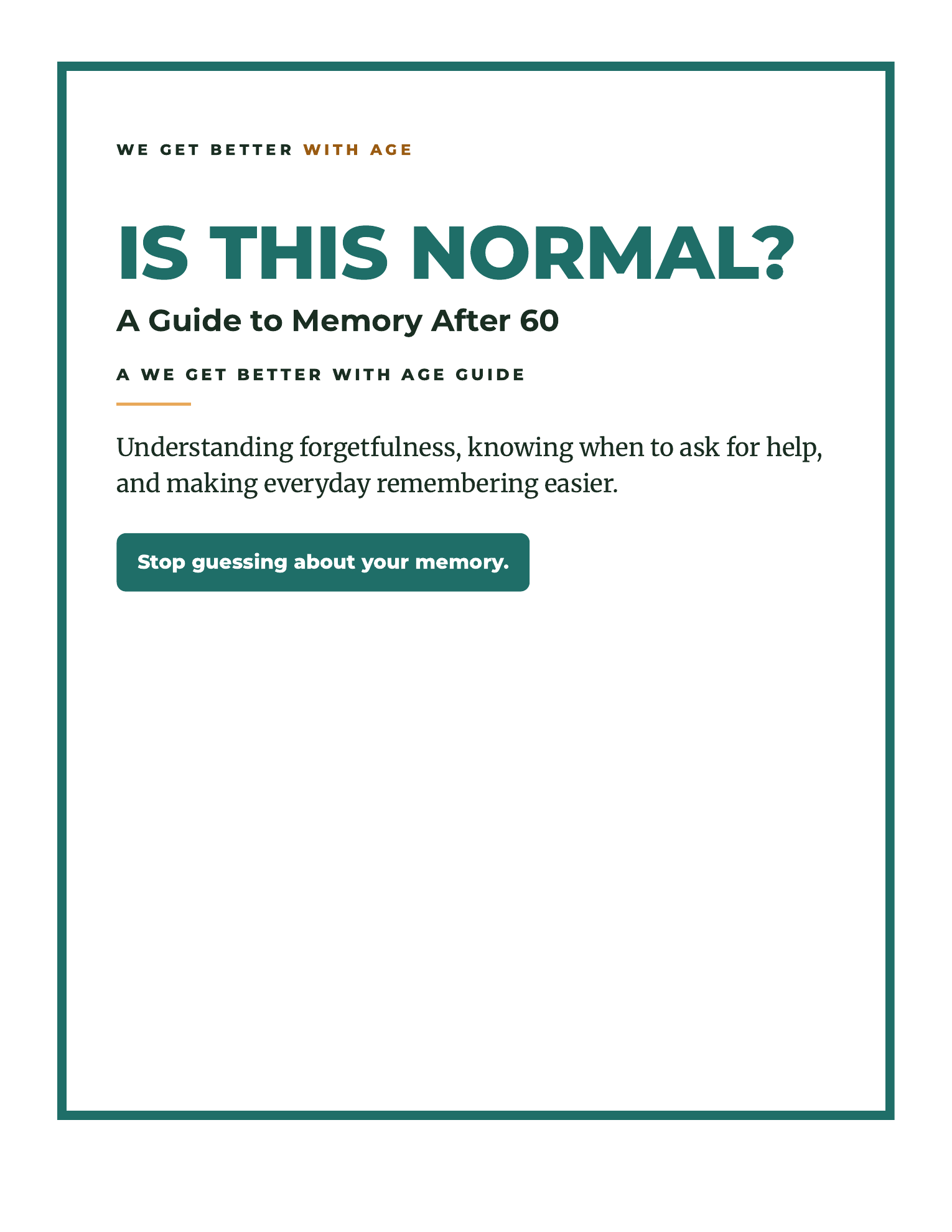
We wanted to put the answers in one place, written plainly, with the research behind them and practical ideas you can actually use.
If you’re tired of hunting for your glasses, you’ll find ways to make those small moments less frustrating. If you’ve begun noticing changes that concern you, you’ll understand which patterns deserve attention and how to describe them to your doctor.
If someone you love is having memory difficulties, you’ll find guidance on how to bring up the subject without making an already sensitive conversation harder.
And if you’re wondering whether you should be taking a supplement, doing more puzzles, or trying a brain-training app, you’ll find a clear look at what the evidence supports — and what it doesn’t.
The guide also helps you prepare for a doctor’s appointment, with questions to ask, things to bring, and an explanation of what an assessment may involve.
There are 17 short chapters, organized so you can go straight to the question that matters to you. We’ve included printable reference pages and checklists, too, because useful information shouldn’t disappear the moment you close a book.
Our hope is that you’ll come away with a better understanding of your memory, a few practical changes that make your days easier, and a clearer idea of when to ask for professional help.
It won’t diagnose a problem or promise to prevent dementia. What it offers is something more grounded: reliable information, practical tools, and a way to approach your questions without having to guess.
PS — If your subscription includes Plus + All Guides, this guide is already yours: you can read it or download it from this page. If it doesn't yet, you can upgrade there too.
You don’t need to wait until you’re seriously worried to take an interest in your memory. And you don’t have to interpret every forgotten name as a warning. There is plenty worth understanding in between.
Great information!
Information Retrieval seems to be a common propblem. You know it's in there, but can't surface it.
For me anything that is out of sight is indeed out of mind. I use physical cues to help me remember things. Stuff everyone else does I’m sure. Have to mail something at the Post Office, keep it at the door (kind of like what you mentioned).
I may take it a step further because I hate to look for things, so I have a habit of putting things back exactly where they were. An item in the refrigerator or the pantry, for example. I use it and return it to the exact shelf and spot from whence it came.
Less daily friction.