What Happened When Retirees Went Back to Kindergarten
In 2015, a team at Johns Hopkins published a study about volunteering that reads more like a study about brains.
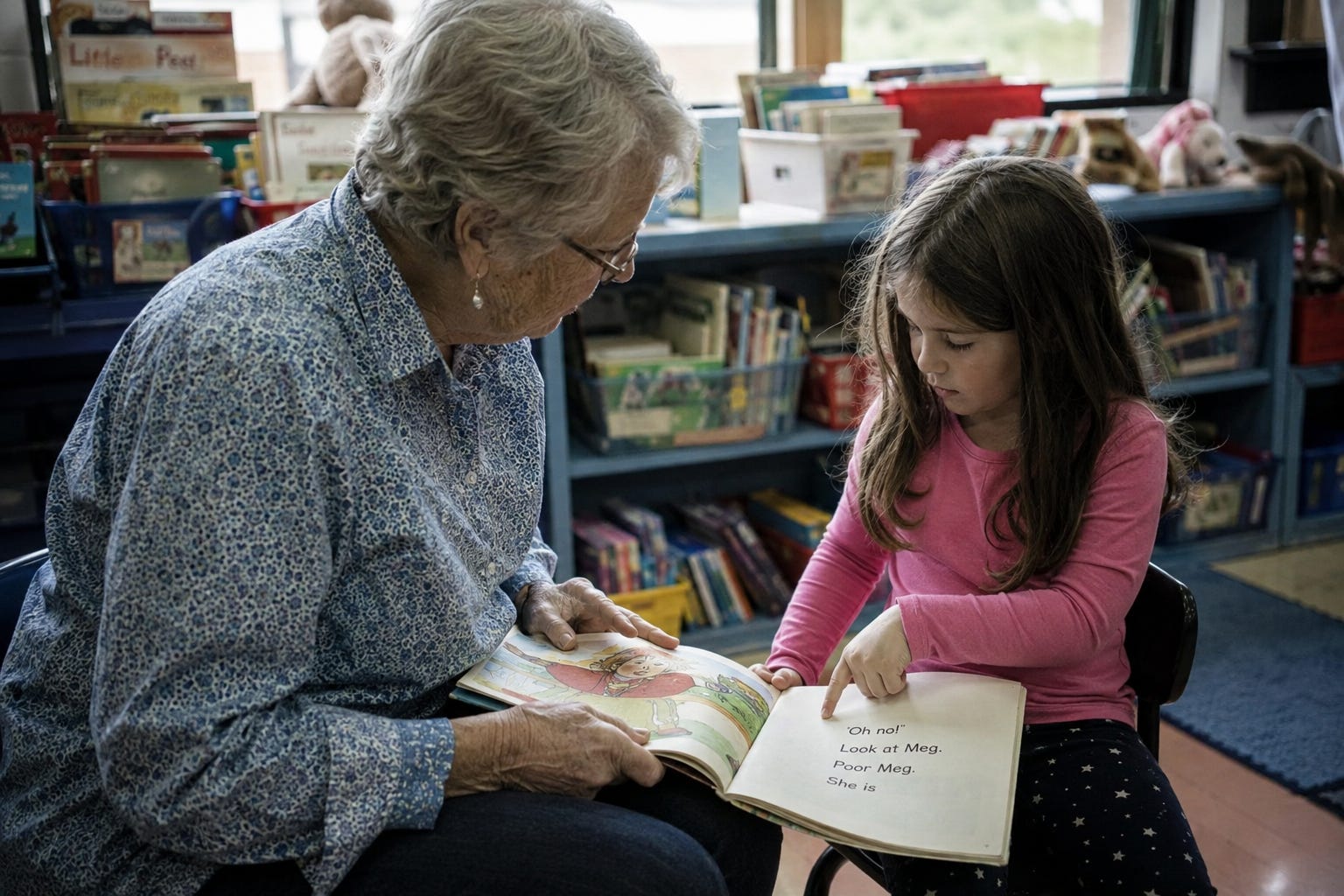
They took 111 people, average age sixty-seven, and drew lots. Half were placed in Baltimore public schools for fifteen hours a week, helping children learn to read in libraries that were short-staffed. The other half went on with their lives as they were. Everyone had their brain scanned at the start, again after a year, and again after two.
The people who stayed home had brains that did the ordinary thing. They shrank. Past sixty-five, that runs somewhere between 0.8 and 2 percent a year, and it happens to everyone.
The men in the schools went the other way. Their brain volume rose — between 0.7 and 1.6 percent over the two years, in the regions that go first in Alzheimer’s disease. The women in the program held roughly level, with small gains that didn’t reach statistical significance, against a decline of about 1 percent in the group that stayed home. And the people whose volumes rose the most were the same people whose memory scores rose the most.
It isn’t a promise. It’s 111 people, one city, one program, and the clean result showed up in half the sample. But it’s a strange enough finding to sit with, because the thing being tested wasn’t a drug or a puzzle book. It was a Tuesday morning in a school library.
The reason you keep saying no
You have seen the notice. In the church bulletin, on the corkboard at the library, in the mail from the hospital auxiliary. Volunteers needed.
And what happens next isn’t reluctance. It’s arithmetic.
Because the ask, as written, has no edges. It doesn’t say how many hours. It doesn’t say for how long. It doesn’t say what happens when your daughter visits, or when your knee flares up in February, or when you decide four months in that you’d rather not. So your mind does the sensible thing and prices it at the maximum: this could take over my week, and I’d have no way out that doesn’t make me the person who quit.
That is a completely reasonable read of an unbounded request. Saying no to it isn’t selfishness, and it isn’t a sign you’ve stopped caring about anything.
It just means the ask never came with a number attached.
The number that makes it smaller
Here it is, and it’s smaller than you think.
Researchers at Harvard tracked nearly 13,000 American adults over fifty for four years, looking at thirty-four different health and well-being outcomes. The line that mattered came at 100 hours a year. That’s about two hours a week.
People clearing that threshold had lower mortality risk over the follow-up period, fewer limitations in physical functioning, and more physical activity. They also had higher positive mood, more optimism, a stronger sense of purpose — and lower rates of depressive symptoms, hopelessness, and loneliness.
Two hours a week. One morning, or two afternoons that end before lunch.
I want to be careful here, because the same study is worth reading for what it did not find. Volunteering showed no association with diabetes, with hypertension, or with a list of other physical conditions. It is not a treatment. Nobody in that data set volunteered their way out of a diagnosis, and any article that tells you otherwise is selling something.
What it did move were the things that make a life feel livable: mood, purpose, activity, and the ache of being alone too much.
What it appears to do to an aging brain
The brain findings come from a different direction, and they’re worth knowing with their limits attached.
A team at UC Davis looked at 2,476 older adults, average age seventy-four, from two large and unusually diverse California studies. Forty-three percent had volunteered in the past year. Those who had scored better on tests of executive function — planning, focus, switching between tasks — and on verbal episodic memory, which is the kind you use to recall a conversation from Thursday. The people volunteering several times a week had the strongest executive function scores of all.
Now the limits. That study is observational, which means it can’t rule out that sharper people simply volunteer more. And when the researchers looked at decline over time, they saw a trend in the right direction that didn’t reach statistical significance. So: strongly suggestive, not settled.
But it lines up with the Baltimore trial, which was a randomized experiment and therefore harder to explain away. And Rachel Whitmer, who led the UC Davis work, put the practical point better than I could: “You’re not in control of your family history or age — you can’t turn back the clock. But you are in control of how you spend your day and life.”
It isn’t the good deed. It’s the learning.
Michelle Carlson, who led the Baltimore study, was asked why a school library would do anything for a sixty-seven-year-old brain. Her answer was not about virtue:
“We’re not training them on one skill, like doing crossword puzzles. We’re embedding complexity and novelty into their daily lives, something that tends to disappear once people retire.”
Look at what those mornings actually required. Getting out of bed at a fixed hour. Walking to the bus. Stairs. A room full of six-year-olds, which is a problem-solving environment of the highest order. A curriculum to learn. Other adults to coordinate with. Being needed by someone at ten in the morning on a specific day, whether or not you felt like it.
That is a demanding, novel, social, scheduled activity — which happens to be the exact recipe the research keeps pointing to for a brain that stays engaged. Volunteering just puts it inside something that looks like helping, so nobody calls it brain training.
She added something I keep coming back to: the ingredients that do a person good at five, at twenty-five, at thirty-five are the same ones that do it later. Her words for them were “contact with others, meaningful work.”
Not different ingredients. The same ones, still available.
Finding the one that fits
So the question isn’t whether to volunteer. It’s which, and how much, and how to leave if it’s wrong.
Three questions do most of the sorting.
Who do you want to be in a room with? Children, teenagers, animals, plants, adults in trouble, adults having a nice time, or nobody at all. Be honest about this one before you’re honest about anything else. A person who finds small children exhausting will not last a month as a reading tutor, and there is no virtue in choosing the version that drains you.
What do you want to get better at? This is the question most people skip, and it’s the one the research points at. If the role asks nothing new of you — if it’s a thing your hands already know — you’ll get the company and the schedule, which are worth having, but not the part that grew those brains in Baltimore. Look for something with a learning curve you can see from the outside.
What can you hold on a bad week? Not your best week. The week your back hurts and someone’s in the hospital and the car needs looking at. Whatever number survives that test is your real number, and two hours is a completely respectable answer.
Then, where to look. Local is easier than national:
The school district’s volunteer coordinator. Reading tutors, library help, lunch programs. This is the Experience Corps model, and most districts run some version of it.
The public library. Literacy programs, tech help desks for people who need a hand with a phone, book sales, homebound delivery.
Meals on Wheels or the local food bank. The driving routes come with conversation built in, which is half the point.
Hospital auxiliaries, museums, historical societies, animal shelters, botanical gardens. Docent work is the sleeper here — you have to learn a body of material and then explain it to strangers, which is about as good a cognitive workout as exists outside a classroom.
Your Area Agency on Aging or senior center, which keeps a list of what’s actually short-handed nearby.
AmeriCorps Seniors runs three national programs for people 55 and over — Foster Grandparents, Senior Companions, and RSVP — and some roles come with a modest stipend. Ask a local sponsor organization; the national website has been in flux this year.
Idealist, which absorbed VolunteerMatch, if you’d rather browse from your kitchen table first.
And one script, which is the most useful sentence in this whole article:
“I can do Tuesday mornings through Thanksgiving. After that, let’s both see how it’s going.”
That sentence turns an unbounded commitment into a trial with a door in it. Any organization worth your time will say yes to it immediately, because they would rather have three reliable months than a year of someone who dreads coming. Ask them, while you’re at it, what the real weekly time comes to — including travel and training. The number in the flyer is usually the optimistic one.
The kind that doesn’t do much
Not all of it works, and pretending otherwise is how people end up quietly disappointed.
Stuffing envelopes alone in a back room is a fine thing to do for an organization and does very little for you. No new learning, no people, no complexity — the three ingredients the Baltimore results turned on. Same with the role that’s just your old job for free, with none of the recognition and all of the aggravation.
Then there’s the opposite failure, which I’ve watched happen to competent people more than once: the volunteer job that expands until it’s a second career without pay or boundaries, because you were the only one who said yes and now you can’t say no. Purpose is supposed to hold up your week. When it starts eating the week, something has gone wrong with the arrangement, not with you.
And if you try one and it isn’t right, you are allowed to stop. Leaving a volunteer role is not a moral failure. It’s information — about the room, the work, or the fit — and the next one starts from a better guess.
What you’re actually being offered
There’s a version of this conversation that runs on guilt. Give back. Stay useful. Don’t be a burden. You’ve probably heard some of it, and it’s worth naming, because it’s the reason the word volunteering makes some people tired before the sentence is finished.
That framing has it backwards. You do not owe anyone proof that you’re still contributing. You are not on trial for the use of your own time.
What the research is describing is a much plainer trade. Somewhere near you is a room that needs a person on Tuesday, and being that person happens to hand you the four things that get scarce after retirement all at once: a reason to be somewhere at a fixed hour, other people who notice whether you came, work that asks you to learn something, and the small ordinary weight of being needed. Structure is the thing that quietly goes first when the working years end, and this is one of the few ways to get it back that doesn’t require inventing it from scratch.
Whether that shows up on a brain scan in your case, nobody can tell you. But two hours a week is not a life-changing sacrifice, and the room is short a person either way.
You could go and look at one. Just look. You are not signing anything.
Sources
Brain volumes in the Baltimore Experience Corps randomized trial: Carlson et al., Impact of the Baltimore Experience Corps Trial on cortical and hippocampal volumes, Alzheimer’s & Dementia, 2015. Michelle Carlson’s comments are from the Johns Hopkins Bloomberg School of Public Health release announcing the study.
The 100-hours-a-year threshold: Kim, Whillans, Lee, Chen and VanderWeele, Volunteering and Subsequent Health and Well-Being in Older Adults, American Journal of Preventive Medicine, 2020. 12,998 adults over 50.
Executive function and episodic memory in volunteers: UC Davis Health, Volunteering in late life may protect the brain against cognitive decline and dementia (Lor et al., KHANDLE and STAR cohorts).
One last thing, then I’ll let you go.
What the Baltimore study kept pointing at was novelty. New material, new people, a demand the brain hadn’t met before — the volunteering was just the container it came in. And that is exactly the question the Sunday posts are working through this month: what keeps a mind engaged as it ages, and how to hand it more of that on purpose, without waiting for a school library to call.
The Sundays are for Plus members, and August runs as one theme from beginning to end rather than five unrelated posts — so joining part-way still gets you the whole arc, from the start. The month’s Fun Pack comes with it: twenty-five puzzles built around the same theme, on any device or printed out if you’d rather use a pen. $10 a month, or $97 for the year.


