


Hi, it’s Diana from We Get Better With Age, and I’m continuing my series on books I’ve read and genuinely enjoyed (you can check them all here).
I first came across Swedish death cleaning while researching our Decluttering & Downsizing guide. I found the name irresistible. Who calls a perfectly sensible approach to sorting through your belongings death cleaning?
The woman behind it was Margareta Magnusson, a Swedish artist who became a bestselling author in her eighties. Her first book, The Gentle Art of Swedish Death Cleaning, is about sorting through the possessions you’ve accumulated over a lifetime, preferably before somebody else has to do it for you.
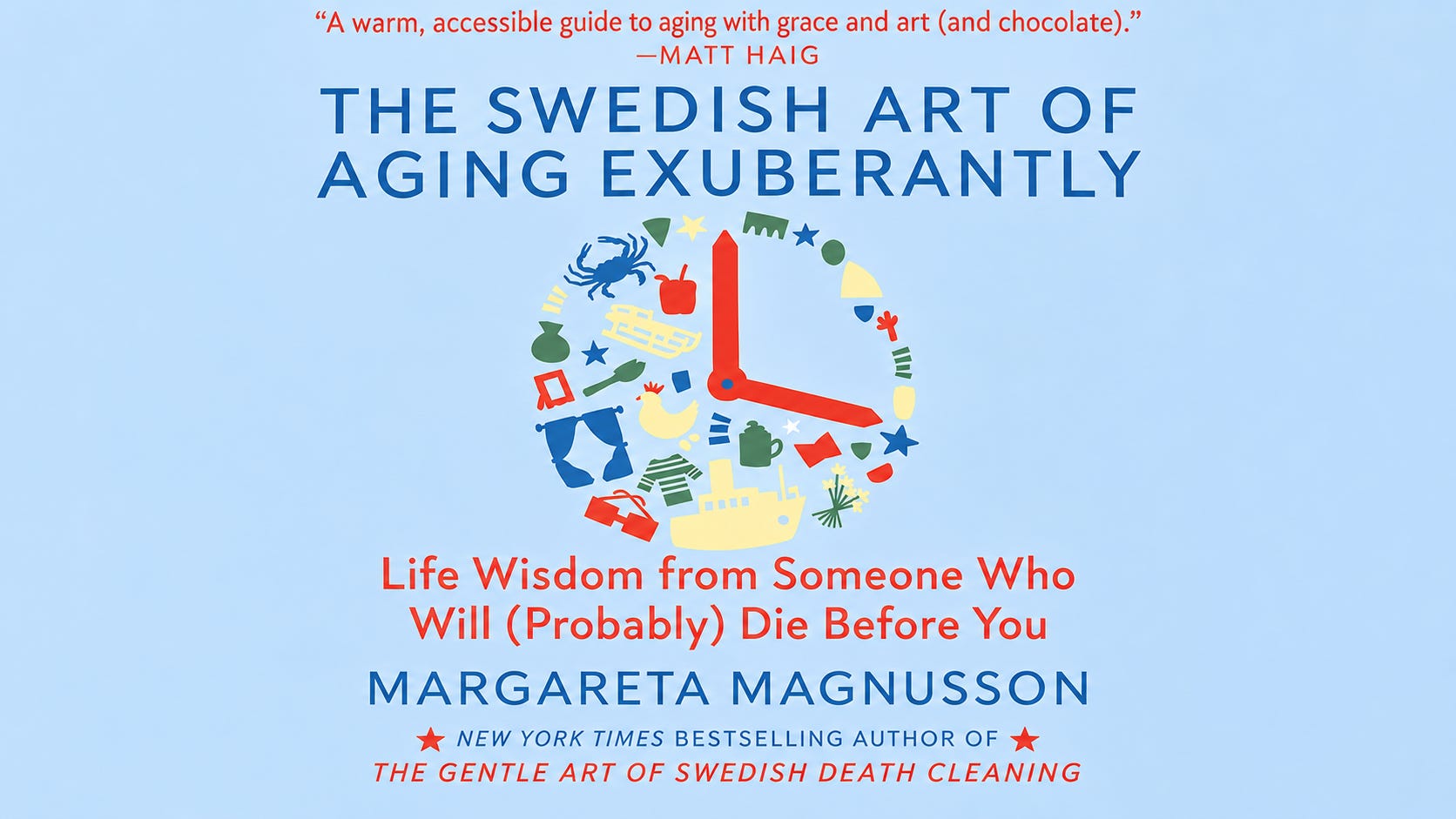
One thing led to another, and I ended up buying her next book, The Swedish Art of Aging Exuberantly: Life Wisdom from Someone Who Will (Probably) Die Before You.
That subtitle alone made me smile. Here was a woman in her late eighties, perfectly aware that she was approaching the end of her life, offering advice about how to enjoy it. Her suggestions included eating chocolate, wearing stripes, keeping up with technology, and having a gin and tonic with a friend.
I wanted to know more.
Margareta Magnusson was born in Gothenburg, Sweden, in 1934. She studied art and design, married, raised five children, and lived in several countries, including the United States, Singapore, and Hong Kong.
By the time she wrote The Swedish Art of Aging Exuberantly, she was a widow, a grandmother, and an internationally successful author. She had also reached an age she hadn’t necessarily expected to see.
In the prologue, written when she was 86, Magnusson remembers that her mother died at 68 and her father at 81. She has outlived both of them, and she’s under no illusions about having another twenty years waiting around the corner.
Yet there’s something wonderfully cheerful about the way she approaches the whole business. Her chapter titles range from Take Care of Your Hair, If You Have Any to Don’t Fall Over and Eat Chocolate.
I particularly enjoyed that last one. Any book offering chocolate as part of its philosophy of aging has at least earned my attention.
But the chapter I kept thinking about was the one involving a gin and tonic.
Margareta and Lola
Magnusson’s best friend was a woman named Lola. They met in Gothenburg when they were eight years old. Lola wore a blue dress with little white dots, had fabulous hair, and apparently knew how to make an entrance. Magnusson remembers wanting to be her friend almost immediately.
They went to school together, grew up, married, had children, and eventually settled in different countries. Lola lived in France, Magnusson in Sweden. Nearly eighty years later, they were still friends.
During the pandemic, when visiting became impossible, they started having their drinks together over WhatsApp.
I love imagining these two women in their late eighties, separated by hundreds of miles, clinking glasses in front of their screens and remembering the days when they were Scouts, went to summer camp, and attended a French language course where they apparently learned rather more about boys than French.
What makes the story particularly charming is how casually Magnusson approaches the technology involved. She wants to see Lola. WhatsApp makes that possible. So she learns to use WhatsApp.
She doesn’t make a great fuss about being an older person learning something new, and I rather like that. These two have cocktails to drink and nearly eight decades of stories to revisit. Of course they’re going to figure out how to make a video call.
There’s a sadder note toward the end of the chapter, when Magnusson admits that sometimes she wonders which of them will be the first not to answer the other’s call. It’s a heartbreaking thought, especially after reading about everything they’ve shared, but she doesn’t linger over it.
I think that’s part of what makes her writing so appealing. She knows perfectly well what’s coming, and she has no intention of spending every remaining afternoon thinking about it. There’s still plenty to talk about with Lola.
Eat the Chocolate
Magnusson is very fond of chocolate. Milk chocolate, specifically, and she doesn’t see why she should pretend to prefer dark chocolate just because somebody has decided it’s the more respectable choice.
She also recommends wearing stripes, which apparently make her feel lively and sporty, and has opinions about hair, clothes, household routines, and the various irritations that accompany growing older.
Some of her suggestions are so ordinary that they’re almost funny. Eat chocolate. Wear clothes you like. Take care of something. Keep in touch with your friends. Hardly revolutionary, I’ll admit, but there’s something appealing about the woman delivering them.
We spend an extraordinary amount of time discussing how to age well. There are books and articles about protecting our brains, improving our balance, sleeping better, eating better, and making sure we stay physically capable for as long as possible. Much of this advice is useful, and I write about these things myself.
Still, I rather enjoy the idea of an 86-year-old woman sitting down to write a book about aging and deciding that chocolate deserves its own chapter.
Magnusson has lived through World War II, raised five children, lost her husband, adapted to life in different countries, and learned to manage alone. She has earned the right to have a few opinions about how she’d like to spend her afternoons.
And if one of those opinions involves milk chocolate, I’m inclined to hear her out.
The World Is Always Ending
This is probably the most unexpected chapter in the book.
Magnusson grew up during World War II and remembers the Cold War, Chernobyl, and a long succession of events that seemed, at the time, to threaten the future of the world. She also remembers belonging to a generation that cheerfully threw plastic into the sea without thinking much about what might happen to it.
Having lived through so much, she’s seen how some of the things people feared never happened, while others turned out to be every bit as serious as predicted.
What I found interesting was that she doesn’t dismiss today’s concerns by talking about how much harder things were in the old days. She’s worried about the environment, recognizes that her own generation made mistakes, and thinks people should do something about the problems they can influence.
At the same time, she has lived long enough to know that you can spend decades worrying about the end of the world and still have to get up the next morning, buy groceries, pay bills, and decide what to have for dinner.
I think there’s considerable wisdom in that. There will always be something frightening in the news, sometimes with very good reason, but worrying about the future doesn’t mean you have to stop enjoying the present.
After all, if you’ve made it through eighty-six years of history, you’ve probably learned that life has a habit of continuing, often in ways nobody expected.
And while you’re figuring out what to do about the latest crisis, there’s nothing wrong with having a little chocolate.
Good Advice, Better Stories
Not every chapter impressed me equally. Some of Magnusson’s recommendations are familiar: volunteer, stay curious, keep an open mind, look after your friendships.
They’re good suggestions, and if you’ve been reading We Get Better With Age for a while, you’ll recognize quite a few of them. I’ve written about these very things myself, more than once. And with good reason. They’re worth repeating.
Still, I occasionally found myself wishing Magnusson would spend less time telling us what to do and more time telling us about her life. Because that’s when the book really comes alive.
I loved reading about her childhood during the war, her adventures living abroad, the complications of raising five children, and the business of getting older in a world that keeps changing its rules. She has a wonderful ability to move from something quite serious to a completely ordinary detail, often with a little joke at her own expense.
She’s also perfectly capable of contradicting herself. She hates change. She loves change. Both sentiments appear in the book, and somehow I believed both.
I certainly recognize the feeling. Some changes are exciting, others are thoroughly inconvenient, and quite a few are things we’d happily avoid if anyone gave us a choice. We adapt anyway, sometimes enthusiastically and sometimes because there isn’t much alternative.
Magnusson seems to understand this better than many authors who insist that we should welcome every new chapter of life with open arms.
I also appreciate that she’s willing to sound like an old woman with strong opinions. She doesn’t try to make every suggestion agreeable to everybody, and she’s certainly not trying to present herself as an example of perfect aging.
She’s lived a long and interesting life, she’s made mistakes, she’s learned a few things, and she has opinions about the rest. You can take them or leave them.
Personally, I found her stories much more persuasive than her advice.
Margareta Magnusson died in March 2026, aged 91.
Knowing that gives the subtitle of this book a rather different weight. She told us she would probably die before us, and for many readers, she was right.
I’ve been thinking about the relationship between her two books. The Gentle Art of Swedish Death Cleaning asks you to look around your home and decide what is worth keeping. The Swedish Art of Aging Exuberantly seems to ask something similar about your life.
Which friendships are worth the effort? Which routines still bring you pleasure? Which worries have occupied far too much space, and what have you been meaning to enjoy while there’s still time?
I like that a woman who became famous for teaching people how to get rid of things followed it with a book about the pleasures worth keeping. And I particularly like that so many of those pleasures are ordinary ones, things that don’t require much money or elaborate plans, just a little attention.
Of all the stories in the book, I keep returning to Magnusson and Lola, two old friends sitting hundreds of miles apart, with their drinks and their memories and their occasionally unreliable internet connection.
They’ve known each other since they were eight years old, and they still have things to talk about.
I think that’s a rather wonderful picture of growing older.
Have you read either of Margareta Magnusson’s books? I’d love to know what you thought. And if there’s a book you’ve particularly enjoyed lately, tell me about that too. I’m always looking for my next read.
Yes, I've read The Gentle Art of Swedish Death Cleaning and bought it. I didn't know about Margareta Magnusson's second book, but I'm looking forward to reading it, too. I'm so sorry to hear of her death and wonder if Lola has out lived her. As a woman who's just turned 80, I think about which childhood friend will leave the chain first. Every day becomes more precious. People (and pets) matter more than things. Margareta Magnusson is a gentle reminder of what matters most in life. And add chocolate to my list, definitely milk chocolate!
I agree with the chocolate, specially, dark chocolate