

The Watch That Calls For Help When You Can't

My father fell in the garage last Tuesday.
Not dramatically. He was reaching for something on a high shelf, the step stool shifted, and he went down sideways onto the concrete. He wasn’t badly hurt — a bruised hip, a scraped forearm, the particular indignity of not being able to get up easily. But the part that stayed with all of us wasn’t the fall.
It was the forty minutes he spent on the floor before anyone knew.
My mother was at the store. His phone was on the kitchen counter, where it always was, doing him no good at all. So he lay there on the cool concrete, working out the geometry of how to get himself up, and when he finally did, he didn’t tell anyone for two days. Because telling us meant something. It meant a conversation he didn’t want to have about what he could and couldn’t do alone anymore.
I understand that instinct completely. And I want to talk about it honestly, because there is a small piece of technology that speaks directly to those forty minutes — and most people dismiss it for exactly the wrong reasons.
The fear underneath the fall
Let’s name the real thing first, because it isn’t the falling.
Plenty of seniors trip, stumble, catch themselves on a doorframe, and laugh it off. The fear that actually lives in the body after a certain age isn’t I might fall. It’s I might fall when no one is there. It’s the bathroom at two in the morning. The garden on a quiet afternoon. The stairs when the house is empty.
That specific fear has a name in the research — it’s sometimes called fear of falling, and studies have found it can be as limiting as a fall itself. People start doing less. They skip the walk, avoid the garden, stop reaching for the high shelf. The world contracts one cautious decision at a time, and the irony is brutal: avoiding movement to stay safe makes you weaker, which makes the next fall more likely, not less.
So when I talk about a watch that detects a fall, I am not talking about a gadget. I’m talking about something aimed precisely at that fear — the one that quietly shrinks a life. And whether or not the device is right for you, the fear deserves to be taken seriously rather than brushed off.
This connects to something I’ve written about before, the question of when a support tool stops being a sign of decline and starts being the thing that keeps you independent. (If you read Do You Really Need a Cane?, this is the same idea wearing different hardware.)
What these watches actually do
Let me demystify the technology, because the marketing makes it sound either magical or sinister, and it’s neither.
Modern smartwatches — the kind made by Apple, Samsung, Google, and a handful of dedicated medical-alert companies — carry tiny motion sensors. The same sensors that count your steps can recognize the specific signature of a hard fall: the sudden acceleration, the impact, the stillness that follows. When the watch detects that pattern, it taps your wrist and asks if you’re okay. If you answer, nothing happens. If you don’t respond within a minute or so — because you’re hurt, or unconscious, or simply can’t reach the screen — it places a call to emergency services and messages the people you’ve chosen, with your location.
That’s the headline feature, but it’s not the only one that matters.
It watches your heart, too. Many of these watches track heart rate continuously and can flag an irregular rhythm — specifically atrial fibrillation, or AFib, a common condition that often produces no symptoms and meaningfully raises stroke risk. The Apple Heart Study, published in The New England Journal of Medicine, followed hundreds of thousands of people and found these watches could identify irregular rhythms that users had no idea they had. That’s not a small thing. A silent rhythm problem caught early is a stroke you may never have.
It can simply be a phone on your wrist. For someone who leaves their phone on the counter the way my father did, a watch that can call, text, and be found by location is, all by itself, a safety net — no falling required.
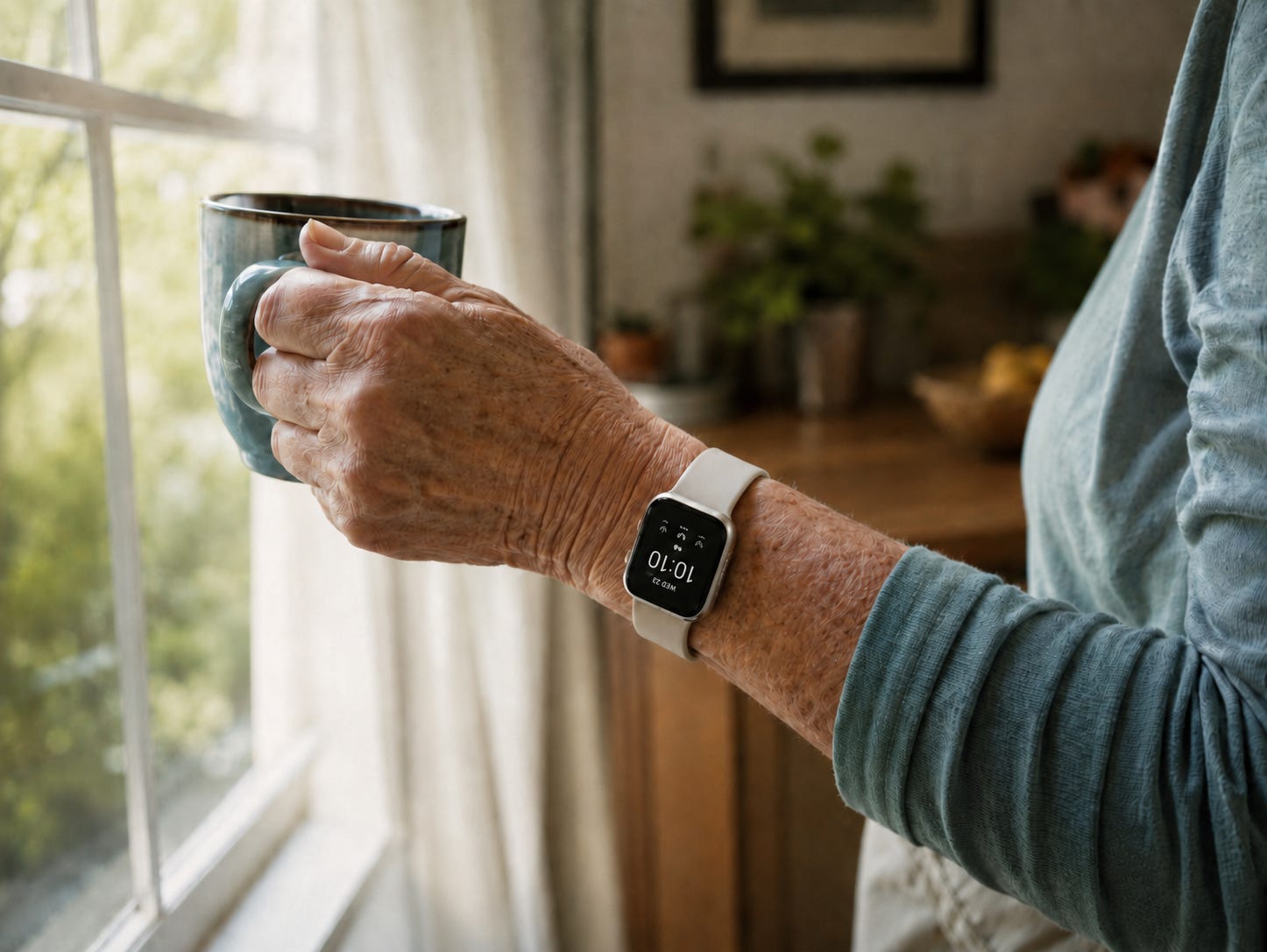
I want to be honest about the limits in the same breath, because the voice that oversells this is the voice you shouldn’t trust.
What they can’t do — said plainly
A fall-detection watch is not a medical device, and it is not a person.
It will miss some falls — a slow slide down a wall doesn’t always register the way a hard impact does. It will also sound false alarms — a dropped arm, a hard clap, a vigorous gardening session can occasionally trick it. The heart-rhythm feature flags possible problems; it does not diagnose, and it is not a replacement for a doctor looking at a proper reading. And none of it works if the watch is dead on the charger, which means there’s a daily habit to build that not everyone wants to build.
There is also a real conversation to have about privacy and comfort — wearing something that knows where you are and how your body is doing. For some people that feels like care. For others it feels like surveillance. Both reactions are legitimate, and the answer isn’t the same for everyone.
So this is not me telling you to go buy one. It’s me telling you it exists, what it honestly does and doesn’t do, and how to think clearly about whether it belongs in your life or someone else’s. The research validates the why; the decision is still yours.
A framework for deciding (for yourself, or someone you love)
When my family finally talked about my father and the garage, what helped wasn’t a sales pitch. It was three honest questions. I’ll give them to you the same way.
One: Is the risk real, or is it anxiety?
Be specific, not catastrophic. Has there actually been a fall, a near-fall, a dizzy spell, a diagnosed heart or balance condition? Does this person spend real stretches of time alone? About one in four adults over 65 falls each year, according to the CDC, and falls are the leading cause of injury for that age group — so the risk is not imaginary. But there’s a difference between a genuine pattern and a worried child projecting fear onto a perfectly steady parent. Name the actual risk. If it’s real, this is a reasonable tool. If it’s anxiety, the watch won’t fix that — and may insult someone who’s doing fine.
Two: Will it actually get worn?
The best safety device is the one on the wrist, not in the drawer. This is where most of these efforts quietly fail. If the person finds the watch fussy, ugly, confusing, or infantilizing, it will end up uncharged in a bedside drawer within a month. So the conversation matters more than the hardware. A watch chosen with someone, framed as their decision, in a style they actually like, gets worn. A watch imposed on someone as proof you think they’re declining gets resented and abandoned. The technology is the easy part. The respect is the whole thing.
Three: Whose peace of mind is this for?
This one’s worth sitting with. Sometimes a device like this is genuinely for the wearer — it lets them keep gardening alone, traveling, living in their own home with less fear. That’s the good version. Sometimes, though, it’s really for the adult child who wants to feel less anxious from three states away. That’s not wrong, but it should be named, because a tool sold to a parent as “for your safety” when it’s actually “for my worry” tends to backfire. The honest version — I love you, I worry, would this help either of us breathe easier? — lands very differently than a watch that just shows up in the mail, already decided.
If you’ve ever had the keys conversation with a parent, you already know this terrain. (When It’s Time to Hand Over the Keys is the harder cousin of this exact discussion — the difference is that a watch expands independence instead of removing it, which makes it a much easier yes.)
Enjoying this? Plus members get exclusive Sunday deep-dives, a printable 60-page Fun Pack every month, and full library access. $10/month or $97/year.
The reframe that changed how I see this
For a long time I thought of medical-alert technology as something that came after — after independence ended, after the fall that changed everything, after the line had been crossed. The clunky pendant. The “I’ve fallen and I can’t get up” of a hundred old commercials. Something you accepted when you’d run out of other options.
The research, and honestly my own father, reframed it for me completely.
A safety net is not what you reach for after you’ve fallen. It’s what lets you keep climbing. Acrobats don’t use a net because they expect to fall — they use it because the net is what makes the daring possible. The net is why they can try the harder thing.
That’s the whole reframe. A watch that can call for help is not a white flag. It’s the opposite. It’s what might let my father keep reaching for the high shelf, keep puttering in the garage alone on a Tuesday, keep living the unsupervised, ordinary, self-directed life he is absolutely entitled to — with one quiet assurance running in the background, so that forty minutes on the concrete never happens again.
Independence and a safety net are not opposites. We’ve been taught to feel that they are — that accepting help means admitting defeat — and it simply isn’t true. The most independent thing you can do is build the structure that lets you stay independent. A handrail is not surrender. A buddy who knows your schedule is not surrendering. And a small computer on your wrist that can summon help when you can’t is not surrender either.
It’s just a net. And a net is what lets you keep doing the high-wire act of an ordinary, autonomous life.
So, where to start
If something here landed — for yourself, or for someone whose forty-minutes-on-the-floor you’d do anything to prevent — you don’t have to solve it today. You’re allowed to just sit with it.
But if you want a first step, it’s smaller than buying anything. It’s a conversation. Not you’re getting old and I’m worried, but I read about something, and I’m curious whether it would let either of us relax a little. Look at one or two options together. Notice whether the resistance is about the technology or about what the technology seems to say. Usually it’s the second thing — and that’s the part worth talking about gently, because underneath the I don’t need that is almost always I’m not ready to be someone who needs that.
You are allowed to need a net and still be the acrobat. Those two things have never once been in conflict, no matter how the world has framed it.
My father wears the watch now. He grumbled about it for a week, called it a nuisance, said he didn’t see the point. Then one afternoon he was up a ladder cleaning the gutters — which is a whole other conversation — and he said, almost to himself, “Well, if I come off this thing, at least the dratted watch’ll rat me out.” He was joking. But he was also, in his way, telling me he felt a little freer up there than he had in a year.
That’s the point. Not the falling. The freedom.
Have you navigated this — for yourself or a parent? Did it land as care or as an insult? Reply and tell me. I read every single one.
And if someone came to mind while reading — a parent who leaves their phone on the counter, a friend who lives alone, yourself — share this with them. The comments are open too, if you’d rather say it there.
PS - So, which one should I actually get? This is the question everyone asks next, so let me answer it plainly — by category, not by brand loyalty.
If you already use an iPhone, an Apple Watch does everything I’ve described — fall detection, heart-rhythm alerts, one-tap emergency calls. Two honest catches: it needs charging every day, and for it to call for help when your phone isn’t nearby, you need a model with its own cellular plan, which costs a little extra each month. Without that, it leans on the phone you may have left on the counter.
If you use an Android phone, you’re not left out — a Samsung Galaxy Watch or a Google Pixel Watch covers the same ground, fall detection included. The trap to avoid is buying an Apple Watch for an Android user: the two simply don’t work together.
If there’s no smartphone in the picture at all — and for many people there isn’t, by choice — the better answer is a dedicated medical-alert watch. These connect to a staffed monitoring center, work on their own, and ask nothing of a phone. Less elegant, often more reliable for exactly the person who needs it most.
There is no single right answer. The right one is whichever gets worn every day by the person it’s for. The fanciest watch in a drawer protects no one.
Fantastic, articulate article!!!
Thank you for this important post.
A similar thing happened to myself about 6 weeks ago: had a dizzy spell in my kitchen while preparing supper, fell on the floor and was unable to get up.
My cell phone was in the bedroom and, as I live alone, there was no one else in the house. Nor did I expect anyone for days.
What saved me from perishing on my kitchen floor was my little Nokia 105 retro phone that I wear around my neck under clothing at all times. I call this phone “my 911 phone” and use it as a panic button in emergencies. No other calls, just emergencies. My friends know that, if they get a call from my 911 number, I am in some sort of trouble and they will rush to investigate.
This is what happened now. I speed dialled a friend on my 911 phone, they came quickly, found me on the floor, called paramedics and, thankfully, am by now back on my feet.
Needless to say, for those of us who cannot afford fitbits and other expensive gadgets, I recommend a Nokia 105 wholeheartedly. It is small, lightweight, simple to use and very inexpensive. And does not need to be charged frequently.