


You have been saying the same shoe size for about thirty years.
It comes out of you in a store without a thought, the way your birthday does. Seven and a half. Six. Whatever yours is. You have said it to so many salespeople that it has stopped being a measurement and become a fact about you, like your eye color.
For many women reading this, it's been wrong for a decade.
The foot it describes no longer exists.
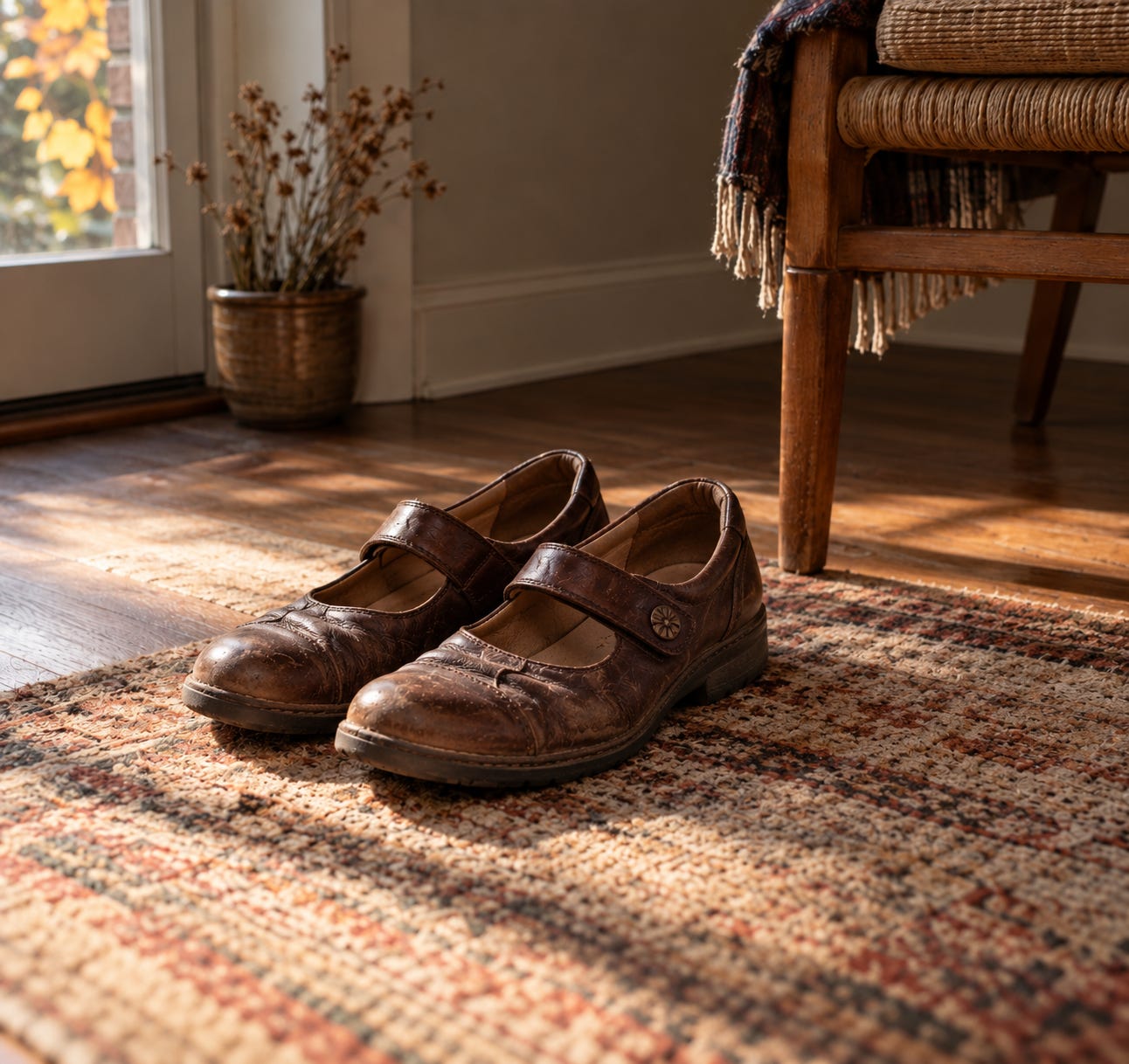
Your foot changed shape
Feet keep changing long after twenty-five.
The arch is held up by soft tissue, and soft tissue gives in slowly under fifty or sixty years of standing, walking, carrying, and being stood on. As the arch lowers, the foot spreads. It gets wider across the ball. It also gets a little longer, because a flatter arch puts more of the foot on the floor.
MedlinePlus, the patient-facing service of the US National Library of Medicine, puts it in six words: feet tend to flatten with age.
At the same time, the padding thins. A cushion of fat sits under the heel and under the ball of the foot, and it wears down with use, which is why a tiled kitchen floor feels harder at seventy than it did at fifty. Same floor. Less padding between you and it.
All this happens gradually. No day marks when your foot changes size, so no moment prompts you to check.
What to look for before anything hurts
Pain comes last. By the time a shoe hurts, it has usually been the wrong shoe for a couple of years.
The earlier signals are duller and easier to explain away:
A callus that keeps coming back in exactly the same place. It marks where the shoe is pressing.
A sock that twists during the day. A sock rotates when the foot is sliding inside the shoe, and a foot slides when the shoe is the wrong shape, even when the length is right.
Toes that look slightly different from each other by evening. Redness on the outside of the little toe, or a pressure groove across the top of another toe.
And the sentence that has done more damage to more feet than any other: they just need breaking in. Leather softens. Width does not appear. A shoe that is too narrow in September is too narrow in March, with a foot squeezed for six months.
In 2020, researchers in Ireland measured the shoes of older adults attending geriatric day services and found that 72% of them were wearing footwear that did not fit correctly on both feet. Only 6% had shoes that fit properly on both.
That was a particular group — people already in contact with health services, so almost certainly worse off than the general population — and the researchers measured length only, not width. They said so themselves. So the number is not a statistic about every woman over seventy.
It is still a striking thing. In a room full of people who were being looked after, almost nobody was wearing shoes that fit.
How to measure your own foot, in about four minutes
You do not need a store for this, and there is an argument for not using one, because a store measures you standing on a cold metal device in the morning while somebody waits.
Do it at home instead, in the evening. Feet swell across the day, and the foot you need shoes for is the evening foot, not the morning one.
Put a piece of paper on a hard floor against a wall. Stand on it with your heel touching the wall, with your weight properly on that foot — not perched, not leaning. Have someone mark the paper at the end of your longest toe if you can; bending over changes how you stand. Then do the other foot, because they are rarely the same, and the bigger one is the one that decides.
Measure heel to mark. Then, when you try shoes on, you want somewhere between a finger’s width and a thumb’s width of room in front of the longest toe.
And press across the widest part of the shoe with your thumb while standing. If the material is under tension there, the shoe is too narrow, whatever the number on the box says.
When the boots come out
Summer shoes forgive a great deal. Sandals, canvas shoes, anything with a strap rather than a seam — a foot that has widened by half a size will sit in those quite happily, and you will never find out.
Then the weather turns, and you put on last year’s boots.
A boot is a rigid box with a zipper. It has no give across the ball, the foot cannot escape upward, and you will be in it for six or seven hours at a time rather than an afternoon. The foot problems of the whole cold season are decided in the first two weeks of wearing closed shoes again, and for most people that is now.
Two things worth doing before you commit to a pair of boots for another winter.
Try them on in the evening, with the thick socks you will actually wear, not the thin ones you have on in the store. A wool sock can take up a quarter of the room you thought you had.
And walk in them on a hard surface, not the carpet the store has thoughtfully laid down. Carpet hides everything.
If last year’s boots were fine but tight by four o’clock, they were not fine.
Check the shoes you already own
Before you buy anything, go and look at what is already in the house. You'll find more pairs than you expect, and you can sort most of them in ten minutes.
Stand each pair on a flat surface and look at it from behind. A shoe that leans inward at the heel has been taking a foot that rolls in, and it will keep doing it, because the shape is worn in now. That pair has done its work.
Turn them over. If one sole is worn smooth under the ball and the other is not, you have been loading one foot harder than the other, which is worth knowing and worth mentioning at your next appointment.
Then press your thumb into the sole at the heel. If it is hard all the way through with no give at all, there is nothing left between your heel bone and the sidewalk, and that pair is now a pair of slippers with laces.
And then there are the actual slippers.
This is the pair almost nobody counts, and in a cold month it is the pair worn for more hours than any other. Most of them are soft-backed, loose, smooth on the sole, and older than anyone wants to admit. A slipper that has flattened at the back and has to be gripped with the toes to stay on changes how you walk across a kitchen floor, and it does it for eight hours a day, every day, from October to March.
If one thing on this list gets replaced this month, make it that one. A slipper with a back, a sole with some grip, and a fit snug enough that your toes do not have a job to do.
When it is not about the shoes
If you have numbness, or patches where the sensation is simply not there, or a burning that arrives at night, no shoe will fix it. The same goes for a sore or a blister that has not healed in a couple of weeks, for a change in the color of a foot, or for swelling on one side and not the other.
Those are worth a conversation with your doctor, and worth it sooner rather than at your next appointment. Reduced sensation matters especially, because a foot that cannot feel pressure cannot warn you that a shoe is doing damage — you lose the very signal this whole article has been asking you to listen to.
Mention it out loud, even though people tend not to talk about their feet.
Feet are private, and that is most of the problem
There is a reason this goes unspoken for so long.
Feet are the part of the body people apologize for. They get hidden in company. Women of every age have been taught that a foot that has spread, has a bunion, or needs a wide fit is a foot that has let itself go—and so the response to a foot changing shape is often to buy the same size again and say nothing.
But a foot that spreads is doing exactly what the research says feet do. It is adjusting after decades of carrying somebody around.
The only real mistake available here is insisting on a number.
Your foot is allowed to be the size it is now. Go and find out what that is.
Two earlier pieces come back to the same slippers. The Twenty Seconds Between Your Bed and the Door is about the walk to the bathroom at night, and the backless pair most people keep by the bed. Why Your Ankles Might Be the Key to Better Balance looks at what happens just above the shoe.
If you’re getting value from my articles and want to support the work, the paid membership is where to do it - learn more about the perks you get as a Plus member.
Excellent info! Never thought about that. Thanks.