
The Last Third of This Book Is the Reason to Read It
Hi, it’s Diana from We Get Better With Age, and I’m continuing my series on books I’ve read and genuinely enjoyed.
I bought this one for my parents and ended up keeping it. They’re both eighty now, and the questions they ask me have changed over the last couple of years. Less about blood pressure. More about whether forgetting a name in the middle of a sentence means something.
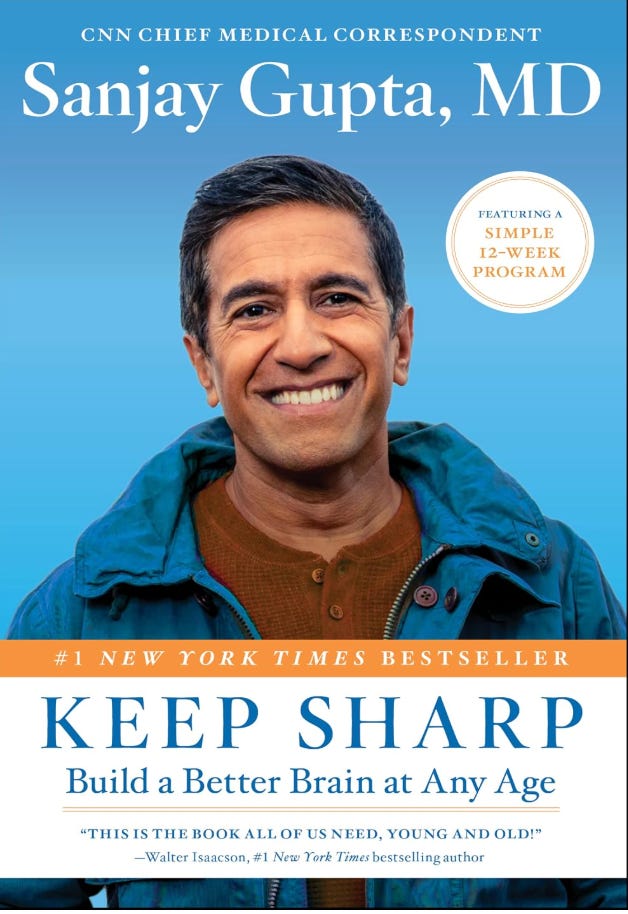
Keep Sharp: Build A Better Brain At Any Age is sold as a program for building a better brain. Five pillars, twelve weeks, a plan you follow. That part is competent and I’ll come to it.
But it isn’t the part I’d press into someone’s hands. The last third of the book is, and it’s the part the book isn’t sold on.
What it is, plainly
Sanjay Gupta is a neurosurgeon. He’s also CNN’s chief medical correspondent and teaches neurosurgery at Emory, which means he writes with one foot in the operating room and one in a television studio — and you can feel both. The explanations are clear in a way that most doctors can’t manage. The structure is a little too tidy in a way that most doctors wouldn’t bother with.
Three hundred and thirty-six pages, in three parts. How the brain works. How to keep it working. What to do when it stops.
The middle part is where the five pillars live: Move, Discover, Relax, Nourish, Connect. Exercise, novelty, sleep, food, people. If you’ve been reading this newsletter for a while, you already know the list, and I’m not going to pretend otherwise — that would be doing you a disservice and doing the book one too.
What the pillars give you that a newsletter can’t is proportion. Reading them side by side, with the evidence for each laid out at the same depth, you get a sense of what carries weight and what’s noise. Movement carries more than people expect. Supplements carry almost nothing, and Gupta is unusually direct about that for a doctor with a television career to protect.
The three things it kills
A brain-health book earns its place by what it removes, not by what it adds. This one removes three things.
That decline is coming for everyone. This is the book’s central argument, and it’s the reason it exists. Gupta spends real time on people in their eighties and nineties with no meaningful slowing — not as inspiration, but as evidence that the standard story is wrong about the average and wrong about the individual. More on them in a moment, because they’re the most interesting thing in the subject.
That there’s a supplement for this. There is an entire industry selling capsules to people frightened of forgetting, and it works because the fear is specific and the product is easy. Gupta goes at it with the evidence rather than the outrage, which is the only approach that ever changes a mind — he takes the claims seriously enough to check them, then reports what checking found. If someone in your life is spending forty dollars a month on brain pills, this is the section to leave open on the kitchen table. It will do more than an argument.
That a crossword is enough. He compares the memory-and-speed games to plain social interaction and doesn’t land where the games industry would like. I’ll leave it there, because that argument gets its own treatment in Sunday’s post and it deserves the room.
The eighty-year-olds with fifty-year-old memories
The people Gupta leans on aren’t anecdotes. They have a research program of their own, and it’s worth knowing about whether or not you read the book.
At Northwestern University’s Mesulam Institute, researchers coined the term as a technical category: SuperAgers are, in their own definition, “adults over age 80 who have the memory capacity of individuals who are at least three decades younger.” Eighty-two years old, remembering like a fifty-year-old. The program started in the 1990s after an autopsy on an eighty-one-year-old woman with an exceptional memory and almost none of the damage her age would predict.
Their stated reason for studying them is the sentence I’d put on the wall: to understand “what is going right with aging, as opposed to what is going wrong.”
What they’ve found inside those heads is genuinely odd. The cortex — the outer layer, which normally thins steadily after sixty — doesn’t thin the way it should. One region involved in attention and social processing is thicker in these eighty-year-olds than in adults decades younger. Whatever is happening, it isn’t that they’re aging slowly. Something is holding.
And then there’s the finding I keep turning over. When researchers looked at what separated SuperAgers from their same-age peers psychologically, the difference that showed up was not discipline, or diet, or a punishing exercise routine. It was relationships. In the published comparison, SuperAgers reported markedly higher quality in their close relationships than cognitively average people the same age — the researchers’ own conclusion was that “perceived high-quality social relationships may be an important factor in cognitive SuperAging.”
Hold that loosely. It was thirty-one SuperAgers against nineteen others, which is a small study, and people who are sharp at eighty-five find it easier to keep friendships than people who aren’t — the arrow could point either way.
But it lines up with everything else, including the pillar most people treat as the soft one. Connect isn’t the nice-to-have at the end of the list. In the group that beat the odds, it’s the thing that stood out.
The part I’d photocopy
Now the third act, which is about what happens when something has already gone wrong. Diagnosis. Caregiving. The legal and financial work. Burnout.
Most brain-health books stop before this, because it doesn’t fit the promise on the cover. Gupta doesn’t stop, and the section reads like it was written by someone who has sat in the room while a family was told.
Three things in it are worth knowing even if you never buy the book.
A memory problem is not automatically dementia, and some causes are fixable. This is the single most useful thing in the whole subject, and it’s the thing people don’t hear, because fear arrives before information does. The National Institute on Aging keeps a list of what else can cause memory trouble: thyroid, kidney or liver problems. Medication side effects. Depression and anxiety. Sleep problems. Low vitamin B12. Alcohol. Head injury. Infections. Their own phrasing is worth reading twice — “These problems usually go away once the condition is successfully treated.”
Usually go away. That’s a very different sentence from the one people are braced for.
There’s a difference between forgetting and not managing, and it’s describable. The NIA sets it out in two lists that I think everyone over sixty should read once, because they turn a vague dread into something you can check. They’re paired — the first item in one belongs with the first item in the other.
Ordinary, and true of most people most weeks:
Making a bad decision once in a while
Missing a monthly payment
Forgetting which day it is, and remembering later
Sometimes forgetting which word you want
Losing things from time to time
Worth mentioning to a doctor:
Making poor judgments and decisions a lot of the time
Problems taking care of monthly bills
Losing track of the date or the time of year
Trouble having a conversation
Misplacing things often and being unable to find them
The second list isn’t the first one louder. It’s a different thing — not a worse version of forgetting, but a loss of the ability to manage. That distinction is the whole point, and most of the fear people carry sits in the gap between the two.
The paperwork has a deadline, and it arrives earlier than the illness does. Gupta puts the legal and financial arrangements in the same section as the medical ones, and that placement is the argument. Powers of attorney, healthcare directives, who is allowed to speak to the bank — all of it has to be set up while the person can still take part in setting it up. Wait until it’s obviously needed and you’ve waited too long. It’s the least uplifting paragraph in the book and probably the most valuable.
And the caregiver is treated as a patient. This is the part I didn’t expect from a brain book. Gupta gives real space to caregiver burnout — not as a footnote about self-care, but as a predictable medical consequence of doing that job without help. The person looking after someone with dementia is at genuine risk themselves, and the arrangement most families fall into by default is one person doing everything until they break.
If you are the daughter or the husband in that arrangement, the useful thing is that somebody with a stethoscope is telling you it’s a health problem and not a question of devotion. That reframe arrives too late for most people. It’s in this book, in the section people skip because they aren’t there yet.
Where it’s weak
Two things, so you can decide with your eyes open.
It repeats itself. Points that landed in part one come round again in part two with new packaging, and by the third repetition you start skimming. A hundred pages shorter, this would be a better book.
And the twelve-week program at the end is the weakest thing in it. It’s fine — walk more, sleep more, learn something, eat better, call someone — but it’s generic in a way the rest of the book isn’t, and if you’ve ever followed a plan from a book you’ll know how quickly week four stops happening. Read it for the argument and the third act. The plan is a bonus you probably won’t use.
If you only have an evening
Three hundred and thirty-six pages is a commitment, and not everyone wants one. If you’d rather get the value in two hours, here’s the order I’d read it in.
Start at the back. The third part, on diagnosis and caregiving, is the section with information you can’t easily assemble yourself, and it reads quickly because it’s practical.
Then the supplement chapter, because it will probably save you money.
Then, if you want the argument that underpins everything else, the opening section on what the brain does as it ages — that’s where the case against inevitable decline is built, and it’s the part that changes how the rest lands.
The twelve-week plan you can skip without losing anything. Skim the pillars and read properly the one you know you’re worst at.
That’s an evening, and it’s most of the book’s usefulness. Borrow it from the library on that basis and buy it later if it earns a place on the shelf.
The idea I took away
One pillar stayed with me more than the others, and it’s Discover.
The other four are things you already know you should do. Discover is the one nobody nags you about — it has no doctor, no annual check, no number on a chart. Nobody asks whether you’ve learned anything difficult lately. And it turns out to be the one that asks something of the brain that walking and sleeping and eating well simply can’t.
That’s the thread the Sunday posts are pulling on this month: what keeps a mind engaged as it ages, and how to build more of it into an ordinary week on purpose. If you want the version with the evidence and the sequence, that’s where it lives.
If you’d rather have the short, free version of what’s within your control, the piece from July covers the fourteen risk factors that the research says can still be changed after seventy.
Who should buy it
Buy it if you’re the person in your family who ends up handling things — the one who goes to the appointments, or will. The third act alone justifies the eighteen dollars, and you’ll be glad you read it before you needed it rather than after.
Buy it for a parent who is frightened and reading nonsense on the internet. It’s calm, it’s specific, and it takes the fear seriously instead of dismissing it.
Don’t buy it expecting a revelation about the first two-thirds. If you’ve read Outlive, or you’ve been here a while, you’ll be nodding rather than underlining.
And that’s a reasonable thing for a book to be. Not every good book changes your mind. Some of them just put what you half-knew into an order you can act on, and then tell you the one thing you were avoiding.
This one told me to get the paperwork done while everyone can still argue about it. So we did, and it was harder than the medical chapter had prepared me for, because signing the forms means saying out loud what they’re for.
That’s a whole conversation of its own, and it’s the one I’m writing next. Stay tuned on Tuesday!


