


Somewhere in the last five or six years, you said yes to a magazine you meant to read on a flight. To a streaming service, for one series everybody was talking about. To a cloud storage plan, because the phone kept saying it was full. Then to a second cloud storage plan, because the first was attached to an account you no longer open. A meditation app, in January. An identity monitoring service, after a news segment made you uneasy. A subscription box a friend swore by. A newspaper, mostly for the crossword.
Every one of those was a sensible decision on the day you made it. Most were three dollars, or nine, or fourteen. Not one of them was a mistake.
They are all still being paid.
This is not about spending less
Two things this is not, because both would send you off in the wrong direction.
It is not a lecture about being careful with money. You do not need to be told to economize at sixty-eight, least of all by someone who does not know what is in your account. If you want the calmer, wider conversation about money in later life — the clarity, the difficult talks, the emotional part of it — that one is already written, and there is a single line in it that this whole piece grew out of: a quiet review of what goes out often turns up more than people expect.
And it is not about being taken advantage of. Nobody tricked you. You signed up, deliberately, in daylight, for reasons that made sense. The money leaving your account every month is money you approved — which is precisely why it is harder to spot than a fraudulent charge would be. A stranger taking your money leaves a trace that feels wrong. Your own decision from 2022 does not feel like anything at all.
What this is: an hour of work, once, that hands you back an amount most people find surprising, and does not require you to give up a single thing you actually use.
Why your memory is the wrong tool
Try it now, before reading further. Say out loud what you pay every month in recurring charges. A number.
Whatever you said is almost certainly low, and not because you are forgetful. Recurring payments are designed to be forgotten. That is not a figure of speech and it is not a conspiracy — it is a documented feature of how the business works.
Economists at Stanford and Texas A&M looked at exactly this, using data from a large payment card network. Their method was clever: they tracked what happens to subscriptions in the month a customer’s card gets replaced, because a card expiring or being reissued is the one event that forces a person to stop and re-enter their details deliberately.
Retention fell from about 75 percent to about 52 percent in those months. Roughly a quarter of subscribers walked away the moment something obliged them to make a decision again. The service had not changed that month. They had simply been asked.
The same researchers estimate that inattention of this kind raises the revenue of subscription businesses by anywhere from fourteen percent to more than double, depending on the service.
Read that back the other way: a large part of what these companies earn comes from people who never revisit the decision, because nothing ever asks them to. That is not a moral failing. It is a system working as designed, and no amount of trying harder to remember will beat it.
Which is why the method below does not rely on memory at all.
The hour, and where the real list is
Set aside an hour. One is enough. Make tea.
The list you need is not in your head, and it is not in your email either. Email misses everything billed to a card you set up years ago, everything from a company that changed its name, and everything you unsubscribed from without unsubscribing from the charge.
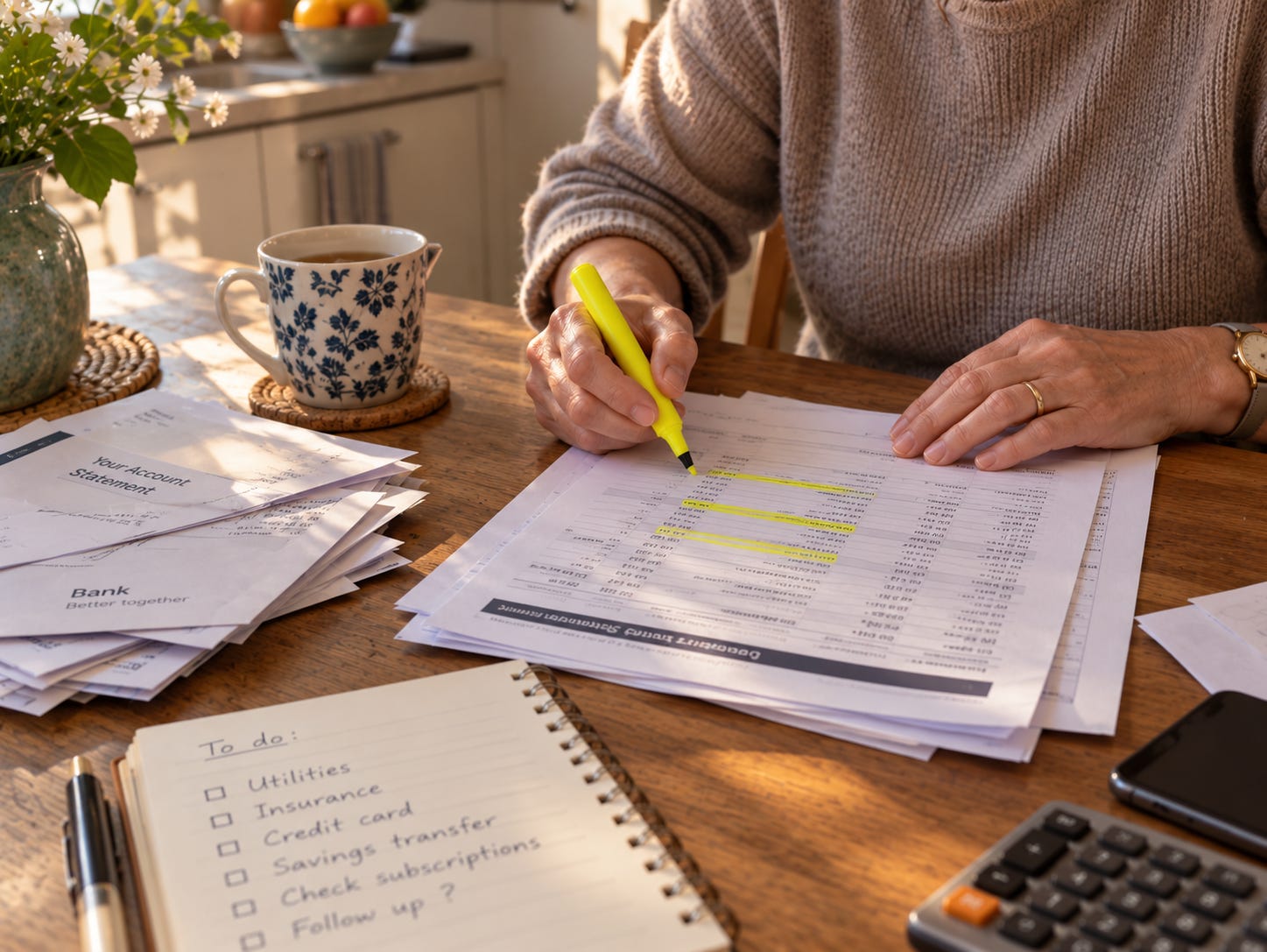
The real list is twelve months of statements — bank account and every credit card. Twelve months, because the ones that hurt most are annual: the antivirus, the extended warranty, the membership you joined for one trip, the roadside assistance. A quarterly look never sees them.
Print them if paper is easier. A highlighter and a kitchen table beat a screen for this, because you are pattern-hunting, and patterns show up better across a spread page.
Then go month by month and mark every charge that appears more than once. That is the whole of the first pass. Do not decide anything yet, do not feel anything about any of it. Just mark.
Start with the small ones
The instinct is to look at the big numbers first. Resist it. The big numbers are the rent, the insurance, the car — you know about those, you have thought about them, and they are not where the leak is.
The leak is between two and twenty dollars a month, which is exactly the range that never triggers a second look on a statement. A single nine-dollar charge is invisible. Nine dollars a month for four years is four hundred and thirty-two dollars, for something you have opened twice.
Six or seven of those is not unusual. That is the number that surprises people, and it only becomes visible when they are written down in one column instead of scattered across twelve pages.
The question that decides each line
Now go down your marked list. For each one, do not ask whether you can afford it. You almost certainly can, individually, which is how all of them survived this long.
Ask this instead:
“Do I actually use this?”
Not did I pay for it — you did, and that is why it is on the list. Use it. In the last few months, did you open it, watch it, read it, log into it? Opening it once when it was new does not count. Recently, and on purpose.
For most lines the honest answer is no. There was a reason to sign up, once, and then years of nothing.
That question sorts most of the list on its own, and it carries no judgment with it. It is not asking whether you were careless with money. It is asking something factual that you already know the answer to, which is why it works so fast.
A few lines will not settle that easily, and they are usually the ones you pay for precisely so that you never have to use them. Roadside assistance. A backup service. For those, use is the wrong measure, and there is a second question:
“Would you notice if it stopped?”
The roadside assistance: not until the one morning the car will not start, and then all at once. The cloud storage plan attached to a phone you no longer own: no, not this year and not next.
The ones you keep
Some will survive both questions, and they should. The newspaper you read every morning has earned its place. So has the streaming service the grandchildren use when they visit, even if you never turn it on yourself.
Keeping something is a fine outcome. Do one thing with it, though: write down the renewal date. On a calendar, on the list you just made, anywhere you will see it again.
That single act converts a charge that renews in silence into a decision that comes back around once a year. The researchers above found that requiring people to make an active choice every six months would cut the effect of inattention roughly in half. You do not need to wait for anyone to require it.
When they make it hard to leave
Some will not go quietly. The cancel button is three menus deep, or the site tells you to call, or the call has a wait, or the person on the call has a script and an offer.
A few things that help.
Do it in the same sitting. The whole hour works because the list is in front of you and you are decided. Come back to it tomorrow and half of them survive by default.
If they offer you a discount to stay, notice what has happened: they have just told you the service was worth less than you were paying. Take the discount only if the answer to the question above was yes and the price was the problem. If the answer was no, a cheaper version of something you do not use is still something you do not use.
If a company flatly will not let you cancel, your card issuer can usually stop a recurring payment from their end. That is a last resort, and it works better if you have already tried to cancel properly and can say so.
Write down what you canceled and when. If a charge shows up next month anyway — and occasionally one does — you will have the date.
One habit, so next year takes ten minutes
Pick a month. September is a reasonable one, since you are already here.
Once a year, in that month, do the same pass — but only over the last twelve months, and only over the small recurring amounts. It will take ten minutes instead of an hour, because the list is already made and you are only looking for what is new.
If you want one more layer of protection, use a single card for subscriptions and nothing else. Then the statement for that card is the list, and the yearly pass takes five minutes.
What you get back
The money is the obvious part, and it is usually more than expected — enough to matter, and it arrives every month from here on rather than once.
The other part is quieter. There is a particular low-grade irritation in not being sure what you are paying for, a background sense of things running on without you. An hour at the kitchen table ends it. You will know, for the first time in years, exactly what leaves your account and why.
And every one of those charges will be there because you decided it should be, this year, on purpose. Which is what it was supposed to be in the first place, before the automatic part quietly took over the deciding.
Two more, if this was useful:
How to Find Peace of Mind With Money in Later Life — the wider version of this conversation, including the parts that are not arithmetic.
The Simple Systems at Home That Help You Stay on Top of Things — for Plus members, on setting things up so they do not need remembering.
PS — And yes: everything I wrote here applies to the paid part of our newsletter. Ask it the same two questions everything else got. And if you don’t find it valuable, please do yourself a favor and disable the subscription. If, on the other hand, you’re actually reading it every week and found it useful, please consider becoming a Plus member - learn what you get in return!
You're preaching to the choir here. Curating your subscriptions does result in freeing up some funds -- sometimes, a lot -- but it's more about making space in your mind for more relevant ideas to grow. Kind of like weeding a garden.
This is fantastic advice. I especially like the idea of putting anything that automatically renews on the same card. It would make it so much easier to stay aware of. Thank you!