

It’s six o’clock, and you’re standing in front of the open fridge.
There’s food in there. A few eggs. Half an onion wrapped in plastic. Something you meant to use two days ago. You could make a real dinner — you know how, you’ve made thousands of them. But it’s just you tonight, the way it’s just you most nights now, and somewhere between the fridge door and the stove the whole idea deflates. You close the door. You have toast. Or cereal. Or cheese and crackers eaten standing at the counter, still half in your coat.
And you tell yourself it’s fine. It’s only dinner. Who’s it hurting.
I want to sit with that moment for a bit, because I don’t think it’s about food at all. And I don’t think the answer is a folder of clever recipes for one.
The dinner that quietly got smaller
Nobody decides to stop cooking. It happens by subtraction.
First it’s the big Sunday meal that goes, because there’s no one to make it for. Then the weeknight dinners shrink — why dirty three pans for one plate. Then some evenings there’s no plate at all, just a bowl of something in front of the television, or a piece of fruit and a couple of crackers called supper. The kitchen you once ran, the one that fed a family and held Christmas, becomes a place you pass through on the way to bed.
For most of a life, cooking meant cooking for someone. A husband. Children. A table that filled up. The effort made sense because it landed on people you loved. Take the people away and the effort loses its reason — and the meal follows the reason down.
That’s the part worth naming plainly: when you eat alone, you’re not just missing company. You’re missing the whole point the cooking used to have. So of course it feels like too much. It isn’t laziness, and it isn’t a character flaw. It’s grief wearing an apron.
Your appetite really did change — you’re not imagining it
Something gets missed here, because it’s invisible from the inside.
The hunger itself gets quieter with age, and not through any fault of yours. The body’s appetite signaling genuinely shifts over time. The hormones that tell you you’re hungry get softer; the ones that tell you you’re full arrive sooner and stay longer. The stomach empties more slowly, so you feel satisfied on less. Taste and smell dull a little, so food that used to call to you now sort of murmurs. Researchers have a clinical name for the pattern — the anorexia of aging — and in a 2019 review they found it affects up to a quarter of older adults living at home.
Read that again, because it changes the story you’ve been telling yourself. If you’ve noticed you’re “just not that hungry any more,” that you can skip a meal and barely feel it, that food has lost some of its pull — that is a real, measurable thing happening in your body. It is not you being difficult. It is not you letting yourself go.
Why does that matter? Because a body that isn’t sending strong hunger signals will happily let you undereat for weeks without complaining. The alarm that used to make you cook — I’m starving — rings faint now. Which means the meal can’t wait for you to feel like it. Some nights you’ll have to make it before the hunger shows up, because the hunger has gotten shy.
This is the kind of thing I dig into here every week — the quiet biology behind the ordinary stuff, explained so it makes you feel more capable, not more managed. If that’s useful to you, subscribe to We Get Better With Age. A couple of practical reads a week, no lectures.
The part that has nothing to do with food
There’s a second force at work, and it’s the one most “healthy eating for one” advice walks right past.
People eat more, and eat better, in company. That isn’t a feeling — it’s one of the most repeatable findings in the study of how people eat. A 2019 meta-analysis pooling forty-two studies found that people eat substantially more when they’re with familiar others than when they’re alone. And the detail that stopped me: the effect only shows up with people you actually know. Strangers don’t do it. Company does — the specific, easy company of someone whose presence you don’t have to manage.
That’s exactly the thing that thins out when you live alone. The table stops being a shared event and becomes a chore you perform for an audience of none. And the food quietly pays for it. New Zealand researchers who followed nearly three thousand older adults found that 37% of those living in the community were at risk of malnutrition — and living alone was its own independent risk, separate from age or income or illness. The researchers pointed to a plain cause: with no one to share meals with, both how much you eat and how well you eat tend to slip.
I watched a version of this up close. After my mother-in-law died, my father-in-law — who had, in the way of his generation, never really cooked — was suddenly alone at every meal. For a while he lived on tea and whatever didn’t need a pan. Watching him find his way back to actually cooking for himself (I wrote about the small tool that finally made it click) taught me that the problem was never that he couldn’t cook. It was that no one had ever needed him to feed only himself, and he didn’t yet believe that was reason enough.
It is reason enough. You are reason enough. That’s the whole quiet argument of this piece.
Why the meal is worth more than it feels like
If the stakes were only pleasure, I’d say eat your toast in peace and never mention it again. But there’s a harder reason the small dinners cost you more than they look like they do.
The nutrient an older body needs most, and most reliably comes up short on, is protein — and the requirement doesn’t drop with age, it climbs. The expert group that studied this closely recommends older adults get roughly 1.0 to 1.2 grams of protein per kilogram of body weight each day, noticeably more than the standard adult guideline. The reason is muscle. After about fifty, the body sheds muscle steadily unless it’s given both the movement and the raw material to hold on — and protein is the raw material. (I went deeper into the numbers in Are You Eating Enough Protein?)
And that is what turns a food question into an independence question. The muscle you’re feeding isn’t for looking strong. It’s the muscle that gets you off a low chair, steadies you on the stairs, carries the groceries in from the car, catches you when you stumble. A run of small, protein-thin dinners doesn’t announce itself. It shows up months later as legs that give out sooner and a body that feels less sure of itself — and it gets read as “getting old” when a good part of it was “getting underfed.”
So the plate matters. Not for the number on a scale. For the life the plate quietly keeps holding up.
How to feed yourself well without cooking like it’s a performance
This is the practical part, and I’ve kept it deliberately low-effort — because the whole trouble is that effort is exactly what’s in short supply at six o’clock. None of this asks you to become someone who cooks elaborate meals for one. It asks you to make eating well the easy default instead of the thing you have to talk yourself into.
Stop cooking dinner. Start assembling it. A meal doesn’t need a recipe. Canned sardines on good toast with sliced tomato is dinner. A boiled egg, some cheese, an apple and a handful of nuts is dinner. Rotisserie chicken, a bag of pre-washed salad, a slice of bread is dinner. When “cook” feels like too much, “assemble” almost never does — and the plate still ends up with protein on it, which is the part that counts.
Cook once, eat three times. On a night you do have it in you, make the pot of soup, the tray of roasted vegetables, the batch of chili. Then you’ve bought yourself two more dinners that need nothing but reheating. The energy isn’t in cooking every day. It’s in cooking on a good day so the tired days are already handled.
Put protein on the plate first, then build around it. Decide the egg, the fish, the beans, the chicken, the yoghurt — the protein — before anything else, and let the rest of the meal assemble itself next to it. If the only decision you make is “what’s my protein tonight,” you’ll clear the bar that matters most, even on a toast night.
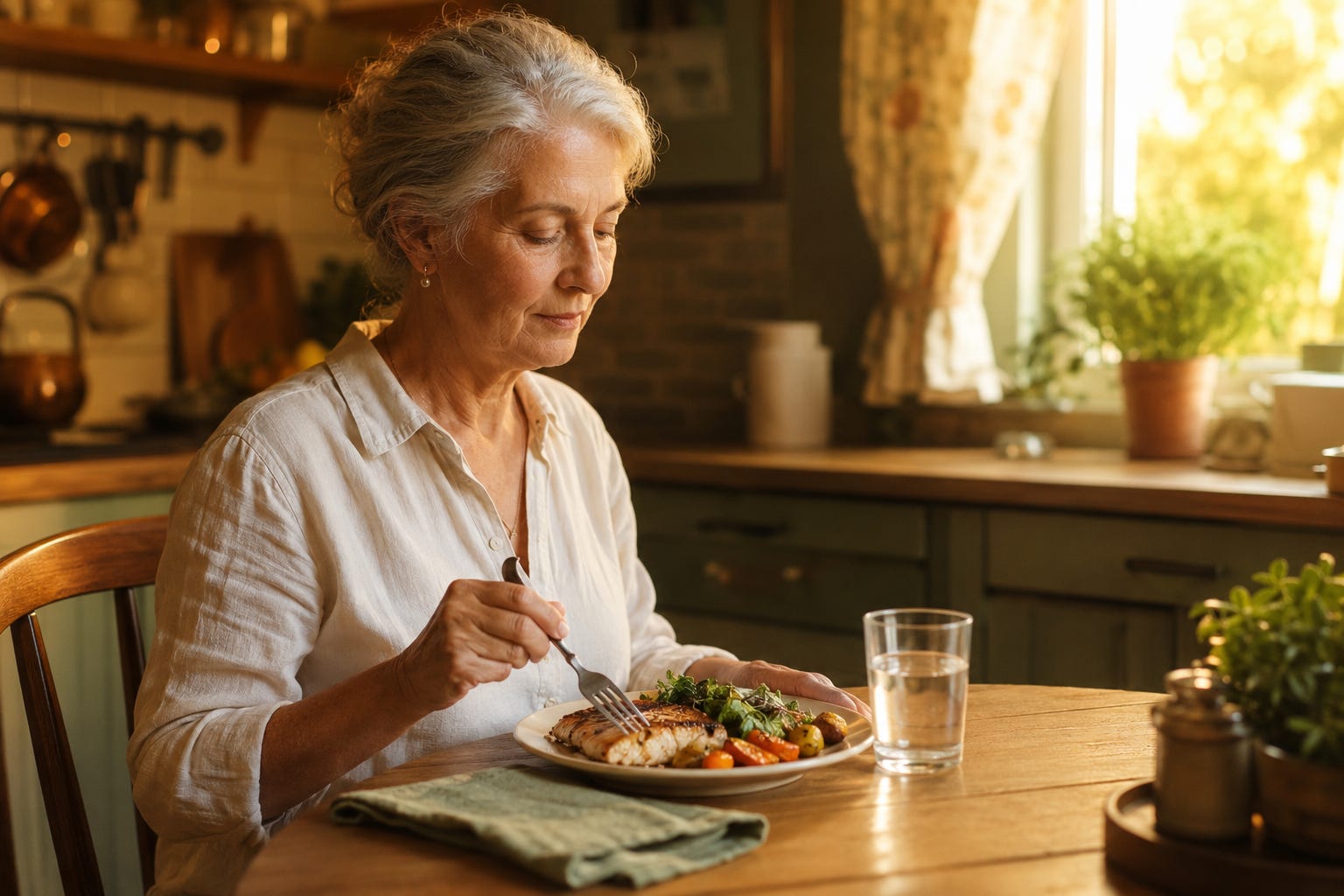
Set the place like it’s for a guest. This sounds sentimental. It’s actually mechanical. Put it on a real plate. Sit at the table, not the counter. Use the good napkin if you have one. You’re not performing dinner for anyone — you’re telling your own nervous system that this meal, and the person eating it, are worth the small ceremony. The body eats better when the meal is treated like an occasion, even an occasion of one.
Borrow the company. Since familiar company is the thing that’s missing, bring a version of it to the table on purpose. Eat while you’re on the phone with a friend or a grandchild. Put the radio on, or a program you like, so the room isn’t silent. If you have a neighbor in the same boat, trade dinners once a week — you cook Tuesday, they cook Thursday, and suddenly you’re both eating properly twice as often. The point isn’t to fill the silence. It’s that eating goes better when it doesn’t feel like eating in an empty room.
Keep a shelf of “no-decision” food. The nights the fridge feels like a problem, the answer is to have already answered it. A few cans of beans and fish, eggs, crackers, frozen vegetables, a good cheese, some fruit. Nothing that expires by Thursday, nothing that needs a plan. When the willpower is thin, the cupboard does the deciding for you.
Why I made a guide for this
I’ll be honest about what usually comes next, because you might feel it already. Deciding you’re worth a real meal is one thing. Knowing what to actually put on the plate — enough protein to protect the muscle, enough fiber to keep everything moving, on the days the appetite has gone quiet and you’re cooking for one — is another thing entirely.
I’ve been circling this for a while. When I wrote about how much protein an older body really needs, the replies all asked the same next question: fine — but what does that actually look like on a Tuesday, for one person, when I don’t feel like cooking?
So I put the answer in one place. It’s called The Easiest Nutrition Guide for Seniors, and it’s built to think the way this article does — food as something you assemble, not a regimen you follow.
Inside: how much protein and fiber an older body actually needs, worked out for your size instead of a generic number. A chapter on why hunger fades with age — the thing we just named — and how to eat well anyway. A whole section on cooking for one, because it’s the hardest part and it deserved its own room. “Good enough” targets for the low-appetite days, so a small day still counts instead of feeling like a failure. A batch of simple, high-protein meals you can assemble in minutes, with vegetarian options throughout. And a plain shopping list, so the “no-decision” shelf builds itself.
One honest note, since some of you will remember it. I first shared this guide with readers earlier, and it’s since been completely redesigned. Back then, buying it meant a PDF in your inbox. Now it opens the moment you buy it: a full online reading experience you can read on your phone, tablet, or computer, picking up wherever you left off. The printable version, over 100 pages, is still included, yours to keep.
It’s $19.99 right now instead of $24.99, with instant access. And it carries a gentle 7-day money-back guarantee: if it isn’t right for you, email me at diana@wegetbetterwithage.com and I’ll refund you, kindly, no questions asked.
PS — If your subscription includes Plus + All Guides, this guide is already yours: you can download it from this page. If it doesn’t yet, you can upgrade there too.
And if a guide isn’t what you need right now, take today’s article at full strength anyway. The protein-first plate, the assembled dinner, the borrowed company — all of it is yours, free. You’re welcome here exactly as you are.
A table for one is still a table
I keep thinking about that six o’clock moment at the open fridge — how much it carries that has nothing to do with what’s on the shelves. The pull to skip it isn’t weakness. It’s a body whose hunger has genuinely quieted, and a heart that learned to cook for other people and never quite learned that it counts when the other people are gone.
But you’re still here. Still hungry, even when the signal is faint. Still worth a warm plate and a real chair and ten unhurried minutes. Feeding yourself well when no one’s watching isn’t vanity, and it isn’t fuss. It might be one of the plainest forms of self-respect there is — the daily, private decision that your own body is still worth tending.
So set the place. Sit down. The company may be smaller than it used to be. The table is exactly as real as it ever was.
And if someone came to mind while you read this — a friend, a father, a widowed neighbor eating standing up at the counter — pass it along. Sometimes the permission is easier to accept when it arrives from someone who loves you. The comments are open too.
I cook for one all the time! I love to cook! I “collect” cookbooks. Leftovers are great, or can be put in the freezer.
I suggest to people to find a crazy recipe, purchase the ingredients, and COOK IT!
It’s actually a lot of fun, and I bet you’ll surprise yourself! 😉👍
I use my ‘good’ dinnerware every day it was designed to enjoy. I’m learning to cook Japanese foods (healthy) & confess I love the luxury of a simple, well prepared meal with excellent ingredients. I cook for one & enjoy new recipes & trying new techniques. I keep a supply of prepared meals for those times I am not in the mood to cook. Nutrient levels are tracked on Chronometer app so I know exactly what I might be short on daily.