


Sixty to sixty-five degrees Fahrenheit, roughly 16 to 18 Celsius. A cool house. The kind where you put on a second layer, decide the heating can wait another week, and think nothing more about it.
According to the National Institute on Aging, it is also cool enough to bring on hypothermia in an older adult. At home, indoors, in a house that feels a bit chilly. The same page notes that about one in five injuries from cold exposure happens inside the home.
So winter preparation is smaller and closer to home than it sounds. A handful of ordinary jobs, simple on a mild afternoon in late September and considerably harder once the weather has turned. Some of them become dangerous.
The same job, done in January
This article started in my own house. For the past few days we have had problems with the hot water, and a few things needed repairing before it worked properly again. The whole time, I kept picturing the same week in January.
Everything below can also be done in the middle of winter. That is the trouble with it.
A ladder against the house is one thing on a dry October morning and something else on wet leaves in December. A plumber booked in advance costs what plumbers cost; the same plumber, called out on the first hard freeze when half the town is calling, costs more and arrives later. A furnace that refuses to start in September gives you three weeks to sort it out. The same refusal in January gives you an evening.
Every job on this list is easy. The calendar is what makes it urgent: in most places, the window is roughly the next six weeks.
So here is a list of things you might want to check:
The heater
Turn the heating on now, before there is any need for it, and let it run for twenty minutes.
This single act does more than the rest of the list combined. After six idle months, something is wrong more often than people expect, and this way you find out while you still have weeks, mild weather, and your pick of anyone in the trade.
Expect a smell of burning dust for the first few minutes. That is normal and it passes. What is not normal: no heat at all, an unusual noise, a smell that does not clear, or rooms that heat unevenly when they did not before. Any of those is worth a phone call this week.
While you are at it, change or clean the filter if your system has one, and look at when it was last serviced. The NFPA is direct about this one: chimneys and heating systems should be inspected and cleaned every year, before they are fired up for the season.
If you use a fireplace or a wood stove, the chimney sweep’s calendar is empty in September and full in November. Call now.
The space heater and the three feet around it
Portable heaters get their own section because of one set of numbers.
In the NFPA’s figures for 2020 through 2024, space heaters and heating stoves caused about thirty percent of home heating fires — but seventy-three percent of the deaths. Nearly half of all heating fires happen in the three months from December through February.
These fires are less common than the rest, and they are the ones people do not get out of.
Most people who rely on a space heater have a good reason: a cold bedroom, a drafty corner, a living room the central heating never quite reaches. Keep the heater, and keep three habits with it.
Keep three feet of clear space around it, in every direction. That means bedding, curtains, the arm of the sofa, a newspaper, the dog’s blanket. The single largest cause of death in heating fires is equipment placed too close to something that burns.
Plug it straight into a wall outlet, never into an extension cord or a power strip. A heater draws more current than either is designed to carry.
Turn it off when you leave the room and before you go to sleep. Every time.
If the heater is the only thing making a room usable in January, that is worth knowing now rather than in January, because it usually points at a draft or an insulation gap that can be fixed properly while the weather still allows it.
The alarms are useful only if they work
Smoke alarms and carbon monoxide alarms matter more in winter than at any other time of year, because winter is when the heating runs, and the heating is what they are listening for.
Three things, and all three take ten minutes.
Press the test button on every alarm in the house. Every one, including the ones in rooms nobody uses. Roughly three out of five home fire deaths happen in homes where there was no alarm, or the alarm did not work.
Put in fresh batteries, even in the ones that have not chirped. The chirp arrives at three in the morning, and nobody standing on a chair at three in the morning is at their most sure-footed.
Then turn one over and look at the date printed on the back. Alarms expire. The NFPA says to replace smoke alarms every ten years, and a surprising number of houses have alarms older than that quietly doing nothing. If the date says 2014, the alarm is decoration.
Carbon monoxide alarms matter for the same season and the same reason — furnaces, stoves, fireplaces, anything that burns fuel. If there is no CO alarm outside the bedrooms, that is the most worthwhile purchase on this entire list.
The entrance that is fine until it is wet
Go outside and walk the route you actually use — the one from the car or the sidewalk to your own front door — and look at it as though the ground were wet.
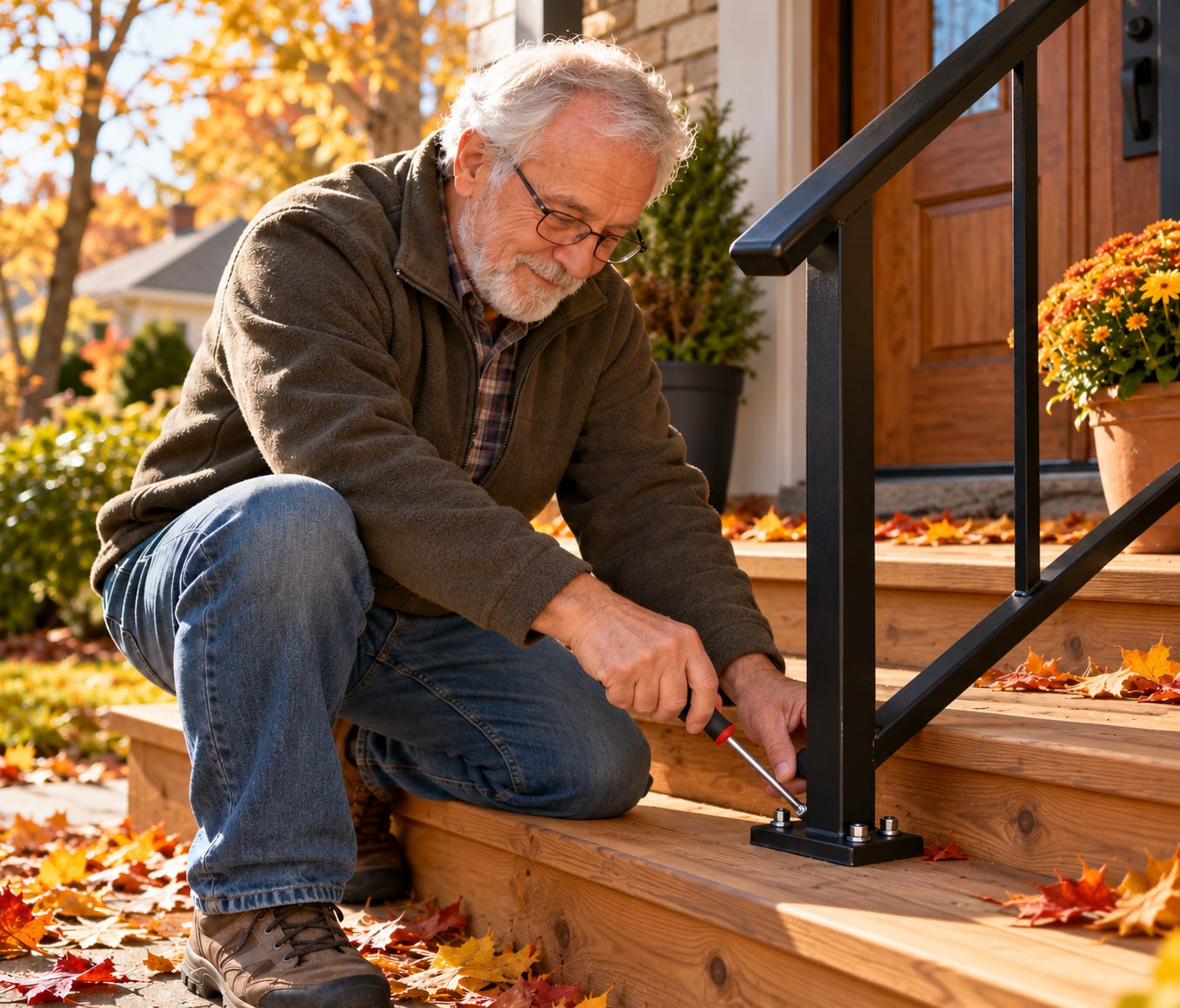
Test the handrail by leaning your weight on it, properly, the way you would if you slipped. If it wobbles, it will not hold you when it counts. Tightening it takes a screwdriver and five minutes in September. In December you would be doing it in the wind.
Notice where water collects and where it runs across the path, because that is exactly where ice will form, and it will form there every year in the same place. Clear the leaves out of that spot now; wet leaves are nearly as slippery as ice and they arrive first.
Check that the light over the door works and actually reaches the steps. The clocks change, and the walk from the car stops happening in daylight.
Buy the de-icing salt this month and put it somewhere you can reach without going out first. Buying it during the storm means going out in the storm.
If what you find out there is a step that has needed proper attention for a while, or a rail that was never right — that is a different conversation, and there is a fuller one about the front door and the entry for Plus members, about the permanent fixes rather than the seasonal ones.
The draft you no longer notice
Drafts get filed under discomfort, which understates them. If a room is losing heat faster than the heating can replace it, the thermostat setting stops describing the temperature you are living in.
The National Institute on Aging suggests keeping the heat at 68°F or above, and its own list of how to manage a cold house is plain: weather stripping or caulk where there are gaps around the windows, a rolled towel along the bottom of a door, blinds and curtains closed once it is dark.
None of that requires a contractor. Weather stripping is inexpensive, comes with adhesive backing, and goes on with scissors and a wipe of the frame. An hour on the two or three worst windows changes how a room holds heat.
The way to find them is to wait for a cold evening and walk around the edges of the room with the back of your hand held up near the frames. You will feel the cold coming in before you can see anything at all.
What if the power goes out?
This part is short, because most of it is about having things in one place rather than buying anything.
Flashlights where you can find them in the dark, with batteries that work. Skip the candles: a house full of them during an outage is how the outage becomes something worse.
A phone charged, and ideally a battery pack — charged too, and stored with the flashlights. Blankets somewhere reachable without a stepladder.
If the heat goes out and stays out, the plan is to close off one room and keep that one warm rather than trying to hold the whole house. It is easier, it works, and it is a decision better made now than at ten at night in the cold.
And if anything you take needs refrigerating, find out this week what the guidance is for it when the power is off. That is a question for the pharmacist, and it takes one phone call.
The jobs for which you should hire help
There is a part of this list that belongs to somebody else now, and it is worth naming plainly rather than leaving it to be discovered halfway up a ladder.
Gutters. Roofs. Anything that involves being above the ground on something that moves.
Gutters are dangerous work at fifty as well, and people who do it for a living use proper equipment and a second person. What changes with time is the cost of a fall. That part is arithmetic.
The practical piece: book it now. In September you can choose who comes and when. In late November you take whoever is available, at whatever they are charging — which is the worst position from which to make any decision.
If asking feels like giving something up, notice that you are still the person who knew the gutters needed doing and made sure they got done. That is the same job it always was. Only the ladder changed hands.
What a few afternoons buys
Done across a few mild afternoons between now and the end of October, the whole list costs a couple of phone calls, one small purchase, and a bit of time outside while it is still pleasant to be outside. Leave it for winter and the bill looks different: emergency service fees, a cold house for two days, a wet step in the dark.
What you are buying is an uneventful season. No scramble, no expensive February, no morning where the house is at 58°F and everyone in the trade is already booked.
And if you only do one thing on this page, turn the heating on this week and let it run for twenty minutes. Everything else can wait two weeks. That one cannot. It is the job that turns a crisis into an errand.
The seasonal twin of this one, from July: Keeping Your Home Cool and Safe Through a Heatwave — same house, opposite problem, and the same principle that the dangerous weather is the kind that does not feel dangerous.
Tuesdays and Fridays stay free, always. If you’re getting something out of them and want to support the work, the paid membership is where to do it - learn more about the perks you get as a Plus member.
I, thankfully, have had an annual service contract with the folks who replaced our old HVAC unit several years ago since before we had them replace it. They do scheduled maintenance on the unit twice a year (usually in May and November) to clean it out, replace the filters, and repair/replace whatever parts need to be repaired/replaced. And, even when Sam’s dementia demons were on a rampage, the technician assigned to us has always been right there to help, and unfazed by it all. And those times when it was urgent? He was here within a couple of hours, not days or weeks.
And last fall when the plumber whose employer had been bought out by a private equity firm tried to tell me I needed $5K’s worth of re-plumbing work done, I told him “I don’t think so” and called my friend at church who is a registered home builder/contractor. He sent the plumbers he works with to look at the problem I was having and they quoted $900! And when the work was done, they actually billed me only $850 and I haven’t had a problem since. Pays to have friends in the right places! He had also sent a roofer over to my house the day before Hurricane Helene roared through because I had a leak over the kitchen window. That roofer found the problem, put a “band-aid” on it (his word), and came back the following Monday. Meanwhile, the “band-aid” stayed firmly in place in spite of the wind and when he came back to complete the job, he also repaired the dent in the gutter on the back of the house (from a falling tree branch that landed in the driveway). So, someone (Sam!) was watching over the pups and me!
I find that putting up my simple Christmas lights/decorations when it’s mild so much better!!!!