


On Thursday, somewhere between the turkey and the pie, someone may tap a glass and suggest going around the table.
If you’re fourth or fifth in line, you know how the next few minutes go. You half-listen to everyone before you while you work out your own answer. The person before you says “my health,” so that one’s gone. Something real comes to mind, then feels too personal to say with the gravy going round. When your turn comes you say “my family,” which is true, and everyone nods, and the round moves on.
And if there’s an empty chair this year, you may spend the whole round hoping nobody looks at it while you’re talking.
Gratitude deserves better than one rushed sentence a year. Last November the Sunday articles spent a whole month on it. This week felt like the right time to bring back the parts that stuck, for everyone, with a few things I’d say differently now.
How it started for me
Years ago I tried a one-month challenge: every night, one line about one thing I was grateful for.
The first week was a little embarrassing. My health. My family. A roof over my head, food on the table. All true, and all a bit like reading out a list I’d learned years ago. I wondered whether I’d make it to thirty days or just write “my family” thirty times.
Then one autumn afternoon I went for a walk. The air was crisp, the light had gone golden, and I took my jacket off to feel the sun on my arms. And I caught myself thinking: that’s tonight’s line.
I’d had plenty of sunny afternoons before that one. I just hadn’t been out looking for them. Knowing I’d need something to write that evening had me watching for it all day, without quite meaning to.
That walk convinced me more than anything I’ve read since.
Why the good days slip away
The walk needed a nudge for a reason. The mind keeps a much firmer grip on what went wrong than on what went right. A curt word from the woman at the pharmacy counter can follow you home and sit with you through dinner, while the lovely hour you spent with a friend that same afternoon has gone soft at the edges by six o’clock.
Psychologists call it the negativity bias. For most of human history it was useful, because remembering where the danger was mattered more than remembering a sunset. Now it mostly means you can live a perfectly good week and come away with a sharp memory of the irritations and a vague one of everything else.
Writing down one good thing tips the scales back a little. It won’t fix grief, pay a bill or make a lonely evening less lonely, and I’d be wary of anyone who says it will. When researchers test it, the effects are small but real: people feel a bit more content and a bit less low, and people who feel more grateful tend to say they sleep a little better. Small is still worth having.
One line is enough
The usual advice is three good things every evening. If three feels like homework, write one. One line is enough to keep you looking.
The more particular the line, the more it gives back. “My family” is true, but it doesn’t take you anywhere. “My grandson rang to tell me about his spelling test, and he got necessary right” puts you back in the kitchen with the phone at your ear, and that’s where the good feeling is.
Tie it to something you already do, like the kettle in the morning or brushing your teeth at night. Keep the notebook on the nightstand, where you’ll see it, not in a drawer.
And if the notebook starts to feel like a chore, change the notebook. Mine did by the fourth week. I moved to a journaling app that lets you add one photo a day, and suddenly I was taking pictures of a sunset, a good meal, the dog asleep. A sticky note on the fridge works too. If you miss a few days, start again tonight. Nobody’s keeping score.
On the days when nothing comes
Some evenings the line writes itself. Other evenings you sit there with the pen, and the only honest thing you could write is a complaint.
I had one of those. Everything that could go wrong that day had gone wrong, and I sat with the notebook for a good five minutes, getting crosser, trying to find something that wouldn’t feel like a lie. In the end I wrote: “I’m grateful this day is over.”
It made me laugh. As it turned out, that was the good thing.
A bad day can still have relief in it. The hot shower after an afternoon in a hospital waiting room. The friend who brought soup and didn’t ask too many questions. You can write those down without pretending it was a good day.
Holiday weeks are when this gets hardest. If this is the first Thanksgiving without him, or without her, you may have been dreading Thursday since Halloween, and quietly wondering how you’re supposed to be thankful at a table with a gap in it. Nobody should expect a cheerful list from you. You can be grateful for the person you’re missing, for the way they carved the turkey or the thing they said every single year, and still miss them every bit as much. “I’m glad I had all those Thanksgivings with him” is a gratitude line, and it may be the truest one at the table.
The body that got you through today
Most people only notice their body when it complains: the knee on the stairs, the back the morning after an afternoon of raking leaves. The rest of the time it quietly gets on with things, a bit like a reliable old car you never think about until the morning it won’t start.
A few years ago I was recovering from a minor operation and getting impatient with how slowly I was healing. One morning I caught my reflection and, a little to my own surprise, said “thank you” to it. It felt strange, standing in the bathroom thanking a mirror. But I meant it. The body I’d been grumbling at for weeks had been doing all the repair work, and I hadn’t given it a word of credit.
You don’t need to talk to the mirror. But one of your lines this week could be about your body, as long as it’s true. You carried the groceries up the steps in one trip. Your knee let you sit on the floor with the grandchildren for half an hour. You slept until five. You stayed steady on an icy driveway.
The aches are still real, and some of them deserve a doctor. Writing down what went right just means the one thing that hurt isn’t the only thing you remember about the day.
The thank-you note you keep meaning to write
Of everything I tried, writing to someone else made the biggest difference.
A few years ago I wrote to my high school teacher, the one who first encouraged me to write. I hadn’t spoken to her in decades. I wrote it in one go and then nearly didn’t mail it. It felt presumptuous, landing in someone’s mailbox after all that time.
A week later she called. “Your note made my day,” she said, and then the part I still think about: “You reminded me why I loved teaching.”
There’s research behind what that phone call taught me. People who write thank-you notes consistently underestimate how much the other person will enjoy getting one, and overestimate how awkward it will feel. The worry that it’ll seem odd, arriving out of nowhere, is usually the part that’s wrong.
If someone came to mind while you were reading this, you probably already know what you’d say to them. A few lines are enough: what they did, and what it meant. “Thank you for the day you drove me to my appointment and stayed for the whole thing” says more than a page about what a wonderful person they are. Mail it, read it to them over the phone, or tuck it into a Christmas card, since those will be going out soon anyway.
And if the person has died, you can still write it. Some people keep the note in a photo album, some read it aloud at the grave, and some write it and put it away. The writing is the part that matters.
Something to start on Thursday
In 2020 my family kept a gratitude jar. Every day someone dropped in a scrap of paper. “I called Mom today.” “The soup turned out great.” “The dog made us laugh.” On New Year’s Eve we read them all out loud.
It had been a hard year for everyone. Reading the notes back, we found it had more good days in it than any of us remembered.
From Thursday to New Year’s Eve is five weeks, so about thirty-five notes. Put an empty jar and a stack of small papers on the table on Thursday and ask everyone to drop one in before they reach for their coats. Then keep it going yourself through December, one a day. Any jar will do. So will a shoebox or a bowl.
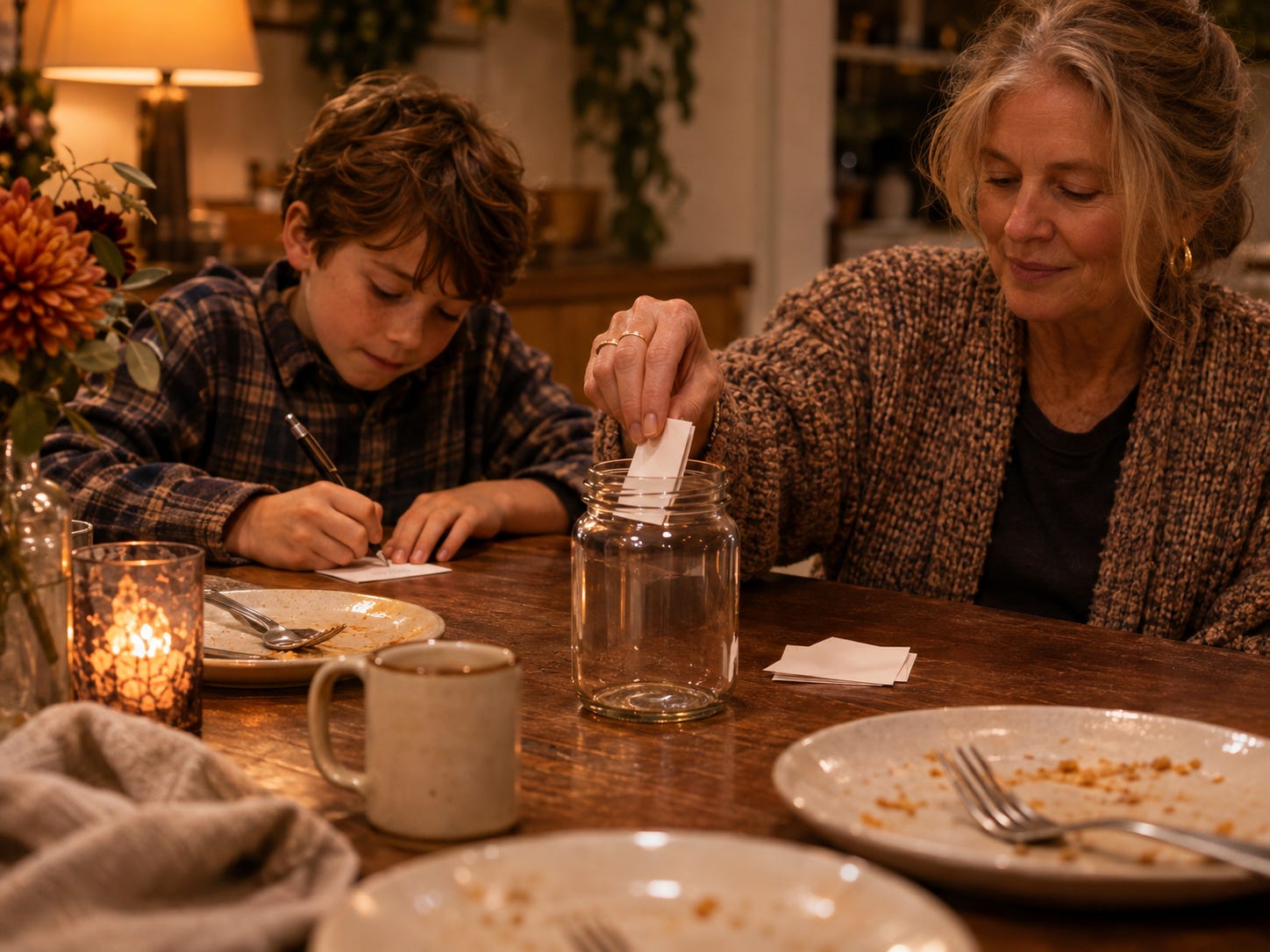
It works if you live alone, too. Thirty-odd small notes in your own handwriting, read on New Year’s Eve with a cup of tea, is a lovely way to close a year.
A better question for the table
If you’re hosting, or you’d rather skip the round altogether, try something smaller. Turn to the person next to you and ask: “What was one good thing about your week?”
It’s easier to answer than “What are you thankful for?” Nobody has to make a speech, and the answers tend to be small and real: a good night’s sleep, a parking space right by the door, a grandchild who finally called back. More often than not, it turns into a proper conversation.
The question travels well, too. Try it on a phone call in January.
Last year’s four Sunday articles went much further into all of this, with daily practices, a 30-day challenge and the research behind it. They’re in the paid archive now, starting with The Healing Power of Gratitude.
Has a thank-you note ever stayed with you, one you wrote or one you received? I’d love to hear about it in the comments.
If this was useful and you’d like to back the work, becoming a Plus member is how. You’ll also get the full archive, the Sunday deep dives and a new Fun Pack every month.
I'm thinking of taking the idea of writing a thank you to someone deceased one step further and doing it on the anniversary of their death. To remember them and honor them.
I've had over 25 people die in my lifetime already so maybe it wouldn't be all of them. But the anniversary of my mother in law’s death is next week and that seems like a great thing to do.
I use two different journal apps - “Gratitude” and “Diary” - and occasionally the Apple Journal app that came installed on the phone. I have to admit I haven’t used any of them in quite some time; and I won’t commit to starting again because it feels too much like a New Year’s resolution. But you asked about thank you notes we may have sent or received that “stayed” with us. So I’ll tell you about it….
It was a thank-you note from my then-10 year old stepson written inside a birthday card. I don’t recall the exact words any more (and I’d have to dig through a big box of them to find it), but in essence he thanked me for “making” him do little things around the house to help his Dad and me on the alternate weekends he spent with us, “making” him brush his teeth on Saturday & Sunday mornings before going outside to play, and for being a great stepmom. That little boy is now 42 years old - two years older than I was when I married his dad 33 years ago this Thursday - has his own wife and five kids of his own, ages 15 down to 5, plus two young dogs. 💙