

Hi, it’s Diana from We Get Better With Age, and I’m continuing my series on books I’ve read and genuinely enjoyed (you can check them all here).
I should say up front that I am a fan of this author. I’ve read pretty much everything Nir Eyal has written and liked all of it, so when a new one arrived in March there was never much question about whether I’d pick it up.
Here’s what I didn’t expect. Beyond Belief is a book about beliefs that spends most of its length arguing against the thing you’d assume a book about beliefs would sell you. Eyal calls it, in his own words, a “staunch rejection of magical thinking.” No vision boards. No manifesting. At one point he tells you to stop visualizing your goals altogether, and gives you the study that explains why.
Which is why it’s here, and not filed with the business books.
What it is
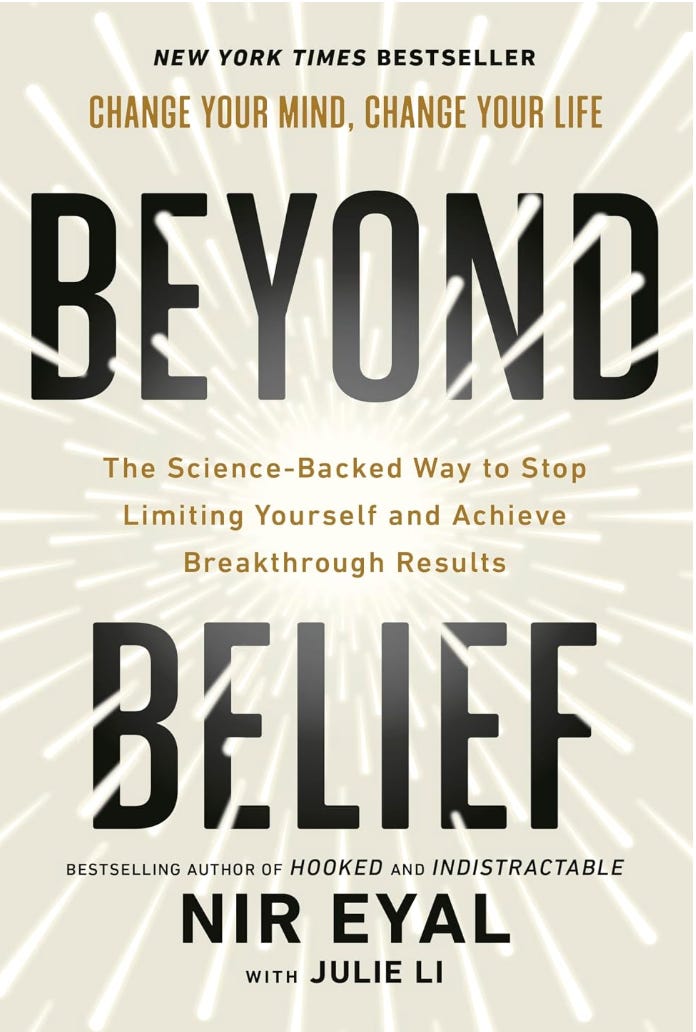
Nir Eyal wrote Hooked, about how products are designed to become habits, and Indistractable, about how to get your attention back from them. He has an MBA from Stanford and has taught there, which shows in the writing: clear, structured, allergic to fluff.
Beyond Belief, written with Julie Li, came out in March. Three hundred and four pages, hardcover, thirty dollars. The publisher’s jacket calls it an instant New York Times bestseller.
The argument runs like this. Behind most of what you attempt sits an assumption you’ve never examined. The publisher’s line for it is the cleanest summary I’ve seen: these beliefs “aren’t facts. They’re tools.” Eyal draws the distinction carefully in interviews — facts are true whether or not you accept them, faith needs no evidence, and beliefs sit between the two. “Beliefs are not facts,” he told CNN. “They’re convictions that are open to revision based on new evidence.”
Which sounds like a philosophy seminar until you notice what it licenses. The first chapter is called “Beliefs Are Tools, Not Truths,” and the title is the whole argument. A tool that’s stopped working gets put down — you don’t argue with it, you don’t defend it, you swap it.
The sentence I stopped on
There’s a passage on aging, and it holds the most uncomfortable line I’ve read in a book this year.
Eyal quotes the Yale finding you may already have come across: people with positive views about aging live, on average, seven and a half years longer than people without them. That figure gets repeated everywhere, and I’ve repeated it myself — twice, in fact, in this newsletter.
And both times I left out the middle.
Asked how a belief could possibly do that, Eyal doesn’t reach for anything mystical. “Belief itself is not what changes your biology,” he says. “It’s just the first step.” Then the part that stayed with me: “How does the person who says, ’I’m having a senior moment’ behave? They behave old.”
They behave old. Not “they feel old.” Not “they think old.” They behave — differently, in ways that accumulate.
His summary of the whole chain is one line: “Your beliefs become your biology by way of behavior.”
Someone who assumes strength is still buildable at seventy-four lifts something heavy occasionally. Someone who assumes it isn’t, doesn’t — and in time the assumption makes itself true. Someone who reads a forgotten name as evidence of decline stops putting themselves in rooms where names are needed. The belief didn’t reach into the body. It changed the week, and the week reached into the body.
That number, by the way, is an association. Nobody ran a trial where one group was handed better beliefs at fifty and another wasn’t. But the mechanism Eyal describes doesn’t need the trial, because it isn’t asking you to believe harder. It’s pointing at the behavior sitting underneath the belief, and behavior is a thing a person can actually get hold of.
The two earlier pieces I wrote on this told you the belief mattered and then, more or less, encouraged you. This book gave me what was missing from them, which is the step in between.
If you want the evidence pointing the other way — the things that measurably improve with age rather than decline — I went through that research in May, and that piece is free to read.
The opposite of what you’ve been told
Here’s the practical part, and it’s the reason I’d hand the book to somebody.
Everything in the culture tells you to picture the outcome. See yourself at the goal weight, on the stage, in the finished garden. Eyal’s instruction is blunt: “Stop visualizing the outcome and instead prepare for the pain.”
The evidence comes from Gabriele Oettingen, who studied students visualizing success on their exams. The ones who only pictured the good result — with no thought given to what would get in the way — studied less and did worse than the students who hadn’t. Oettingen’s explanation is that the pleasant fantasy fools the system. As the interview puts it, “the mental high of the fantasy acted like a false signal that the goal was already reached, draining the motivation to actually pursue it.”
What Oettingen recommends instead is called mental contrasting, and it takes about four minutes. It goes like this.
Name what you want, in one sentence. Say it’s the Tuesday group you stopped going to in February, when your knee was bad, and haven’t been back to since.
Picture yourself there again — thirty seconds, no more. The point isn’t to skip the pleasure of it. The point is to stop there, because that’s where the vision-board version of this ends and where the trouble starts.
Now name the obstacle, and be specific enough that it’s slightly embarrassing to write down. Not “motivation.” The actual thing, which in this case is almost certainly: I’d have to walk in after seven months and explain where I’ve been, in front of everyone, and someone will ask about the knee.
Then make the plan in the form of if this, then that. If someone asks where I’ve been, then I say “knee, it’s better now” and ask them a question back. If I can’t face walking in cold, then I message Margaret on Monday and go in with her.
That is the technique, all of it. Four minutes, mostly spent on the third step. The reason it works, according to Oettingen, is that the brain starts filing obstacles next to solutions instead of filing them as reasons to stop.
One warning about the third step, which is where all the work is. The obstacle you name first is almost never the real one. “I don’t have time” is usually “the appointment I’m dreading is at ten and I don’t want to be out when the phone goes.” Sit with the question a minute longer than feels necessary.
What I haven’t covered
Three things I know are in the book and am deliberately leaving alone.
There’s a chapter on prayer, which I’d have bet money against finding in a book by this author. He heads off the obvious objection in one line — “It is not a religious book, but it is a ritual book” — and his case is that the protective effect shows up whether or not you hold any certainty about who is listening. Whatever you make of that, it’s the most surprising thing in there.
There’s a set of four questions meant to strengthen a relationship, which I’d want to try before writing about them.
And there’s a stretch on expectation and health — what happens to a body that expects to recover, and what happens to one that doesn’t. That is close enough to what this newsletter is about that I’d rather you had it from him, at full length, than from me second hand.
Where it doesn’t fit
Three warnings.
The first is the opening, which is a study on rats from the 1950s — he calls it “groundbreaking, though ethically dubious” himself, which is more than most people who retell it bother to say.
The experiment, conducted by biologist Curt Richter, involved placing rats in containers of water and observing how long they would keep swimming. In one version, rats that were pulled out just before they gave up, allowed to recover briefly, and then returned to the water went on swimming dramatically longer the second time. Eyal’s interpretation is that the experience of being rescued changed what they expected: the situation no longer seemed entirely hopeless, so they persisted.
It’s a wonderful story, and that’s the problem: it has been through a hundred motivational talks by now, and a story that good stops getting checked. The human evidence later in the book is stronger.
The second is that this is a book about performance, and it reads like one. The examples are speaking engagements, careers, diets, sales calls. The aging material is a thread running through it, not the subject. A reader over seventy will do some translating from a world of quarterly targets into a world that doesn’t have any, and while the translation works, it’s work.
The third is the cover. “Achieve Breakthrough Results” is publisher language, and it oversells a quieter book. What’s inside is patient and careful — how a filter forms, why a person defends an assumption long after it’s stopped paying, what to do about it on a Tuesday. If you buy it expecting transformation, you’ll be underwhelmed. If you buy it expecting a good explanation of why you keep knowing what to do without doing it, you’ll get one.
I’ve also linked to the publisher’s online version of the first chapter, where the rats and the thirty years of dieting appear, and to a long interview Eyal gave to CNN in May, because those give you a way to check some of the material for yourself. Everything inside quotation marks above is his, word for word. The judgments are mine, based on the book as a whole.
Who should buy it
Buy it if there’s a sentence you’ve caught yourself saying that begins “I’m not the kind of person who.” That sentence is the book’s exact target, and it’s the one it’s best at taking apart.
Buy it if you’ve tried the vision-board version of self-improvement and felt slightly worse afterward without being able to say why. The Oettingen material explains it, and the fix is small enough to use this week.
Don’t buy it if what you want is a book about aging. A part of it will speak directly to you and the rest is about other people’s ambitions. The piece of mine I linked to earlier is closer to that, and free.
And don’t buy it if you’re in a stretch where things are heavy. Books that ask you to examine your assumptions land badly when you’re already exhausted by them. Wait for a better month. It’ll still be there.
The line I kept
For the prayer chapter Eyal interviewed a rabbi in Singapore, Mordechai Abergel, and asked him whether a person could pray without being sure about God. The rabbi shrugged and said yes, then gave him a principle from Jewish tradition: “Practice comes before understanding.” Or, more bluntly: “You want to change yourself? Start to do.”
Eyal draws it out: “You don’t need to believe first. You act, and the understanding follows.”
This month I’ve been writing about routine, and that’s the sentence I’d put next to all of it. Most advice about routine assumes you have to want it first, and that the wanting carries you through the difficult mornings. It doesn’t, and anyone who has tried already knows it doesn’t.
What carries you is having done it before. The conviction arrives afterward, built out of the mornings, and only for people who went ahead without it.
It’s an odd thing to take from a book about beliefs, and it’s the part I’ve used most.
Of course what one believes about aging helps. It's not magical. There's no guarantee.
Effort, luck and who knows what else helps age one as well as possible. Belief matters!
This is excellent. It brings to mind a motivational speech I stumbled into in the late 1990s (not a topic I'd usuallt choose, but I'd paid for the conference luncheon). I memorized the speaker's instruction and access it often: 1) Decide what you want. 2) Decide what you're willing to give up to get it. 3) Take action now.