

Hi, it’s Diana from We Get Better With Age, and I’m continuing my series on books I’ve read and genuinely enjoyed (you can check them all here).
I’m a fan of Oliver Burkeman, and I’m not going to pretend otherwise.
Back in April I wrote about his earlier book, Four Thousand Weeks, the one built on a simple piece of arithmetic: a life of about eighty years comes to roughly four thousand weeks. That book stayed with me.
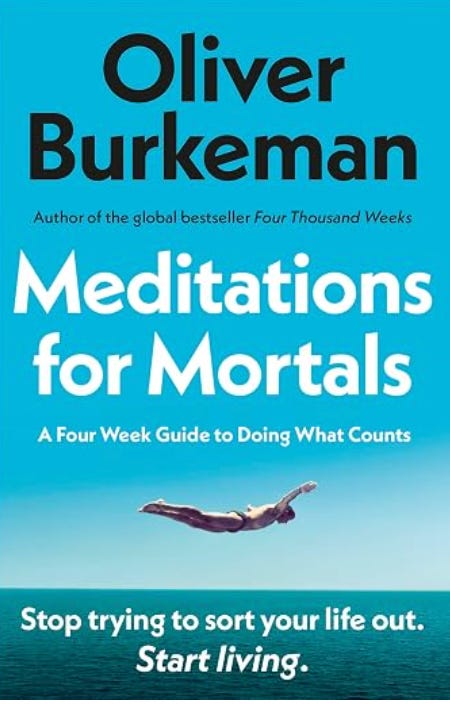
So when I picked up his next one, Meditations for Mortals, I already expected to like it. I did. But it’s a different kind of book, and the difference is the reason I’m writing about it.
How this one is built
Four Thousand Weeks makes an argument from start to finish. Meditations for Mortals is built to be lived with.
It has twenty-eight short chapters, meant to be read about one a day, over four weeks. They are numbered by day, and the ones I have read each open with a short quotation from someone else: a philosopher, a psychoanalyst, Umberto Eco. Then Burkeman takes one idea and turns it over for a few pages, in about the time it takes to drink a cup of tea.
He calls the whole approach “imperfectionism.” The starting point is that you are a finite person, with limited time and limited control over it, and that most of the advice about getting on top of things quietly assumes you aren’t.
The daily format suits the subject. Nothing in it asks you to overhaul your life. You read one short chapter, put the book down, and see whether the idea is still with you that evening. Some of them were. These are three that stayed with me.
Day 1: It’s worse than you think
The first chapter has the least encouraging title in the book, and it’s the one I think about most.
It starts with the familiar feeling of an impossibly long to-do list. The usual advice is to get more efficient, find more energy, cut out distractions and push through. Burkeman’s answer is that your situation is worse than you think: the supply of things that feel as though they need doing is, as he puts it, “to all intents and purposes infinite.” You were never going to get through it all.
And then he explains why that is good news. When you finally see that a struggle you had been treating as very difficult is in fact impossible, something changes. In his words: “Something inside unclenches.”
His picture for it is being caught in a rainstorm without an umbrella. For a while you hurry and hunch and try to stay dry. Then at some point you give up and accept that you’re getting soaked, and the walk home becomes just a walk.
He borrows a second picture from the Zen teacher Houn Jiyu-Kennett, who used to say that her job was not to lighten a student’s burden. It was to make it so heavy that the student had to put it down. Most advice does the opposite. It tells you that with enough effort you will eventually feel you are doing enough, and so you keep carrying it.
And then there is the image I could not shake. We live, Burkeman writes, as if bracing for a plane crash that someone might still prevent. But the plane has already come down. You are already on the island, with whatever you managed to bring, and with the people who landed there with you. The only question left is what to do with the time.
I recognize that moment, and I suspect many of you do too. The list of calls to return, papers to sort, things to fix, people to see. There is a way of carrying it that makes every day feel like falling behind. Burkeman’s point is that the falling behind was built in from the start, and once you stop fighting that, you get some of your attention back for the things you can actually do.
He ends the chapter with a question: “Now…what might be some good things to do with your time?”
Day 5: The art of reading, and of not reading
This is the chapter I’d most like to hand to a friend.
It opens with a story Burkeman borrows from Umberto Eco, who owned an enormous library. Visitors would walk in, look at the shelves, and ask whether he had read all of those books. Eco found the usual clever reply a little cruel, and settled on a different one: these were the books he had to read by the end of the month, and the others he kept at his office.
From there Burkeman takes on the pile. The books you mean to read, the articles saved for later, the magazines, the newspapers. He points out that trying to consume it all faster, by speed-reading or listening at double speed, does not make you feel any better. It only makes you more scattered, because the pile refills as fast as you get through it.
What he offers instead are three pieces of advice, and the first one is the reason I kept this chapter.
Treat it like a river, not a bucket. A bucket is something you have to empty, so every unread thing in it feels like a small failure. A river flows past you, and you can dip in and take what you want without feeling guilty about what goes by.
He writes that he knows several older people who seem to believe that if a newspaper or a magazine arrives in the house, they have a moral duty to read it. If you have ever kept a stack of unread magazines next to your chair out of a vague sense of obligation, that sentence is for you.
Don’t read like a squirrel storing nuts (I loved this image) It’s easy to assume the point of reading is to stockpile knowledge for some future use, which is how reading turns into note-taking, and note-taking into a chore. Burkeman argues that most of what reading gives you comes from the way it slowly changes you, whether or not you remember the details afterwards.
Reading happens in the present, like everything else. You don’t always have to choose the most improving book. Sometimes the right choice is whatever you’ll enjoy most. Half an hour spent reading something that moves you, or simply entertains you, is worth doing for its own sake, and not only as an investment in a better future you.
If your eyes have made the pile harder to get through lately, How To Continue Reading Even If Your Eyes Are Tired covers the practical side.
Day 16: The inverted golden rule
The third idea is about the voice in your head that tells you how badly you’re doing.
Burkeman opens the chapter with an observation from the psychoanalyst Adam Phillips. If we met that relentless inner critic at a party, we would think there was something wrong with him. We would assume something terrible had happened to him to make him that way.
Burkeman admits that for years he admired the opposite approach. He collected lines from artists and writers who simply sat down and worked at the same hour every day, whether or not they felt inspired, and he wanted to be that kind of person. It sounded like the most sensible, least dramatic way to get things done. For him, it didn’t work, and it was Piver’s story that helped him understand why.
For years she ran her days on a strict schedule: up at five, meditate, write, breakfast at eight. Whenever she slipped, she was furious with herself. One day, with nothing much left to lose, she tried doing what she felt like doing, when she felt like doing it. She expected to get nothing done. Instead, the day turned out more productive than usual, and the things she normally had to force herself through felt easy.
Burkeman’s explanation is simple. When you do what you actually want to do, your wants become fuel, instead of something you spend all your energy fighting.
The chapter’s title comes from the philosopher Iddo Landau, who suggests turning the golden rule around: don’t treat yourself in ways you would never dream of treating anyone else.
It is worth remembering on the days when nothing on the list got done. The way we talk to ourselves then is a way we would never speak to a friend who had the same day.
Where it may not suit you
The opening can put people off. A first chapter called “It’s worse than you think”, about accepting defeat, is an odd way to begin a book meant to help, and if you are going through something genuinely hard right now, it may land badly on the first day. It helps to know where it is going: each of the chapters I have read ends up somewhere gentler than it starts.
And if you have read Four Thousand Weeks recently, some of the ground will feel familiar. That is partly the point. The first book explains why; this one gives you something to do with the explanation, one day at a time.
The line I kept
The question at the end of the first chapter is the one I keep coming back to, because it turns the attention from what cannot be done to what can:
“Now…what might be some good things to do with your time?”
If you’re getting value from my articles and want to support the work, the paid membership is where to do it - learn more about the perks you get as a Plus member.